
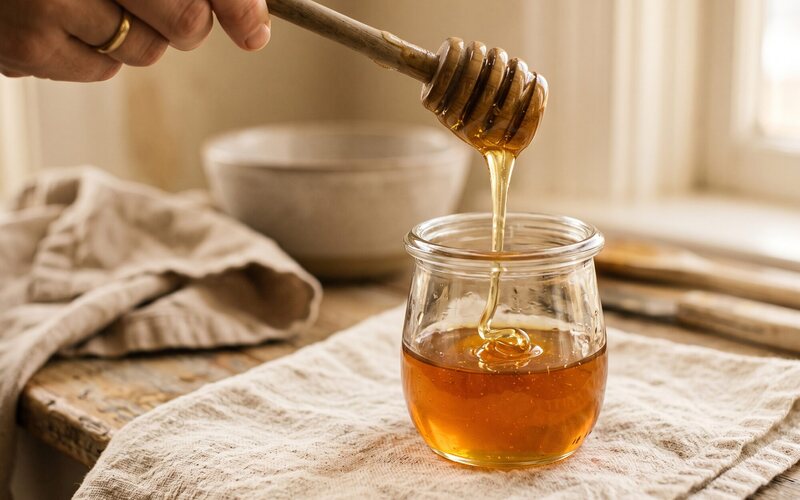
Raw honey crystallizes because it holds more sugar than its water can keep dissolved. Glucose, the less soluble of honey's two main sugars, slowly falls out of solution and forms crystals, often around tiny particles such as pollen. It's a physical change, not spoilage. Crystallized honey is safe to eat, a warm water bath turns it liquid again, and a sealed jar of honey doesn't really expire. The one thing that does spoil honey is extra water, which lets yeast ferment it.
The rest of this guide covers why some jars set in weeks and others stay liquid for a year, how to re-liquefy honey without cooking it, what a best-by date actually means, and how to store honey so neither problem bothers you.
Why does honey crystallize?
Honey is a supersaturated sugar solution: mostly fructose and glucose, with less than 20% water. The two sugars behave very differently in water. Glucose dissolves at about 47 g per 100 g of water, while fructose dissolves at about 385 g (Weber et al., MethodsX, 2022). There's far more glucose in a jar than the water can hold for long, so the glucose eventually separates out as crystals. The fructose stays liquid, which is why a half-set jar can have a runny layer on top.
Three things control how fast that happens.
1. The glucose-to-fructose balance (set by the flowers)
The ratio of fructose to glucose depends on what the bees foraged, and it varies from roughly 0.4 to 2.5 across honeys. Fructose-rich honey usually stays liquid for months or years, while glucose-rich honey can start crystallizing soon after harvest (Weber et al., 2022).
Researchers also use the glucose-to-water ratio as a predictor: below about 1.7 a honey crystallizes slowly, and above 2.0 it crystallizes quickly. In one study, rapeseed (canola) honey measured 2.84 and acacia honey 1.54, which matches what beekeepers see. Canola sets fast, and acacia stays pourable (Scripcă & Amariei, Foods, 2021).
2. Temperature
Crystallization runs fastest in cool conditions. Honey scientists who make creamed honey on purpose treat about 57°F (14°C) as the ideal crystallizing temperature (Meixner et al., Foods, 2022). That's why a jar kept in a cold pantry, a garage or the fridge sets faster than one on a warm kitchen shelf. The University of Missouri Extension notes that honey forms crystals "as it gets older or if it is refrigerated" (MU Extension, GH1120).
3. Particles for crystals to grow on
Crystals start ("nucleate") on small solids: existing micro-crystals, pollen, dust grains and air bubbles (Meixner et al., 2022). Raw honey that hasn't been fine-filtered keeps its pollen, so it has more starting points. Ours is strained once through a coarse mesh to remove wax and hive debris and is never fine-filtered, so the natural pollen stays in. Expect it to crystallize.
Does crystallization mean honey is raw, or fake?
Neither, on its own. Crystallization is typical of raw honey, but a liquid jar doesn't prove anything is wrong. High-fructose honeys like acacia stay liquid naturally, and commercial heating and fine filtration also delay crystals. If you want to judge a jar, look at the label, the source and the processing claims together. Our guide on how to tell if honey is raw walks through the checks that hold up.
Is crystallized honey bad?
No. Crystallized honey is still honey. The sugars have just changed from dissolved to solid. The flavor is the same, and many people prefer the thick texture for spreading on toast or stirring into hot tea, where it melts anyway. The National Honey Board describes crystallization as a natural process in which glucose precipitates out of liquid honey, and notes that some varieties crystallize quickly while a few barely crystallize at all (National Honey Board).
What you should look out for is fermentation, not crystals (see below).
How to decrystallize honey safely
Use gentle, even heat. The goal is to dissolve the glucose crystals without holding the honey hot for long. Heat raises hydroxymethylfurfural (HMF), a compound that builds up in heated or old honey, and it can push HMF past the 40 mg/kg limit in the international honey standard (Scripcă & Amariei, 2021; Codex Standard for Honey, CXS 12-1981).
The warm water bath (our recommendation)
- Use a glass jar. If the honey is in a plastic bottle, spoon it into a clean, dry glass jar first. MU Extension specifically advises against setting plastic honey containers in warm water. Loosen the lid so the jar can vent.
- Set the jar in warm water, about 95 to 110°F (35 to 43°C), so the water reaches the level of the honey. Warm tap water is usually in this range. Don't boil it and don't put the pot on a burner.
- Stir and wait. Stir with a dry spoon every 10 to 15 minutes and swap in fresh warm water as it cools.
- Stop when it clears. Most jars clear in 30 to 60 minutes. A rock-solid jar may need a second or third round.
- Dry and seal. Dry the jar, tighten the lid and store it at room temperature.
We handle our own honey the same way: raw and unfiltered, never heated above 95°F. Warmer water works faster, but staying near that range keeps the honey as close as possible to how it left the hive.
What about the microwave?
The National Honey Board says you can microwave honey in a microwave-safe container with the lid off, stirring every 30 seconds, as long as you don't boil or scorch it (NHB FAQ). Lab work backs up the idea that the method matters less than how much total heat the honey gets. A 2026 study found short, controlled microwave treatments produced less HMF than 25 minutes in a 149°F (65°C) water bath (Al-Ghzawi et al., ACS Omega, 2026).
The catch is control. A kitchen microwave heats unevenly, and it's easy to overshoot in a few seconds. If you use one, work in a glass container, go in short bursts, stir between each, and stop while a few crystals remain. They'll dissolve as the honey sits. Never microwave honey in a plastic bottle or a jar with a metal lid.
How long will it stay liquid?
Not forever. The same glucose is still there, and any crystals you missed will seed new ones. Weeks to a few months is typical, depending on the honey and your kitchen temperature. If you keep re-melting the same jar, try the other route: controlled crystallization. Creamed honey turns the process into fine, smooth crystals on purpose, and crystallized honey whips well into honey butter.
Does honey expire?
Not in the way most foods do. Sealed, properly stored honey stays safe indefinitely. Oregon State University Extension notes that honey keeps indefinitely when sealed in food-grade containers with tight-fitting lids, and that honey's low water activity, not its acidity or antimicrobial compounds, is what keeps it safe during long storage (OSU Extension, EM 9885).
Water activity measures how much water is actually free for microbes to use. In honey with 20% moisture or less, it is typically below 0.60. Osmophilic yeasts, the sugar-tolerant yeasts naturally present in honey, need about 0.61 to 0.62 to grow (Gajda et al., Foods, 2026). Bacteria and most molds need far more. The international honey standard caps moisture at 20% for most honey for this reason (Codex CXS 12-1981).
So what does the best-by date mean?
It's a quality date, not a safety deadline. USDA's Food Safety and Inspection Service says that, except for infant formula, product dates aren't required by federal law and don't indicate safety. They tell you when the food should be at its best, and food showing no signs of spoilage can be eaten after a "Best if Used By" date (USDA FSIS, Food Product Dating).
With honey, "best quality" changes slowly. Over months and years, honey darkens, the floral aroma fades, and it crystallizes. Warm storage speeds all of that up. An FAO technical review notes that keeping honey above 77°F (25°C) for a long time does more damage than warming it at 104°F (40°C) for a full day (FAO, Value-added products from beekeeping). Old honey is still safe. It just may taste flatter than a fresh jar.
When honey actually goes bad: fermentation
Honey spoils when it takes on water. Honey is hygroscopic, so it pulls moisture from humid air when the lid is left off. A wet spoon or a drip of tea adds water directly. Once moisture creeps up, the dormant yeasts can wake up. In a risk matrix from a 2026 review, honey at 17% moisture or less carried negligible fermentation risk. Risk rose with each point above 18%, and above 20% it was moderate even at low yeast counts (Gajda et al., 2026).
Crystallization can raise the risk. When glucose leaves solution, the liquid left between the crystals holds more water, and that's where fermentation usually starts. It's a good reason to re-liquefy or stir a partly set jar that has a runny layer on top, especially in a humid kitchen.
Signs your honey has fermented:
- Sour, yeasty or beer-like smell
- Foam or bubbles that keep forming on the surface
- A fizzy or tangy taste
- A domed lid or a hiss when you open it
OSU Extension's guidance is clear: if honey shows signs of fermentation such as bubbling or sour odors, it has spoiled and should be thrown out. Mold on honey is rare and usually means water or food got into the jar. Discard it too.
Crystals, a darker color, a cloudy look or a thin white "frosting" line near the glass aren't spoilage.
How to store raw honey
Keep it sealed, dry and at room temperature. MU Extension recommends a dry place between 50 and 70°F in a tightly covered container, so honey doesn't absorb moisture or odors from the air.
| Where you keep it | What happens | Safe to eat? | Best for |
|---|---|---|---|
| Pantry or cupboard, sealed, 50–70°F | Slow color and aroma change; crystallizes over months | Yes, indefinitely | Everyday storage |
| Warm spot (near stove, sunny window, above the fridge) | Darkens and loses aroma faster | Yes, but quality drops | Avoid |
| Refrigerator | Thickens and crystallizes faster | Yes | Only if you prefer it set |
| Lid left loose in a humid kitchen | Absorbs moisture; fermentation risk climbs | Not if it smells sour or foams | Avoid |
| Freezer, sealed | Very thick; little change | Yes | Not needed. Let the jar reach room temperature before opening so condensation doesn't drip in |
| Crystallized jar with a runny top layer | Liquid layer holds more water | Yes, unless fermenting | Stir or re-liquefy soon |
Four habits that prevent almost every problem:
- Dry spoon, every time. No dipping the tea spoon back in.
- Close the lid right after use.
- Decant from big containers. If you buy a large jar, fill a small everyday jar and keep the big one sealed. It's opened less, so it picks up less moisture. (It's also why buying bigger is fine: honey keeps.)
- Keep it away from heat. A cupboard away from the stove beats the counter next to it.
Storing comb instead of jarred honey? The wax changes the rules a little. See how to store honeycomb for the pantry, fridge and freezer details.
Frequently Asked Questions
Is crystallized honey safe to eat?
Yes. Crystallization is glucose coming out of solution, which is a physical change. The honey is not spoiled, and you can eat it as is or warm it back to liquid.
Why did my honey crystallize so fast?
Probably because of its floral source, its storage temperature, or both. Glucose-rich honeys such as canola can set within weeks, and cool storage around 57°F (14°C) speeds it up. Raw honey with its pollen intact also has more places for crystals to start.
How do I decrystallize honey without ruining it?
Stand the glass jar, lid loosened, in warm water around 95 to 110°F (35 to 43°C). Stir every 10 to 15 minutes and refresh the water until the crystals dissolve. Avoid boiling water and direct stovetop heat.
Does honey expire or go bad?
Sealed honey stored at room temperature stays safe indefinitely because its water activity is too low for microbes to grow. It goes bad only if it takes on water and ferments. A sour smell, foam or a fizzy taste means you should throw it out.
Is it OK to eat honey past its best-by date?
Yes, if it shows no signs of fermentation. USDA says best-by dates describe peak quality, not safety. Older honey may be darker, more crystallized or less aromatic, but it's still safe.
Should I refrigerate honey?
No. Refrigeration isn't needed and makes honey crystallize faster. Keep it sealed at room temperature, out of direct sun.
Can you stop honey from crystallizing?
You can slow it but not stop it. Keep honey at a steady, warm-ish room temperature, keep the lid tight, and re-liquefy it gently when it starts to set. If you like it thick, make it into creamed honey so the crystals come out fine and smooth.
Does crystallized honey work in recipes?
Yes. It melts in anything warm, including batters, sauces and hot drinks. For measuring, warm the jar briefly so it pours, or use the crystallized honey directly in honey butter.
The short version
Crystals mean glucose did what glucose does. Warm water brings honey back, a tight lid and a dry spoon keep it from fermenting, and the best-by date is about flavor, not safety. If you're buying for a household that goes through honey, a larger jar of our raw honey keeps just fine in the pantry.
Sources: Weber et al., "Analysis of sugar crystal size in honey," MethodsX 9 (2022); Scripcă & Amariei, "The Use of Ultrasound for Preventing Honey Crystallization," Foods 10(4) (2021); Meixner et al., "Influence of Stirring Parameters on Creaminess of Spring Blossom Honey," Foods 12(1) (2022); Al-Ghzawi et al., "Microwave Liquefaction of Crystallized Jordanian Honeys," ACS Omega 11(13) (2026); Gajda et al., "Immature Honey as a Quality Challenge in Global Apicultural Production," Foods 15(12) (2026); Codex Alimentarius Standard for Honey CXS 12-1981; FAO, Value-added products from beekeeping, ch. 2; University of Missouri Extension GH1120; Oregon State University Extension EM 9885; USDA FSIS, Food Product Dating; National Honey Board.
Last updated: September 22, 2026
Taste Northern California Raw Honey
Raw, unfiltered wildflower honey in 16, 32 and 64 oz. Never heated above 95°F, so the pollen and enzymes stay in.
16 oz · $24.99
Keep reading
Honeycomb
How to Store Honeycomb (and How Long It Lasts): Shelf-Life Chart
Honeycomb can last indefinitely when stored right. We cover the best temperatures, containers, and methods we use in our own honey house -- plus mistakes that ruin good comb fast.
Recipes
How to Make Creamed Honey at Home: The Seed and Whip Methods Explained
Creamed honey is liquid honey transformed into a smooth, spreadable texture through controlled crystallization. You can make it at home with just two ingredients — raw honey and a spoonful of already-creamed seed honey. This guide covers both the seed method and the whip method step by step.
Recipes
Honey Butter Recipe: Whipped, Cinnamon, Salted & Honeycomb
The basic honey butter ratio, then four ways to take it further: whipped, cinnamon, salted and honeycomb butter. Exact quantities, storage times, and what to spread it on.
Raw Honey Benefits & Education
How to Tell If Honey Is Raw (and Raw vs Pasteurized)
Not all honey is what it claims. This guide walks through visual cues, at-home tests, label red flags, and the questions that separate real raw honey from pasteurized blends.
