
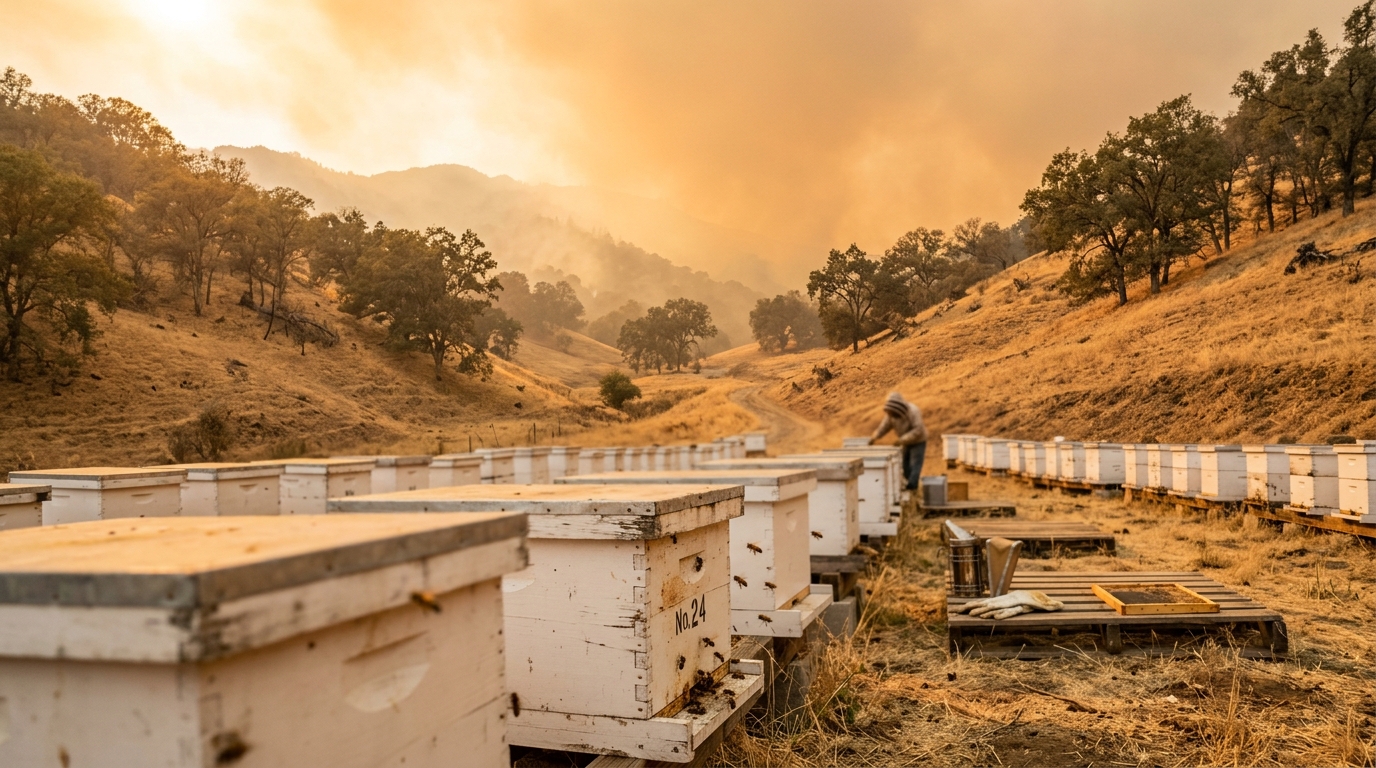
Wildfire smoke and bees do not mix well. When the AQI climbs past 150, foragers cut flight time by roughly half, brood rearing stalls, and queens slow or stop laying within 48 to 72 hours. Add a multi-year drought that shortens the nectar flow by 4 to 8 weeks, and the colonies most beekeepers lose in fall are actually the ones that quietly broke down in late July.
The western US now treats fire and drought as overlapping summer conditions, not exceptional events. NOAA's 2025 climate summary classified 78% of California, 71% of Oregon, and 66% of Nevada as in moderate-to-exceptional drought at some point during the 2025 season (NOAA / U.S. Drought Monitor, 2025). The same season produced 7.8 million acres burned across the western US -- the third-highest total on record (National Interagency Fire Center, 2025).
This guide is a field playbook for keeping colonies alive through climate stress: what smoke actually does to honey bees, the drought signs to watch for, when emergency feeding becomes non-negotiable, and the exact fire-season hive protection moves that buy your apiary a chance.
TL;DR: Wildfire smoke at AQI 150+ suppresses foraging, disrupts queen pheromone signaling, and increases brood mortality within days. Drought compresses nectar flows by weeks, leaving colonies short on stores and water. The protection sequence is: install year-round water stations before May, monitor AQI daily from June through October, feed 1:1 syrup and pollen substitute the moment foraging drops, prop bottom boards and provide shade for ventilation when heat-plus-smoke combines, and have a relocation plan for any apiary within 5 miles of an active fire perimeter. In the 2025 California fire season, beekeepers who ran water stations and pre-positioned relocation gear reported colony losses 40 to 60% lower than apiaries without those measures (UC ANR Apiculture, 2025).
What Wildfire Smoke Actually Does to Honey Bees
Smoke is not just an inconvenience for foragers. It changes the chemistry inside the hive.
Beekeepers have used cool smoke from a smoker for centuries because it temporarily masks alarm pheromones and triggers a feeding response. Wildfire smoke does something different. It is hotter, denser, persists for days or weeks, and contains volatile organic compounds (VOCs), fine particulate matter (PM2.5), carbon monoxide, and ozone in concentrations far above anything a smoker produces.
Three documented effects show up consistently in research:
- Foraging collapse. A 2023 Washington State University study tracking colonies during the 2020 Pacific Northwest fires found that foraging trips dropped 47% when AQI exceeded 150 and 73% when AQI passed 250 (WSU Department of Entomology, 2023). Bees navigate by polarized sunlight; heavy smoke disorients them.
- Pheromone disruption. Smoke compounds bind to and degrade queen mandibular pheromone (QMP) and Nasonov gland signals. Workers stop responding to queen presence, supersedure cells appear, and orientation flights get sloppy. UC Davis Honey Bee Haven researchers documented elevated supersedure attempts in colonies exposed to multi-day smoke events (UC Davis Honey Bee Haven, 2024).
- Brood and queen stress. PM2.5 enters the hive through the entrance and settles on comb. Larvae exposed to smoke-borne particulates during the 5th instar show higher mortality and emerge with lower fat-body mass. Queens reduce egg laying within 48 to 72 hours of sustained smoke exposure and may not return to full laying for 1 to 2 weeks after air clears.
Mini-story from a Sacramento Valley apiary in August 2024: a 14-day smoke event from the Park Fire pushed AQI above 200 for nine consecutive days. The beekeeper's 20-hive operation showed an immediate halt in nectar gain on hive scales, a 30% drop in capped brood at the next inspection, and three colonies attempting supersedure within two weeks. None of those things would have been visible during a quick external check -- the cluster looked normal, the entrance had foragers, and the bearding pattern was unchanged.
see the full breakdown of the 2026 colony loss numbers
The Drought Signal Most Beekeepers Miss
Drought rarely kills colonies in July. It kills them in October by setting up conditions you do not see until the cluster is already too small to overwinter.
The mechanism is straightforward. Drought compresses bloom windows. A normal Northern California year delivers a steady spring nectar flow from February (almonds, willow, mustard) through June (star thistle, blackberry, sage). In drought years, that compresses to 6 to 10 weeks, and the late-summer star thistle flow -- often the calorie backbone for colonies headed into winter -- can fail entirely.
When the late flow fails, three things happen in sequence:
- The queen reduces laying because incoming nectar and pollen drop below the threshold that triggers brood expansion.
- Workers begin consuming stored honey to feed the remaining brood.
- The colony enters fall light on stores, with a smaller worker population and fewer winter bees being raised.
By September, the hive looks fine on a quick external check. By February, the cluster has starved or dwindled below survival mass.
The drought-stress signals to monitor weekly from June onward:
- Hive scale weight. A colony in a normal flow gains 3 to 8 lbs per week during peak. Flat or declining weight in June-July is your earliest drought signal.
- Pollen traffic at the entrance. Drought kills wildflower pollen sources first. Watch for foragers returning empty -- no visible pollen pellets -- on consecutive warm afternoons.
- Brood pattern compression. Drought-stressed queens lay tighter patterns on fewer frames. Three frames of brood in mid-July, when you would normally see 6 to 8, is a feeding trigger.
- Defensiveness uptick. Colonies short on incoming nectar get defensive, especially in the late afternoon. Robbing pressure also rises sharply during dearth.
Fire-Season Hive Protection: The Daily and Weekly Checklist
When fire season hits and drought has already compressed the spring flow, every protection move below contributes to whether the colony makes it to fall. None of them are optional in a high-stress year.
Daily (June through October)
1. Check AQI before you open a hive. Use AirNow, PurpleAir, or your state's air quality dashboard. Do not inspect when AQI is above 100 unless absolutely necessary -- you are stressing an already stressed colony.
2. Check water stations. A queenright colony consumes 1 to 4 quarts of water per day in summer heat. During smoke and drought, that climbs. Water stations dry out fast.
3. Visual hive check. Look for unusual bearding (heat stress), pollen-empty foragers (drought), or unusually quiet entrances during peak flight hours (smoke or pesticide exposure).
Weekly (June through October)
- Heft each hive for store assessment.
- Inspect one or two colonies fully on the lowest-AQI day of the week.
- Check the brood pattern for compression or shotgun gaps.
- Verify the queen is still laying -- young larvae and eggs.
- Pull a mite wash if you are inside the 4-week sampling window.
Trigger-Based Actions
| Trigger | Action |
|---|---|
| AQI > 150 for 24+ hours | Close ventilation slightly, double water stations, skip non-emergency inspections |
| AQI > 250 for 48+ hours | Emergency syrup feed, plan relocation route if smoke persists 5+ days |
| Hive weight flat 2 weeks in June | Start 1:1 syrup, add pollen sub if no natural pollen returning |
| Active fire within 5 miles | Pre-stage relocation gear, identify backup apiary location |
| Active fire within 2 miles | Relocate that night |
| Heat dome (3+ days at 100 F+) | Add shade cloth, prop telescoping cover, prop bottom board |
Pro Tip: The single highest-ROI fire-season purchase is a hive scale. A $130 Bluetooth scale on one representative colony tells you within 48 hours when the flow has stopped, when supplemental feeding is working, and when smoke is killing foraging. Hefting alone is too crude during a compressed-flow drought year.
Water Stations: The One Move Every Apiary Needs
Bees travel up to 3 miles for water in summer. In drought, every neighborhood pool, fountain, and dog bowl within range gets visited -- and bees that visit chlorinated pools or pesticide-treated puddles die. Water stations near the apiary fix that and reduce flight stress during smoke events.
The setup that consistently works:
- Container: A 5-gallon bucket, livestock trough, or shallow pan within 50 feet of the hives.
- Landing surface: Floating cork, wine corks, wood chips, marbles, or a half-submerged sponge. Bees drown without a landing surface.
- Mineral content: A pinch of sea salt and a small splash of cider vinegar in each refill. Bees prefer slightly mineralized water and will use treated stations over distant pristine ones.
- Shade: A simple shade panel keeps the water cool and slows evaporation.
- Number: One station per 5-10 hives, refilled every 1-2 days during heat events.
If you start a water station in late winter or early spring, your bees will imprint on it and continue using it through summer. Start it in July, after they have already locked onto a neighbor's pool, and adoption is much harder.
full nutrition and feeding playbook
Emergency Feeding During Drought and Smoke
When the natural flow fails, you have to replace it. The trigger is not a calendar date -- it is the hive scale or a flat heft test combined with empty pollen traffic.
Sugar Syrup
- 1:1 ratio (one part sugar, one part water by weight) for spring buildup or summer dearth feeding. Stimulates brood rearing and replaces missing nectar income.
- 2:1 ratio is for late-summer and fall store-building, not active dearth feeding. Save it for August-September when you are trying to put weight on the hive.
- Feed inside the hive (top feeder, frame feeder, or jar inverted on the inner cover) -- not in open feeders during dearth, which trigger robbing.
- Add Honey-B-Healthy or a similar essential-oil supplement only if you have a confirmed feeding-rejection issue. Otherwise plain syrup works.
Pollen Substitute
If returning foragers carry no pollen for 5-7 consecutive days, the colony is in a pollen dearth. The brood reduces, then the queen stops laying.
- Place a pollen patty (1 to 1.5 lbs) on the top bars directly above the cluster.
- Replace every 2 weeks until natural pollen returns.
- Brand options that work in field trials: Mann Lake Pro-Health, Global Pollen Patty, MegaBee, or homemade with brewer's yeast and sugar.
- Stop pollen patties once natural pollen returns -- continued patties during a flow can trigger small hive beetle activity.
Frequency and Volume
A hungry colony in dearth can take 1 to 2 quarts of 1:1 syrup per day. Feeders that hold less than a gallon need refilling every 2-3 days. Underfeeding is worse than not feeding -- you trigger brood expansion the colony cannot sustain when the flow does not return.
When to Relocate: The 5-Mile and 2-Mile Rules
Most beekeepers underestimate how fast a fire can change conditions. The decision tree below is calibrated to the western US wildland-urban interface and reflects what UC ANR extension agents and California State Beekeepers Association members reported during the 2024 and 2025 fire seasons.
5-mile rule: If an active fire perimeter is within 5 miles of your apiary, pre-stage your relocation gear. That means ratchet straps, hive entrance closures (8-mesh screen, foam, or ventilated travel screens), a truck or trailer, and a confirmed backup apiary location. Do not wait until you smell smoke at the apiary -- you will be in a queue with every other beekeeper, supplier, and evacuee.
2-mile rule: If the fire moves within 2 miles or red-flag wind conditions push smoke directly toward the apiary, relocate that night. Move colonies after dark when foragers are home. Strap and screen entrances. Drive at low speed (under 50 mph) on cool surface streets when possible, and unstrap entrances at the destination before sunrise.
A pre-positioned backup location matters as much as the move itself. Options that have worked for NorCal beekeepers:
- A friend's property at least 15 miles from the fire perimeter (more than the 3-mile foraging radius, so foragers do not try to return).
- A vetted commercial yard with a sympathetic operator.
- A community garden, school, or church property with an existing pollinator garden.
Avoid moving colonies less than 3 miles from the original site. Foragers will return to the empty original location and die.
mapping nectar timing for relocation planning
Heat-Plus-Smoke: Why Combination Stress Is the Worst Case
A 100 F day with clean air is manageable. A 100 F day with AQI 200 is a colony killer. The two stressors compound because both demand the same colony resource: ventilation.
Heat alone triggers fanning. Workers line up at the entrance and at internal vent points, beating their wings to circulate air and evaporate water. That cooling system requires water, which requires foraging trips, which smoke suppresses. The colony cannot cool itself if it cannot collect water.
The protective moves during combination stress:
- Add shade. A simple shade cloth on a frame, a 4x8 plywood panel propped against the south or west side, or natural tree shade drops hive interior temperature by 5 to 10 F.
- Prop the telescoping cover. A popsicle stick or wood shim under each corner creates an upper vent for hot air to escape.
- Open the bottom board screen (if you closed it for fire-season pesticide protection). Airflow matters more than particulate exclusion during heat events.
- Fill water stations more frequently. Twice daily during a heat dome is not excessive.
- Skip inspections. Even a 10-minute hive opening releases controlled airflow and forces the colony to re-establish thermoregulation.
What 2025 Taught Western Beekeepers
The 2025 fire season produced enough field data to revise standard advice. Three lessons from beekeepers running 20-200 hive operations across California, Oregon, and Washington:
- Pre-positioned water stations cut summer dwindling roughly in half. Apiaries that started water stations in March and maintained them through October reported July-August store losses of 4-7 lbs/week versus 9-14 lbs/week at apiaries without water stations (UC ANR Apiculture, 2025 Fire Season Field Notes, 2025).
- Pollen substitute during smoke events prevented the autumn brood collapse. Colonies that received pollen patties during 7+ day smoke events showed 65-80% normal fall brood production. Colonies without supplementation showed 30-50% normal fall brood.
- Relocation 15+ miles out beat shelter-in-place every time. The most common loss pattern was beekeepers who stayed at the original site through a 10-14 day smoke event, hoping it would clear. The colonies that stayed often survived the smoke but emerged with such severe brood and queen damage that they failed in October-November.
The pattern is clear: aggressive, early intervention beats waiting. By the time the AQI clears and the foragers come back, the damage that decides winter survival has already happened.
Quick-Reference Climate-Stress Hive Protection Checklist
Print this and keep it in your bee shed.
Pre-Season (March-May)
- Install water stations within 50 feet of hives
- Identify backup relocation apiary 15+ miles from primary site
- Buy entrance screens, ratchet straps, and travel covers
- Install hive scale on representative colony
- Bookmark AirNow, PurpleAir, and InciWeb on your phone
Daily (June-October)
- Check AQI before any inspection
- Verify water stations are full
- Visual entrance check on each hive
- Watch for fire alerts within 5 miles
Weekly (June-October)
- Heft each hive
- Read hive scale data
- Inspect 1-2 colonies on the lowest-AQI day
- Refill pollen patties if pollen dearth confirmed
- Adjust syrup volume based on uptake
Trigger-Based
- AQI 150+ -> reduce inspections, double water
- AQI 250+ -> emergency feed, plan relocation
- Fire within 5 miles -> stage relocation gear
- Fire within 2 miles -> relocate that night
- Heat dome -> shade, vent, water 2x daily
Frequently Asked Questions
Does wildfire smoke kill bees?
Wildfire smoke does not usually kill bees outright, but sustained exposure (AQI 150+ for 7+ days) causes foraging collapse, queen pheromone disruption, brood mortality from PM2.5 deposition, and elevated supersedure attempts. The compounding effect -- reduced foraging plus stalled brood production -- often kills colonies indirectly in fall when they enter winter understocked and underpopulated. Short smoke events under 72 hours rarely cause lasting damage; multi-week events during the summer brood-rearing window are far more destructive.
How does drought affect honey bees?
Drought compresses bloom windows, kills wildflower pollen sources first, and often eliminates the late-summer flow that western US colonies rely on for fall stores. Honey bees respond by reducing brood production, consuming reserves, and entering fall with smaller worker populations and fewer winter bees. Drought-stressed colonies look fine in September but frequently fail in February. The earliest drought signal is flat or declining hive weight in June or empty pollen baskets on returning foragers.
Should I move my hives during a wildfire?
Move hives if an active fire perimeter is within 2 miles of the apiary or if red-flag wind conditions push smoke directly toward the site. Pre-stage relocation gear once a fire is within 5 miles. Move at night when foragers are home, screen entrances securely, drive under 50 mph on cool surface streets, and relocate to a backup site at least 15 miles away (well outside the 3-mile foraging radius). Do not move colonies less than 3 miles -- foragers will return to the empty original location and die.
What air quality is dangerous for bees?
Foraging activity drops about 47% at AQI 150 and 73% at AQI 250 based on 2020-2025 western US field data. Sustained AQI above 100 stresses brood and reduces queen laying within 48-72 hours. Use AQI 100 as the threshold for limiting non-essential inspections, AQI 150 as the trigger for closer ventilation management and double water stations, and AQI 250 as the trigger for emergency feeding and active relocation planning.
How can I keep my bees cool in extreme heat?
Add shade with cloth, a plywood panel, or natural tree cover; prop the telescoping cover with a popsicle stick or wood shim under each corner to create an upper vent; open the screened bottom board insert; and refill water stations twice daily. Skip inspections during heat events -- even a 10-minute hive opening forces the colony to re-establish thermoregulation. Apiaries with afternoon shade and reliable water consistently report lower heat-related losses than fully sun-exposed apiaries.
Should I feed my bees during smoke events?
Feed if foraging stops and stores or pollen reserves are dropping. The trigger is not the smoke itself but the colony's response. Watch the hive scale or heft test, and watch for empty-baskets foragers indicating pollen dearth. Use 1:1 sugar syrup to replace missing nectar income and pollen patties (1 to 1.5 lbs) on top bars to replace missing pollen. Feed inside the hive only -- open feeders trigger robbing during dearth -- and continue until natural foraging resumes for at least 7 consecutive days.
Can bees recover from wildfire smoke exposure?
Colonies generally recover from short smoke events (under 72 hours) within 1-2 weeks once air clears. Multi-week exposures during summer brood-rearing produce more lasting damage: reduced fall worker populations, lower winter-bee fat-body mass, and elevated supersedure that can carry into the next year. Active feeding (1:1 syrup plus pollen substitute) during and after the smoke event significantly improves recovery. Field data from 2025 suggests supplemented colonies retained 65-80% normal fall brood versus 30-50% in unsupplemented hives.
The Through-Line: Climate-Stressed Beekeeping Is Active Beekeeping
Beekeeping in the western US used to be largely seasonal: spring inspections, summer honey, fall mite treatment, winter hands-off. That model assumed a stable climate and predictable flows. It does not work anymore.
Climate-stressed beekeeping is active beekeeping. It means a hive scale on at least one colony, a daily AQI check from June through October, year-round water stations, pre-positioned relocation gear, and a willingness to feed and intervene the moment the data says the flow has stopped. The beekeepers losing fewer colonies to drought and wildfire smoke in 2025 were not the ones with the biggest operations -- they were the ones with the best monitoring and the fastest response.
If your apiary sits anywhere in the wildland-urban interface from San Diego to Seattle, every item on the checklist above should already be in place by the time spring buildup ends. The 2026 fire season has not started yet. You still have time.
Ready to keep going? See the honey bee nutrition and feeding guide for syrup ratios and patty recipes, the Northern California nectar flow calendar for regional flow timing, the colony collapse crisis 2026 update for the broader context behind record losses, and the sustainable beekeeping principles that connect climate stress to long-term apiary design.
Learn Beekeeping the Northern California Way
Eight written modules built around Northern California seasons — first inspection through first harvest, with printable checklists.
Keep reading
Beekeeping & Sustainability
Honey Bee Nutrition & Feeding Guide: Sugar Syrup, Pollen Patties, and Winter Stores
Most colony losses trace back to nutritional stress, not a single pest. This guide walks through honey bee nutrition from spring syrup to fall patties, with ratios, timing, and the peer-reviewed research on pollen substitutes, protein requirements, and when supplemental feeding helps -- or hurts.
Beekeeping & Sustainability
Colony Collapse Crisis 2026: What Record Bee Losses Mean and How You Can Help
The 2024-2025 season recorded the highest honeybee colony losses since tracking began — 55.6% of managed colonies gone. This guide breaks down what's driving colony collapse disorder heading into 2026, the real-world consequences for food prices and agriculture, and concrete steps you can take to help reverse the decline.
Beekeeping & Sustainability
Northern California Nectar Flow Calendar: Month-by-Month Bloom Guide for Beekeepers
Northern California runs one of the longest and most complex nectar flows in North America — from January manzanita to November coyote brush. This month-by-month calendar maps the bloom species Sacramento Valley beekeepers can expect, the timing shifts to plan around, and the exact hive actions that separate a surplus honey year from a dead-out in February.
Beekeeping & Sustainability
Sustainable Beekeeping: Practices That Protect Bees
Sustainable beekeeping prioritizes colony health over maximum honey yields. This guide covers chemical-free management, genetic diversity, habitat preservation, and how to identify responsibly sourced honey from beekeepers who put bees first.