
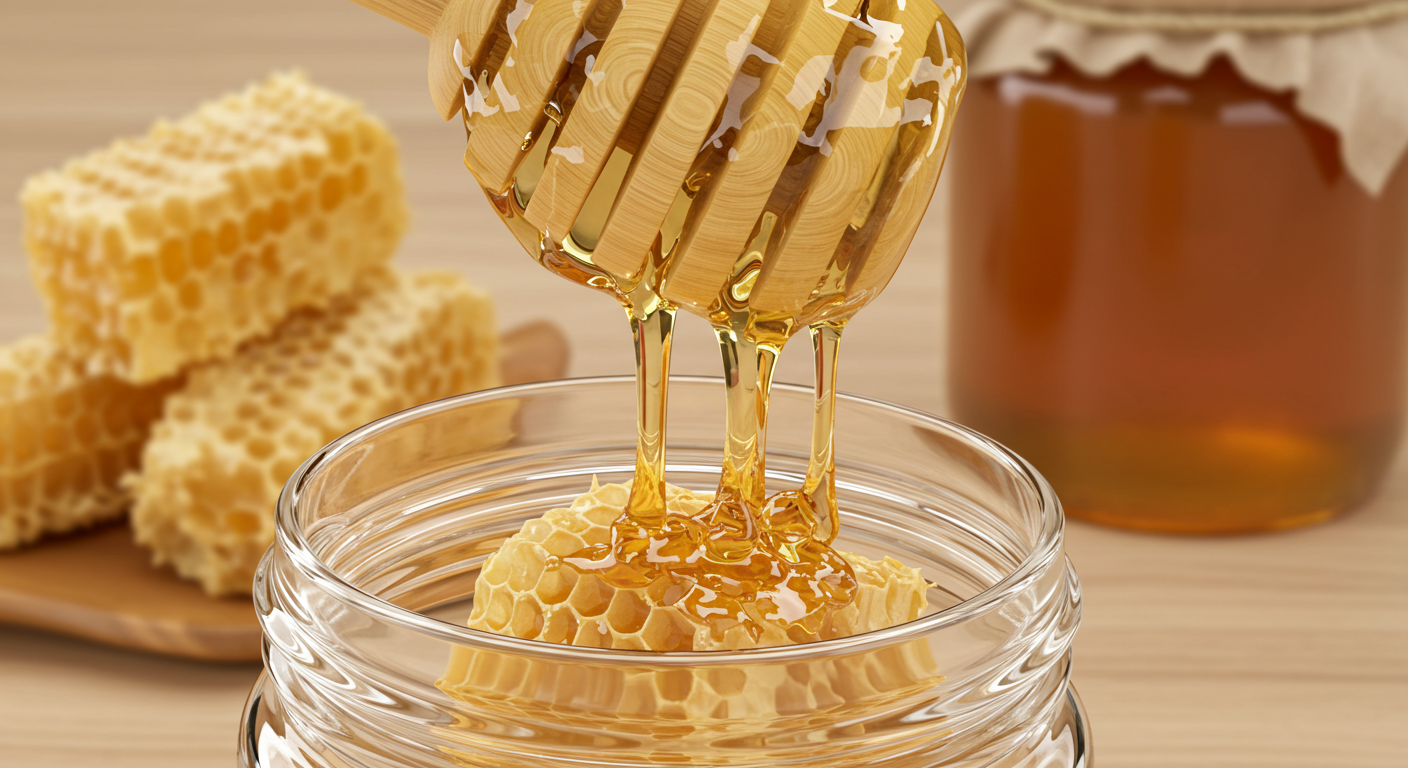
Honey butter is softened butter beaten with honey and a pinch of salt. That's the whole thing, and it takes five minutes. Our base ratio is 1/2 cup (1 stick) butter to 3 tablespoons raw honey and 1/4 teaspoon salt -- sweet enough to taste the honey, not so sweet it buries the butter.
Below: the basic recipe, then whipped, cinnamon, salted and honeycomb versions with exact quantities, plus how long each one keeps.
TL;DR: Beat 1/2 cup (113 g) softened unsalted butter with 3 tablespoons (63 g) raw honey and 1/4 teaspoon fine salt for 2-3 minutes. Beat 4-5 minutes for whipped honey butter. Keep it in the fridge in a sealed container and use within 2 weeks, or freeze for up to 3 months. Leave it out only while you're serving.
Basic Honey Butter Recipe
Makes: about 3/4 cup (roughly 11 tablespoons) | Time: 5 minutes, plus 30-45 minutes to soften the butter
Ingredients
- 1/2 cup (1 stick / 113 g) unsalted butter, softened
- 3 tablespoons (63 g) raw honey
- 1/4 teaspoon fine sea salt
- Optional: 1/2 teaspoon pure vanilla extract
Instructions
- Soften the butter. Leave it on the counter for 30-45 minutes. It should dent easily when pressed but not look shiny or greasy. If you're in a hurry, cut it into cubes -- they soften in about 15 minutes. Avoid the microwave; melted edges won't whip back up.
- Add honey and salt. Put the butter, honey, salt and vanilla (if using) in a medium bowl.
- Beat for 2-3 minutes. Use a hand mixer on medium, a stand mixer with the paddle, or a sturdy fork. Stop when the mixture is pale, smooth and has no streaks of honey.
- Taste and adjust. Add another tablespoon of honey for sweeter butter, or a pinch more salt.
- Pack and chill. Spoon into a small jar or ramekin, or roll into a log in parchment. Chill 30 minutes to firm up.
Take it out of the fridge 10-15 minutes before serving so it spreads without tearing the bread.
How to tell it's right: drag a spoon through it. Properly mixed honey butter leaves a clean trail that slowly softens at the edges. Stiff and crumbly means the butter was too cold -- let it sit 10 minutes and beat again. Soupy means it was too warm -- chill 10 minutes and beat again.
Which Honey to Use
A mild wildflower or clover honey lets the butter come through. Darker, stronger honeys like buckwheat make a bolder, molasses-like spread. Raw honey is thicker than heavily filtered honey, which gives a denser, creamier result. Our guide to choosing between honey types covers the flavor differences.
Crystallized honey works too. It isn't spoiled -- crystallization is normal for raw honey. The crystals mostly dissolve as you beat, leaving a slightly grainy texture a bit like creamed honey. For a perfectly smooth butter, stand the honey jar in warm (not hot) water until it loosens first.
Whipped Honey Butter
Whipped honey butter uses the same ingredients. The difference is time and speed: longer beating pulls air into the butter so it turns lighter, paler and easier to spread straight from the fridge.
- Make the basic recipe above with a hand mixer or stand mixer -- a fork can't get enough air in.
- Beat on medium-high for 4-5 minutes instead of 2-3, scraping the bowl halfway through.
- Stop when it's visibly fluffier, noticeably paler and has grown in volume.
- Spoon into a wide-mouth jar so it's easy to scoop.
Whipped butter softens faster, so it's best for the breakfast table -- pancakes, waffles, toast, dinner rolls. For hot corn or an outdoor summer table, the basic (unwhipped) version holds its shape better.
Cinnamon Honey Butter
This is the one we make most. Add to the basic recipe after beating:
- 1/2 teaspoon ground cinnamon
- 1/4 teaspoon freshly grated nutmeg
- A small pinch of ground cloves (less than 1/8 teaspoon -- cloves take over fast)
- Optional: swap 1 tablespoon of the honey for 1 tablespoon brown sugar for a deeper, caramel note
Beat 30 seconds more to distribute. Spread it on sweet potatoes, cornbread, banana bread, oatmeal and warm biscuits. If you're already baking with raw honey, a pat on a warm loaf is hard to beat.
Salted Honey Butter
Sweet-salty is the best version on a hot biscuit or roll.
- 1/2 cup (113 g) salted butter, softened
- 3 tablespoons (63 g) raw honey
- 1/2 teaspoon flaky sea salt, plus more to finish
Beat the butter and honey together, then fold in the flaky salt with a spatula so the flakes stay crunchy -- don't beat them in. Scatter a few more flakes on top right before serving.
If you only have unsalted butter, use it and fold in 3/4 teaspoon flaky salt instead.
Honeycomb Butter
Honeycomb butter has pockets of liquid honey and soft, chewy wax running through it. It looks impressive on a bread board and takes about as long as the basic recipe.
Ingredients
- 1/2 cup (113 g) unsalted butter, softened
- 1 tablespoon (21 g) raw honey
- 2 oz (about 1/4 cup) raw honeycomb, chilled and cut into small pieces
- 1/4 teaspoon flaky sea salt
Instructions
- Chill the comb first. Put the honeycomb in the fridge for 30 minutes. Cold comb cuts cleanly instead of smearing.
- Beat the butter with the honey and salt for 1-2 minutes until smooth. Use less honey than the basic recipe -- the comb brings plenty.
- Fold, don't beat. Gently fold the comb pieces in with a spatula, just until they're scattered through. Beating breaks the cells and turns it into plain honey butter.
- Shape and chill. Pile it into a ramekin or roll into a log in parchment and chill for 30 minutes.
- Serve on something hot. The butter melts, the honey runs, and the wax softens into a pleasant chew.
The wax is edible. If you'd rather not eat it, spread thin and leave the wax behind. Keep honeycomb butter to about a week in the fridge -- the comb weeps honey the longer it sits. Our guide to cooking with honeycomb has more ways to use comb.
More Flavor Variations
Start with the basic recipe and fold in one of these after beating:
| Variation | Add to the base recipe | Best on |
|---|---|---|
| Garlic herb | 2 cloves garlic (minced), 1 tbsp fresh thyme, 1/2 tsp black pepper; cut honey to 2 tbsp | Steak, roasted vegetables, grilled corn |
| Citrus | 1 tbsp orange or Meyer lemon zest, 1 tsp juice; cut salt to 1/8 tsp | Scones, crepes, crostini |
| Hot honey | 1-2 tsp red pepper flakes, 1 tsp smoked paprika | Fried chicken biscuits, cornbread |
| Maple pecan | 2 tbsp finely chopped toasted pecans, 1 tbsp maple syrup | Waffles, sweet potatoes |
For the hot version, you can replace the plain honey and pepper flakes with 3 tablespoons of homemade hot honey.
How to Store Honey Butter and How Long It Lasts
| Where | How long | Notes |
|---|---|---|
| Counter | Only while serving (about 2 hours) | Bring out 10-15 minutes before eating |
| Refrigerator | Up to 2 weeks | Airtight container; best flavor in the first week |
| Refrigerator -- garlic, fresh herb or honeycomb versions | About 1 week | Fresh garlic and herbs shorten the life |
| Freezer | Up to 3 months | Wrap logs in parchment, then foil or a freezer bag |
Freezer trick: roll honey butter into a log in parchment, twist the ends like a candy wrapper and freeze. Slice coins straight from frozen -- they soften on a warm plate in about 5 minutes. Thaw a whole log overnight in the fridge rather than the microwave, which separates the butter.
Butter keeps better than most dairy, but honey butter is still a dairy spread. The honey doesn't preserve the butter, so keep it cold between uses. Use a clean knife every time -- crumbs are what usually spoil it first.
What to Serve Honey Butter With
Breakfast
- Pancakes and waffles -- a melting pat spreads more evenly than syrup
- Buttermilk biscuits, English muffins and toast
- A spoonful stirred into hot oatmeal
Dinner
- Warm dinner rolls and cornbread
- Grilled corn on the cob (garlic herb or hot honey version)
- Roasted sweet potatoes, split and filled with cinnamon honey butter
- Roasted carrots -- see our honey glazed carrots
Baking and desserts
- Warm banana bread, quick breads and scones -- more ideas in baking with raw honey
- Grilled peaches or pound cake with a pat of cinnamon honey butter
- Toasted baguette with honeycomb butter as a five-minute appetizer
- Looking for more sweet ideas? Our raw honey desserts roundup has no-bake options that pair well with honey butter
Honey Butter Nutrition
Using USDA values for butter and honey, one tablespoon of the basic recipe comes out to roughly 90 calories, 8 g fat and 5 g carbohydrate (sugar from the honey). One tablespoon of plain unsalted butter is about 102 calories and 11.5 g fat (USDA FoodData Central). So honey butter is slightly lighter per spoonful than plain butter, because honey replaces some of the fat -- but it's still a treat, not a health food.
Frequently Asked Questions
What is the ratio for honey butter?
Our base ratio is 1/2 cup (8 tablespoons) butter to 3 tablespoons honey and 1/4 teaspoon salt. Some recipes go closer to 2:1 butter to honey, which is noticeably sweeter. Start with 3 tablespoons and add more to taste.
Can you make honey butter with salted butter?
Yes. Leave out the added salt and taste before adding any. A stick of salted butter usually contains close to the 1/4 teaspoon of salt this recipe calls for.
Does honey butter need to be refrigerated?
Yes. Keep it in the fridge in a sealed container and leave it out only while you're serving, about 2 hours at most. The honey doesn't preserve the butter.
How long does honey butter last?
Up to 2 weeks in the fridge, about 1 week for garlic, fresh herb or honeycomb versions, and up to 3 months in the freezer.
What's the difference between honey butter and whipped honey butter?
Same ingredients, different beating time. Regular honey butter is beaten 2-3 minutes until smooth. Whipped honey butter is beaten 4-5 minutes on higher speed so it takes on air and turns lighter and fluffier.
Is honey butter safe for babies?
No. Honey in any form -- raw, cooked or baked in -- should not be given to babies under 12 months because it can contain Clostridium botulinum spores (CDC).
Start with Good Honey
Honey butter only has three ingredients, so the honey shows. A spoon of raw honey with real floral character makes a better spread than a squeeze bottle of heavily filtered honey. Ours is raw and unfiltered, never heated above 95°F.
Grab a jar of raw honey or a piece of honeycomb, soften a stick of butter, and make a batch tonight.
Last updated: September 22, 2026
Cook With Real Raw Honey
Recipes taste different with unfiltered wildflower honey — more floral, less flat. Start with the 16 oz squeeze bottle.
16 oz · $24.99
Keep reading
Recipes
Homemade Honey Gifts: 10 Edible Gifts You Can Make This Week
Ten edible gifts you can make from raw honey, honeycomb and beeswax, each with a short recipe, how long it keeps, how to package it, and what to write on the label.
Recipes
Baking with Raw Honey Instead of Sugar: A Baker's Complete Guide
Want to replace sugar with raw honey? This guide covers the baking science, conversion ratios for every baked good, temperature adjustments, honey variety pairings, and 3 tested recipes — from banana bread to cornbread.
Recipes
10 Raw Honey Desserts You Can Make at Home
Looking for dessert inspiration? Try these 10 raw honey recipes -- from panna cotta to honey truffles -- that make any occasion extra special.
Recipes
Cooking with Honeycomb: Recipes, Tips, and Pairing Ideas
Honeycomb isn't just for snacking. Discover 15 recipes, temperature guidelines, pairing ideas, and storage tips for cooking with honeycomb at home.
