
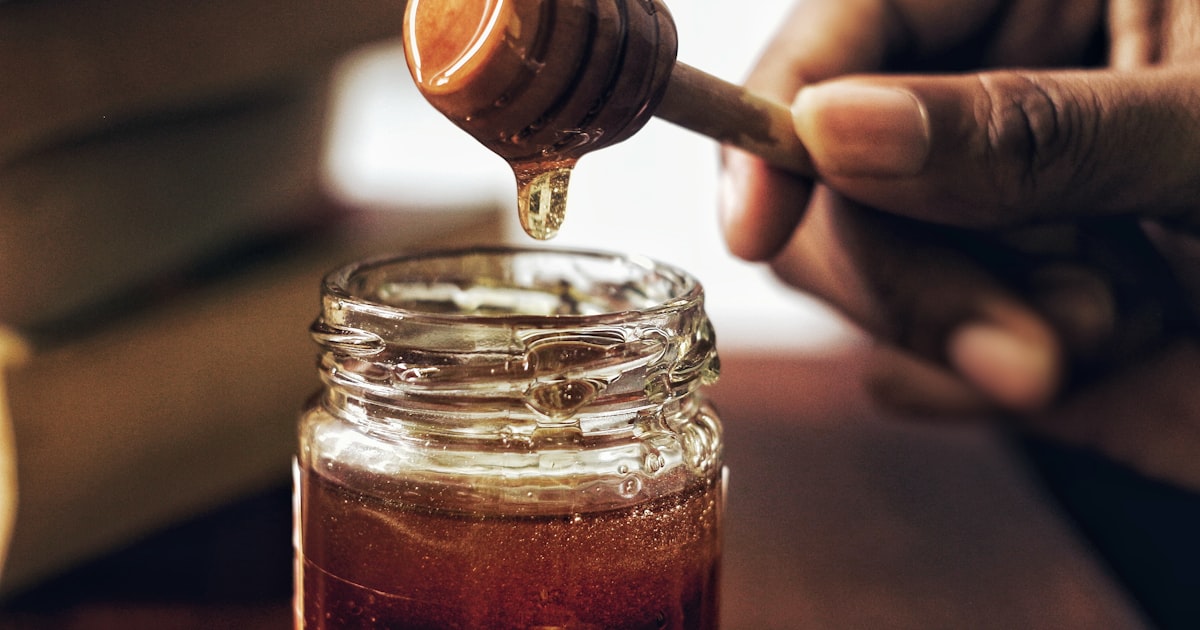
A single pound of honey represents roughly 2.5 million flower visits by honeybees (USDA Agricultural Research Service, 2024). To produce that pound, a colony flies a combined distance equal to circling Earth twice -- approximately 55,000 miles. That fact alone should change the way you look at every jar on your shelf.
Honey is not simply collected. It is manufactured inside the hive through a multi-step biochemical process involving specialized enzymes, precise temperature control, and a division of labor so efficient it puts most factories to shame. Understanding how bees make honey deepens your appreciation for this ancient food and explains why raw, unprocessed honey tastes and performs so differently from the ultra-filtered bottles on supermarket shelves.
TL;DR: Forager bees collect flower nectar (70-80% water), pass it mouth-to-mouth to house bees who add enzymes (invertase, glucose oxidase, diastase), spread it across honeycomb cells, then fan their wings to evaporate the moisture down to 17-18%. Once the water content drops below 18.6%, bees seal the cell with beeswax. The entire process takes 1-3 days per batch. One bee produces about 1/12 teaspoon of honey in its lifetime.
Step 1: Foraging -- Where Honey Begins
Honey production starts in a flower. Specifically, it starts in the nectary -- a gland at the base of a flower's petals that secretes a sugary liquid to attract pollinators.
What Is Nectar?
Nectar is a dilute sugar solution, typically containing 15-75% sugar depending on the plant species, weather, and time of day (Nicolson, 2007, Annals of Botany). The primary sugars are sucrose, glucose, and fructose, along with trace amounts of amino acids, lipids, vitamins, and aromatic compounds that contribute to the flavor profile of the resulting honey.
Different flowers produce nectar with different sugar concentrations:
- Clover: 40-55% sugar
- California wildflower (mixed): 25-50% sugar
- Citrus blossoms: 30-45% sugar
- Lavender: 35-50% sugar
- Buckwheat: 35-55% sugar
This variation is exactly why wildflower honey tastes different from clover honey -- the raw ingredients are chemically distinct from the start.
The Forager's Journey
A forager bee -- typically a worker bee older than 21 days -- leaves the hive and can travel up to 5 miles to find nectar, though most foraging happens within a 1-2 mile radius (Beekman & Ratnieks, 2000, Behavioral Ecology). She visits 50 to 100 flowers per trip and carries the nectar back in a specialized organ called the honey stomach (or crop), which holds about 40 milligrams of nectar -- nearly her own body weight.
The honey stomach is separate from the bee's digestive stomach. A muscular valve called the proventriculus prevents nectar from entering the digestive tract, keeping it isolated for processing. Even during the flight home, enzymes begin breaking down complex sugars.
A single forager makes 7-14 trips per day during peak season (Winston, The Biology of the Honey Bee, Harvard University Press). Over her 5-6 week adult lifespan, she produces approximately 1/12 of a teaspoon of honey. That fraction puts the scale of colony cooperation into perspective: a healthy hive of 60,000 bees working together produces 60-100 pounds of surplus honey in a productive season.
Step 2: The Handoff -- Mouth-to-Mouth Enzyme Transfer
When a forager returns to the hive, she does not deposit nectar directly into a cell. Instead, she transfers it to a house bee through a process called trophallaxis -- a mouth-to-mouth liquid exchange.
This step is not just logistical. It is biochemical.
During trophallaxis, the house bee adds three critical enzymes to the nectar:
The Three Key Enzymes
1. Invertase (Sucrase) Invertase breaks sucrose -- a disaccharide -- into its component monosaccharides: glucose and fructose. This is why honey contains primarily simple sugars rather than complex ones. The conversion happens over several hours and continues even after the honey is capped (White, 1975, Honey: A Comprehensive Survey).
2. Glucose Oxidase This enzyme converts a small amount of glucose into gluconic acid and hydrogen peroxide. Gluconic acid gives honey its slightly acidic pH (3.2-4.5), which inhibits bacterial growth. The hydrogen peroxide provides additional antimicrobial protection -- one of the reasons raw honey has been used for wound care for thousands of years. Learn more about this in our guide to raw honey for wound care.
3. Diastase (Amylase) Diastase breaks down starch molecules that may be present in nectar or pollen. Its presence in finished honey is used as an indicator of honey quality and proper handling -- heat destroys diastase, which is why pasteurized honey has lower enzyme activity than raw honey.
The house bee may pass the nectar through several bees in sequence. Each transfer adds more enzymes and begins reducing moisture content through evaporation. During each exchange, the bee extends her proboscis and manipulates the nectar, exposing it to air.
Step 3: Evaporation -- The Critical Moisture Reduction
After enzymatic processing, the nectar -- still 60-80% water -- is deposited into honeycomb cells. But nectar at this water content would ferment within days. Bees need to reduce moisture to below 18.6% for the honey to be shelf-stable.
They accomplish this through two simultaneous mechanisms:
Fanning
Worker bees position themselves at cell openings and throughout the hive, beating their wings at roughly 230 beats per second to create air currents. This forced ventilation pulls moisture away from the exposed nectar surfaces. On warm summer nights, you can sometimes hear the hum of fanning bees from several feet away.
The bees do not fill cells completely during this phase. They spread a thin film of nectar across the walls of the cell to maximize surface area for evaporation -- the same principle behind spreading wet clothes on a line rather than bunching them in a pile.
Strategic Cell Management
Bees deposit nectar in cells only about one-third full at first, increasing the surface-area-to-volume ratio. As the moisture drops, they consolidate nectar from multiple partially filled cells into fewer, fuller cells. This process of filling, evaporating, and consolidating continues until the honey reaches the target moisture content.
Temperature also plays a role. The brood nest (center of the hive) maintains a steady 93-95°F (34-35°C), but honey storage areas may run slightly warmer to accelerate evaporation (Human et al., 2006, Apidologie).
The entire evaporation process takes 1 to 3 days depending on ambient temperature, humidity, nectar source, and colony strength.
Step 4: Capping -- The Seal of Completion
Once the honey in a cell reaches approximately 17-18% moisture content, bees cap it with a thin layer of fresh beeswax. This cap serves as an airtight seal, protecting the honey from reabsorbing moisture from the air.
Beeswax itself is remarkable. Worker bees produce it from eight wax glands on the underside of their abdomens. The wax is secreted as tiny, transparent flakes that the bee chews and molds with her mandibles. Producing one pound of beeswax requires approximately 6-7 pounds of honey -- a significant energy investment that explains why bees are selective about when they cap cells (Hepburn et al., 1991, Apidologie).
The capping threshold of 18.6% moisture is not arbitrary. Above this level, naturally occurring osmotolerant yeasts (primarily Zygosaccharomyces species) can ferment the sugars, producing alcohol and carbon dioxide. Below it, the combination of low water activity, acidic pH, hydrogen peroxide, and high sugar concentration makes honey one of the most shelf-stable natural foods on Earth.
Properly sealed honey found in Egyptian tombs -- over 3,000 years old -- was still edible (Crane, The World History of Beekeeping and Honey Hunting, Routledge, 1999). That longevity is a direct result of the bees' evaporation and capping process.
The Numbers: How Much Work Goes Into Your Honey
The scale of honey production is staggering when you break down the numbers:
| Metric | Value |
|---|---|
| Flower visits per pound of honey | ~2,500,000 |
| Miles flown per pound of honey | ~55,000 |
| Foraging trips per pound | ~60,000 |
| Bees needed for one pound | ~556 (lifetime output) |
| Nectar needed for 1 lb honey | 8-10 lbs |
| Average colony surplus per year | 60-100 lbs |
| One bee's lifetime honey output | ~1/12 teaspoon |
| Time from nectar to capped honey | 1-3 days |
Sources: USDA ARS, National Honey Board, Winston (1991)
A strong colony in Northern California's wildflower season can bring in 5-10 pounds of nectar per day during peak bloom. But only about 20-25% of that nectar weight becomes finished honey after evaporation removes the water.
Why Raw Honey Preserves What Processing Destroys
Understanding how bees make honey reveals exactly why processing matters.
The enzymes bees add -- invertase, glucose oxidase, diastase -- are heat-sensitive proteins. Commercial honey processing typically involves:
- Heating to 145-170°F (63-77°C) to make honey flow faster through filters
- Ultra-filtration to remove pollen, propolis traces, and wax particles
- Sometimes blending with corn syrup or rice syrup in fraudulent operations
Each of these steps degrades or removes the very compounds bees spent days adding. Heating above 104°F (40°C) begins denaturing invertase. Above 140°F (60°C), glucose oxidase activity drops significantly, reducing the antimicrobial hydrogen peroxide production. Diastase -- the enzyme used to test honey quality in European Union regulations -- is destroyed by sustained heat above 131°F (55°C) (Bogdanov et al., 1999, Bee World).
This is why the enzyme and antioxidant content of raw honey is fundamentally different from processed honey. When you buy raw honey, you are getting the product as the bees designed it. Learning how to tell if honey is raw helps you verify that the jar on your shelf has been handled correctly.
The Role of Pollen in Honey
While bees collect nectar and pollen separately (nectar in the honey stomach, pollen in leg baskets called corbiculae), trace amounts of pollen inevitably end up in honey. This accidental contamination is actually useful:
- Botanical identification: Melissopalynology -- the study of pollen in honey -- allows scientists and beekeepers to determine which flowers contributed to a batch of honey. This is how we verify that our Northern California wildflower honey comes from the specific flora of our region.
- Allergy support: Some research suggests that consuming local raw honey containing regional pollen may help acclimate the immune system to local allergens (Asha'ari et al., 2013, Annals of Saudi Medicine). Our guide on raw honey for allergies covers the evidence in detail.
- Anti-fraud detection: Ultra-filtered honey with all pollen removed cannot be traced to a geographic origin, which is why pollen removal is a red flag for honey fraud.
Different Flowers, Different Honeys
Because honey begins as flower nectar, the plant source determines the flavor, color, aroma, and even nutritional profile of the finished product. Here is how some common honey varieties compare:
| Honey Variety | Color | Flavor Profile | Typical Use |
|---|---|---|---|
| Clover | Light gold | Mild, sweet, floral | Everyday sweetener |
| Wildflower | Amber | Complex, slightly fruity | Cooking, cheese boards |
| Buckwheat | Dark brown | Strong, malty, molasses-like | Baking, marinades |
| Orange blossom | Light amber | Citrusy, fragrant | Tea, desserts |
| Manuka | Dark amber | Earthy, herbal | Wellness, wound care |
| Acacia | Pale yellow | Delicate, vanilla notes | Drizzling, light recipes |
The color difference alone tells you something about chemistry. Darker honeys generally contain higher concentrations of antioxidants and minerals (Gheldof et al., 2002, Journal of Agricultural and Food Chemistry). This is why our raw honey product line includes variety labels -- each one reflects a distinct foraging environment and biochemical profile.
How a Colony Decides What to Forage
Bees do not randomly visit flowers. They use one of the most sophisticated communication systems in the animal kingdom: the waggle dance.
When a forager discovers a productive nectar source, she returns to the hive and performs a figure-eight dance on the surface of the comb. The dance encodes two pieces of information:
- Direction: The angle of the waggle run relative to vertical on the comb indicates the direction of the food source relative to the sun's position.
- Distance: The duration of the waggle run correlates with the distance to the source. Roughly one second of waggling indicates a distance of about 1 kilometer (von Frisch, 1967, The Dance Language and Orientation of Bees, Harvard University Press).
The intensity and duration of the dance also communicate the quality of the nectar source. Other foragers follow the dance, fly to the indicated location, evaluate the resource, and may recruit additional bees through their own dances. This decentralized decision-making system allows a colony of 60,000 individuals to allocate foraging effort efficiently across dozens of nectar sources simultaneously.
Karl von Frisch received the Nobel Prize in Physiology or Medicine in 1973 for decoding the waggle dance -- one of the most celebrated discoveries in animal behavior research.
If this kind of bee intelligence fascinates you, our beekeeping courses go deep into colony behavior, communication, and management. Understanding how bees think makes you a fundamentally better beekeeper.
Seasonal Honey Production in Northern California
Honey production follows the bloom calendar. In Northern California, where we manage our hives, the season unfolds like this:
Early Spring (February-March): Almond blossoms kick off the season. Bees build up population and begin light nectar collection. Colonies that survived winter (first winter survival guide) start expanding rapidly.
Peak Spring (April-May): Wildflowers, clover, California poppies, and fruit tree blossoms provide an abundance of nectar. This is when most honey is produced. Strong colonies can fill an entire super (25-30 lbs of honey) in two weeks during peak flow.
Summer (June-August): Star thistle, buckwheat, and late wildflowers extend the season. Heat can slow foraging as bees spend more energy cooling the hive. Nectar sources become scarcer in dry years.
Fall (September-October): Final flows from late-blooming plants. Beekeepers harvest surplus and ensure colonies have enough stores (60-80 lbs) for winter.
Winter (November-January): The colony clusters together for warmth, consuming stored honey. No meaningful nectar collection occurs. The bees rely entirely on what they produced and stored during the active season.
This cycle explains why our honey harvest varies year to year and why seasonal, location-specific honey carries flavors you cannot replicate in a factory.
From Hive to Jar: How We Handle Honey at NorCal Nectar
Understanding how bees make honey informs how we handle it after harvest. Our process is designed to preserve every enzyme, every compound, and every flavor the bees put into it:
Our approach to responsible honey harvesting is built on the same biological principles described above:
- Harvest capped frames only: We only pull frames where 80%+ of cells are capped, ensuring moisture content is below 18.6%.
- Cold extraction: We uncap cells with a heated knife (set to minimum temperature) and spin frames in a centrifugal extractor. The honey is never heated above hive temperature (95°F / 35°C).
- Coarse straining: We strain through a mesh to remove wax particles and debris, but no ultra-filtration. Pollen and propolis traces remain.
- Direct bottling: Honey goes from extractor to jar within 48 hours. No blending, no additives, no manipulation.
This approach means our raw honey contains the natural pollen and aromatic compounds that the bees produced through the process described above. You are getting honey the way bees engineered it -- not a processed imitation.
Frequently Asked Questions
How long does it take bees to make honey?
From nectar collection to capped honeycomb, the process takes 1-3 days per batch. However, building up enough surplus for a full harvest takes an entire season -- roughly 4-6 months of active foraging. A strong colony produces 60-100 pounds of surplus honey per year beyond what it needs for its own consumption.
How much honey does one bee make in its lifetime?
A single worker bee produces approximately 1/12 of a teaspoon of honey during its 5-6 week adult lifespan. This means roughly 556 bees contribute their entire lifetime output to produce one pound of honey.
Do bees eat their own honey?
Yes. Honey is the primary carbohydrate source for adult bees and developing larvae. A colony consumes 200-300 pounds of honey annually for energy, hive heating, and wax production. The surplus that beekeepers harvest is the amount beyond what the colony needs to survive.
Why is honey different colors and flavors?
The color and flavor of honey depend on the floral source of the nectar. Light-colored honeys (clover, acacia) tend to be milder, while dark honeys (buckwheat, wildflower) have stronger, more complex flavors and higher antioxidant content. Even the mineral content of the soil where plants grow can influence the final product.
Is honey just bee vomit?
This is a common misconception. Nectar is stored in the honey stomach (crop), which is a separate organ from the digestive stomach. The proventriculus valve prevents nectar from entering the digestive system. Bees regurgitate nectar from the crop -- they do not vomit digested food. The process is closer to a specialized transport and enzymatic processing system than digestion.
Can you make honey without bees?
No commercially viable method exists. The specific combination of enzymes (invertase, glucose oxidase, diastase), the controlled evaporation process, and the beeswax capping system cannot be replicated at scale. Lab-produced "honey" alternatives exist but lack the enzymatic complexity and flavor compounds of real bee-produced honey.
How do bees know when honey is ready to cap?
Bees test the moisture content of honey by probing cells with their antennae, which contain hygrosensitive receptors. When the moisture drops below approximately 18.6%, the bee detects this and initiates the wax-capping process. The precision of this biological moisture meter is remarkable -- finished honey typically falls within a narrow 17-18% moisture band.
Learn More About Bees and Beekeeping
Understanding how bees make honey is the foundation of bee literacy. If you want to go deeper:
- Start your own hive: Our complete beginner's beekeeping guide covers everything from equipment to first-year management.
- Take a course: The NorCal Nectar Beekeeping Academy offers hands-on modules covering colony management, seasonal care, and honey harvesting.
- Support conservation: Learn how to help bees at home and why bees are vital for agriculture.
- Plant for pollinators: Our California pollinator garden guide shows you which plants provide the best nectar and pollen sources in our region.
- Taste the difference: Browse our California raw honey and experience honey the way bees intended it -- unheated and unfiltered.
Every jar of raw honey is the end product of millions of flower visits, thousands of enzymatic transformations, and a level of biological engineering that human technology cannot replicate. The next time you open a jar, you will know exactly what went into it.
Learn Beekeeping the Northern California Way
Eight written modules built around Northern California seasons — first inspection through first harvest, with printable checklists.
Keep reading
Raw Honey Benefits & Education
The Complete Guide to Raw Honey: Benefits, Uses, Buying & Storage
Raw honey is nature's most complete sweetener, packed with enzymes, antioxidants, and trace minerals that processed honey loses during heating. This comprehensive guide covers everything you need to know about raw honey.
Raw Honey Benefits & Education
Raw Honey vs Pasteurized Honey: Why It Matters
That clear, perfectly golden honey on store shelves has been through a lot. Learn what pasteurization does to honey and why raw honey delivers more benefits.
Raw Honey Benefits & Education
The Science Behind Raw Honey's Enzymes and Antioxidants
Raw honey is packed with natural enzymes and antioxidants. Here's the science behind its unique properties and why processing destroys what makes honey valuable.
Beekeeping & Sustainability
What Makes Beekeeping Sustainable? Practices That Protect Bees and Ecosystems
Sustainable beekeeping prioritizes colony health over maximum honey yields. This guide covers chemical-free management, genetic diversity, habitat preservation, and how to identify responsibly sourced honey from beekeepers who put bees first.