
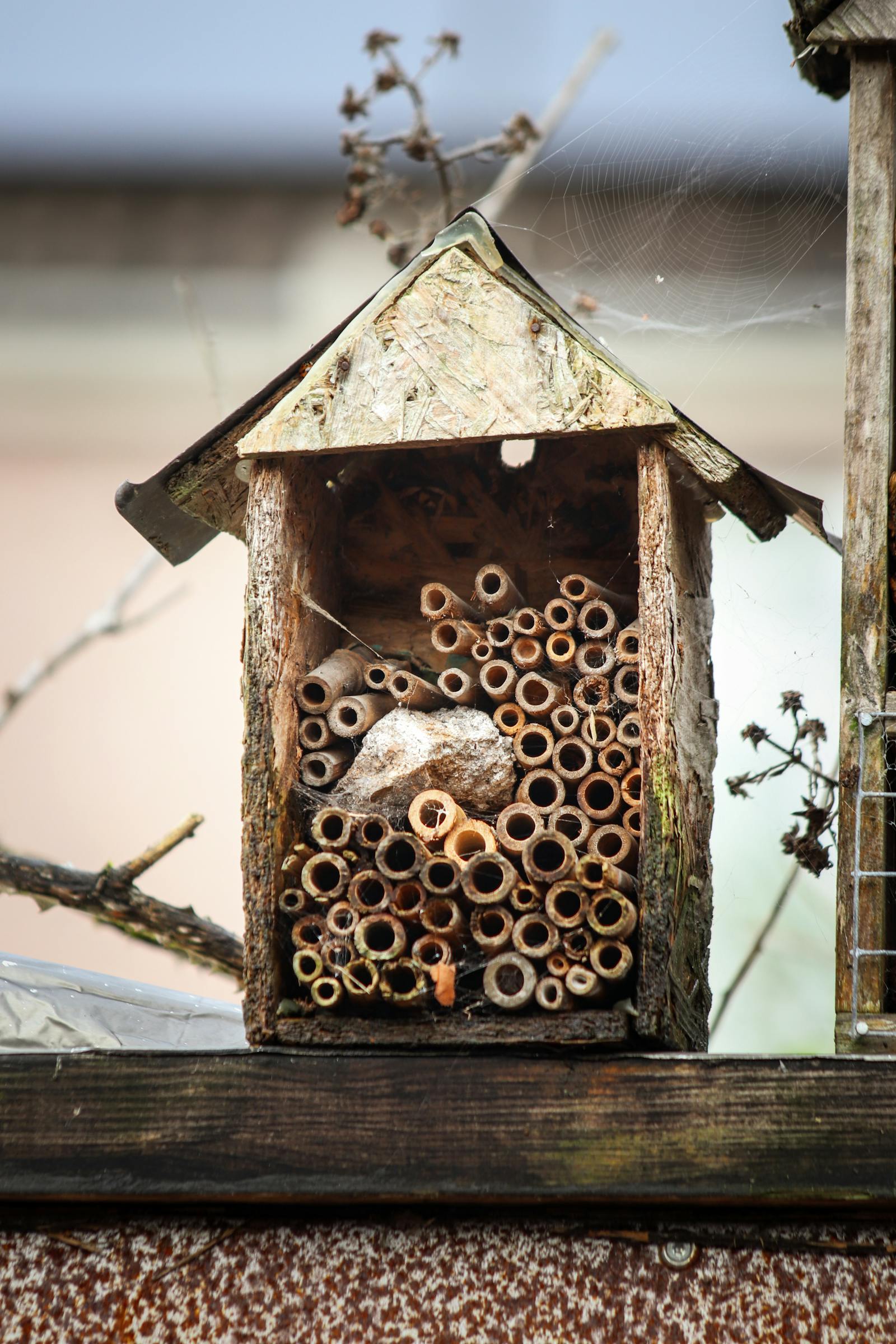
A working mason bee house is a cluster of 5/16-inch holes drilled 6 inches deep into untreated hardwood, mounted 4-6 feet off the ground on a stable south-facing surface, with a roof overhang to keep the holes dry and a mud source within 25 feet. Build that, hang it before the last hard frost, and you can pull 80-100% occupancy in a single season. Get any of those variables wrong and the house will sit empty, mold inside, or hatch a parasite hotel instead of a pollinator one.
This 2026 guide walks through how to build a mason bee house that bees will actually nest in -- not the decorative bee hotels sold in big-box garden centers. You will get exact hole diameters, materials to use and avoid, placement rules, the cocoon-cleaning step almost every kit skips, and answers to the questions hosts ask most: where to place a mason bee house, what size holes for mason bees, when to put up mason bee house, do mason bee houses really work, and how to clean mason bee tubes.
TL;DR: Drill 5/16-inch (8mm) holes 6 inches deep into kiln-dried hardwood, leave a closed back, sand the entrances smooth, add a 2-3 inch roof overhang, and mount it 4-6 feet up facing southeast within 300 feet of early-spring blooms. Replace nesting tubes or harvest cocoons every fall to prevent parasite buildup. A single female mason bee pollinates as effectively as 60-120 honeybees, and a 6 x 6 inch block can house 30-40 nests in one season.
Why Mason Bees Are the Easiest Native Bee to Host
Mason bees (genus Osmia) are gentle, solitary, cavity-nesting bees that show up in early spring -- weeks before honeybees become reliably active. They are docile to the point of indifference. Females rarely sting and males have no stinger at all. You can stand inches from an active nesting block and feel nothing but a faint hum.
The blue orchard bee (Osmia lignaria) is the species most North American hosts attract. It is metallic blue-black, about the size of a housefly, and native to most of the continent. USDA-ARS pollination trials at the Logan Bee Lab found that a single female blue orchard bee can pollinate as effectively as 60-120 honeybees on tree fruit blossoms (USDA Agricultural Research Service, 2024). Commercial orchards now stock them as a managed pollinator alongside honeybees.
The hosting math is unusually generous. A 6 x 6 inch block of hardwood with about 30 properly drilled holes can house 30-40 individual nests in a single season, each containing 5-10 developing bees. That is potentially 300+ pollinators emerging from a single brick-sized block the following spring -- with no hive management, no honey extraction, no protective gear, and no bee stings.
Compared to honeybees, the workload is also dramatically lighter. There is no varroa monitoring, no swarm season scramble, no winter feeding. Twenty minutes of fall maintenance is the entire annual labor budget for a working bee house.
Want the broader native bee picture before you build? Start with our native bees vs honeybees species guide and the urban habitat and conservation strategy overview.
Do Mason Bee Houses Really Work? The Evidence
Skeptics raise a fair question. Many mass-produced "bee hotels" sold online are designed for shelf appeal, not bee biology. They use the wrong hole diameters, lack rain protection, never get cleaned, and sit empty year after year while owners assume bees just are not around.
The data tells a different story when houses are built correctly. The Big Bee Hotel Experiment -- a 2024 community science project that audited 487 bee hotels across the UK and Ireland -- documented 7,293 occupied nesting holes and identified the design variables that separate a productive house from a decorative one (The Big Bee Hotel Experiment, 2024). The strongest predictors of occupancy were: hole diameter (6-10mm worked, smaller and larger failed), depth (5-6 inches outperformed shorter), south-facing orientation, weather protection, and proximity to floral resources.
Studies on managed Osmia lignaria populations consistently report 70-90% female occupancy in well-designed nesting blocks placed in orchard or garden settings. USDA orchard trials in Utah have logged occupancy above 80% in second-year sites where cocoons were harvested and parasites controlled.
The houses that fail follow predictable patterns:
- Hole diameter wrong. Holes that are too narrow (under 5mm) deter mason bees. Holes that are too wide (over 10mm) attract wasps and other species but not Osmia.
- Depth too shallow. Female mason bees lay female eggs at the back of the tunnel and male eggs near the entrance. Tunnels shorter than 5 inches mostly produce males, which collapses the population over time.
- No rain protection. Water entering nesting holes promotes mold and kills larvae. A bee house without a roof overhang is a death trap.
- Treated wood or pine. Resinous softwoods and chemically treated lumber repel bees. Cedar, pressure-treated, and stained wood all underperform untreated hardwood.
- Never cleaned. Krombein's Monodontomerus parasitoid wasps, pollen mites, and fungal spores accumulate in nesting material. After 2-3 unmanaged seasons, parasite loads can wipe out a nesting block.
Get the variables right and the house works. Skip them and it does not. There is very little ambiguity in the data.
Materials to Use (and Materials to Avoid)
Before you reach for a drill, the material choice does most of the work. The wrong block of wood undermines every other decision you make.
Materials That Work
- Kiln-dried hardwood blocks. Oak, hickory, maple, beech, ash, or fruitwood (apple, cherry). Kiln-drying reduces moisture and stabilizes the grain, which prevents the cracking that lets in rain and parasites.
- Untreated hardwood scraps from cabinet shops. Often free or near-free. Avoid plywood and MDF -- the glues are toxic.
- Natural hollow tubes. Bamboo cane sections (cut so a node closes one end), phragmites reeds, or paper tube inserts placed inside a protective frame. These are easier to clean than drilled blocks because you can replace them annually.
- Cardboard tube inserts with paper liners. Sold by mason bee suppliers. The liners pull out for easy cocoon harvest. This is the gold standard for serious hosts who want to manage cocoons over winter.
Materials to Avoid
- Pine, fir, cedar, redwood, and other resinous softwoods. Mason bees largely avoid them. Cedar's natural oils that repel insects also repel pollinators.
- Pressure-treated lumber. Contains copper compounds and other biocides that leach into nesting tubes.
- Stained, painted, or varnished wood. VOCs and finish chemicals are off-gassed inside the warm tunnel during nesting season.
- Plywood, MDF, and particleboard. Formaldehyde-based glues are toxic to developing larvae.
- Plastic tubes. Trap moisture and promote fungal growth.
Tools You Need
- A drill (cordless or corded) with a steady chuck.
- Drill bits in 5/16 inch (8mm) as the primary size, plus 1/4 inch (6mm) and 3/8 inch (10mm) for diversity.
- Sandpaper (medium and fine grit).
- A saw if you are cutting tubes or shaping the block.
- Mounting hardware: screws, brackets, or strong wire suitable for the surface where the house will hang.
- Optional: a simple roof piece -- scrap wood, cedar shingle, or metal flashing.
Pro Tip: If you are building your first mason bee house and only want to invest in one drill bit, buy 5/16 inch (8mm). It is the single most productive diameter for Osmia lignaria and Osmia californica, the two most common North American species. Mixed-diameter blocks attract more diversity, but a single-diameter block sized for blue orchard bees will fill up reliably.
What Size Holes for Mason Bees? Exact Specs
Hole geometry is where most bee houses succeed or fail. The variables are simple but unforgiving.
Diameter
- Primary diameter: 5/16 inch (8mm). This is the sweet spot for blue orchard bees and most North American Osmia species.
- Secondary diameters for diversity: 1/4 inch (6mm) attracts smaller mason bees and some leafcutter species. 3/8 inch (10mm) attracts larger leafcutter bees (Megachile).
- Avoid: Anything below 4mm or above 10mm. Holes outside this range mostly attract wasps, parasitic flies, and species you do not want concentrated in one structure.
A productive block uses 5/16 inch holes for 70-80% of the cavities and a mix of 1/4 inch and 3/8 inch for the remainder.
Depth
- Target depth: 5-6 inches. This matters more than most hosts realize.
- Female mason bees lay female eggs at the back of the tunnel and male eggs toward the front. A short tunnel produces mostly male offspring -- which is a population dead end because females do all the nest-building and male-to-female ratios above 1:1 reduce reproductive output.
- Closed back wall is required. Drill into the wood, not through it. If the back is open, female bees will not nest.
- Maximum useful depth: about 8 inches. Deeper does not help and increases the chance of drill wobble that creates rough internal surfaces.
Spacing
Leave at least 3/4 inch of solid wood between hole centers. This prevents the block from cracking, gives bees clear visual targets when they approach, and reduces the chance of a single parasite outbreak spreading between adjacent nests.
Surface Finish
The internal surface of each hole should be smooth. Rough or splintered tunnels tear bee wings, and bees will reject them. After drilling, run a piece of fine sandpaper or a chopstick wrapped in paper through each hole to clear shavings and smooth the walls. Sand the hole entrances on the outer face of the block as well.
The table below summarizes the build specs at a glance:
| Variable | Specification | Why It Matters |
|---|---|---|
| Primary hole diameter | 5/16 inch (8mm) | Matches blue orchard bee body size |
| Diameter range | 1/4 to 3/8 inch (6-10mm) | Adds species diversity without wasps |
| Hole depth | 5-6 inches | Allows female-biased egg laying |
| Back wall | Closed (do not drill through) | Females require dead-end tunnels |
| Hole spacing | 3/4 inch between centers | Prevents cracking and parasite spread |
| Wood type | Untreated kiln-dried hardwood | Stable, non-toxic, low-resin |
| Finish | Smooth, sanded entrances | Prevents wing damage |
| Roof overhang | 2-3 inches forward | Sheds rain off nesting holes |
| Mount height | 4-6 feet above ground | Ideal foraging launch height |
| Orientation | South or southeast facing | Morning sun warms bees for activity |
Step-by-Step Build: A Working Mason Bee House in Under an Hour
Here is the build sequence that consistently produces high occupancy. Total active work time is 30-60 minutes depending on how many holes you drill.
Step 1: Cut the Block
Start with a block of kiln-dried hardwood at least 4 x 4 x 6 inches deep -- larger if you want more nesting capacity. A 6 x 6 x 8-inch block accommodates roughly 30-40 nesting holes with proper spacing.
Square the back so it sits flush against a mounting surface. Sand any rough edges.
Step 2: Mark the Hole Pattern
Lay out hole positions on the front face in a grid. Use a pencil and a ruler. Standard spacing: 1 inch between hole centers vertically and horizontally for 5/16 inch holes. Stagger the rows slightly so each hole has visually distinct neighbors -- this helps returning females locate their own nests.
Step 3: Drill the Holes
Drill into the end grain of the block (the cut face), not the side grain. Side-grain holes split far more often as the wood expands and contracts seasonally.
For each hole:
- Set the drill perpendicular to the face. Tilted holes shed water inward and confuse bees.
- Drill steadily to a depth of 5-6 inches. Wrap a piece of tape around the drill bit at the 6-inch mark as a depth gauge.
- Stop short of the back of the block -- the closed back is required.
- Withdraw the bit fully before pulling away from the wood to avoid splintering the entrance.
After drilling, run sandpaper or a smooth dowel through each hole to clear debris. Sand the entrance edges smooth.
Step 4: Add the Roof
Attach a roof piece that overhangs the front face of the block by at least 2-3 inches. Use a piece of scrap wood, a cedar shingle, or a strip of metal flashing bent at a slight angle to shed water forward and away from the holes.
The roof is not optional. A bee house without rain protection lasts one wet spring before mold takes over.
Step 5: Mount Hardware
Attach a sturdy mounting bracket, screws, or a hanging wire to the back. The house must not swing in wind. Mason bees will not nest in a structure that moves, because they cannot reliably re-locate their nests when returning with provisions.
Step 6: Install in the Right Spot
This is covered in detail in the next section, but at the build stage make sure your mount can attach to a south-facing wall, fence, or post that is structurally solid.
Where to Place a Mason Bee House: Site Rules That Determine Success
You can build a flawless block and still get zero occupancy if you mount it in the wrong location. Site selection is at least as important as construction.
Orientation
Face the nesting holes south or southeast. Mason bees are cold-blooded and need direct morning sun to warm their flight muscles. East-facing works in warmer climates but slows activity in cool springs. North- and west-facing locations rarely fill.
Height
Mount the house 4-6 feet above ground level. Lower heights expose nesting holes to splashing soil during rain and increase access for ground-based predators. Higher heights make spring inspection and fall harvest difficult.
Stability
The mounting surface must be rigid. A solid fence post, brick wall, sturdy wooden fence, or dedicated 4x4 post work well. Attach the house with screws or hardware that prevents any movement. Do not hang from a tree branch, a flexible wire, or a swinging hook -- mason bees will reject moving structures within hours of investigation.
Distance from Forage
Mason bees forage within roughly 300 feet of their nest. Mount the house within that distance of:
- Early-spring flowering trees (apple, cherry, plum, almond, pear).
- Native spring wildflowers (lupines, California poppies, manzanita, ceanothus, phacelia).
- A diverse mix of bee-friendly plants for the full active season (March-June for most regions).
Our California pollinator garden guide breaks down the best native plants by season for Northern California, and the broader bee friendly plants complete guide covers regions across the country.
Distance from Mud
Mason bees need wet clay or loam to build the partitions between nesting cells. Without an accessible mud source within roughly 25 feet, females will travel further to find one or abandon the site.
If your soil is sandy, dry, or heavily mulched, build a mud station: a shallow dish or bare patch kept consistently moist with clay-rich soil. A 12-inch-square patch of moist clay near the bee house is sufficient.
Distance from Bird Feeders
Keep the bee house at least 20-30 feet from bird feeders. Chickadees, woodpeckers, and house wrens learn to raid mason bee nests for the developing larvae. The bigger problem is sustained predation -- a single woodpecker that finds a productive nesting block can wipe out an entire season of cocoons in a few visits.
Microclimate
Avoid wind tunnels, deep shade, and locations directly under roof drip lines. The ideal site is sunny in the morning, partially shaded in the hot afternoon, and shielded from prevailing wind.
see our complete pollinator garden guide for plant pairings
When to Put Up a Mason Bee House: The Spring Timing Window
Timing is the single variable hosts most often get wrong. A bee house installed too late in spring will sit empty for the year. Installed too early without protection, it can fill with pests before bees emerge.
General Rule
Install the house 2-4 weeks before the first major spring bloom in your area. For most of Northern California, that means mid-February to early March. Colder regions push later -- mid-March to early April for the upper Midwest, late April for northern New England.
Use local fruit tree bloom as the cleanest indicator. When apple, cherry, or plum buds begin to swell and color, mason bees are about to emerge. The house should already be mounted by that point.
If You Are Buying Cocoons
Many hosts purchase blue orchard bee cocoons from regional suppliers to seed a new house in its first year. Store purchased cocoons in a refrigerator at 36-40°F until release. Release them by placing the cocoons in a small protected container (a "release box") attached to the bee house once daytime temperatures consistently reach 55°F.
Released cocoons hatch within 7-14 days. Females mate and begin nesting within a week of emergence.
If You Are Hosting Without Buying Cocoons
In areas with established native populations -- which includes most of North America for Osmia lignaria and Osmia californica -- a properly placed house will be discovered by local females in the first or second season. First-year occupancy in unsupplemented houses runs 10-40%. By year three, well-maintained sites typically reach 70-90%.
Late-Season Maintenance Window
In late summer, after all nesting is complete (August-September in most regions), you can leave the filled tubes in place outdoors -- but they need to be moved to protected storage by late fall.
Citation Capsule: USDA-ARS pollination trials at the Logan Bee Lab have logged blue orchard bee occupancy rates above 80% in well-managed second- and third-year nesting sites with proper hole specifications, southern exposure, and active cocoon management (USDA Agricultural Research Service, 2024).
How to Clean Mason Bee Tubes: The Fall Cocoon Harvest
This is the step almost every commercial bee hotel kit skips, and it is the difference between a house that produces more bees every year and one that becomes a parasite breeding ground by year three.
In an unmanaged nesting block, three threats accumulate over time:
- Pollen mites (Chaetodactylus krombeini). Hitchhike on adult bees, multiply in nesting cells, and consume the pollen provisions intended for larvae.
- Parasitic wasps (Monodontomerus). Lay their eggs inside developing mason bee cocoons; their larvae consume the bee inside.
- Fungal pathogens. Ascosphaera and similar molds proliferate in old nesting material, especially in wet or poorly drained tubes.
A single fall harvest interrupts all three.
Step 1: Time the Harvest Correctly
Harvest cocoons in late October through November for most regions. By this point, mason bees have completed their full development from egg to adult and are sealed inside cocoons in a state of overwintering diapause. Earlier harvest risks disturbing developing larvae. Later harvest into deep winter is fine but the cocoons should already be in protected storage.
Step 2: Open the Tubes
If you used paper tube inserts, simply unroll them. The cocoons fall out as you peel.
If you used bamboo or reed tubes, split them lengthwise with a sharp knife. They are not reusable.
If you drilled into a solid hardwood block, harvest is harder. You either use a tube-style insert system instead in future seasons, or accept that you will need to replace the entire block every 2-3 years.
Step 3: Sort the Cocoons
Lay all cocoons on a clean white surface. Sort them into three groups:
- Healthy mason bee cocoons. Round to oval, dark brown, dry and firm. About the size of a pencil eraser.
- Damaged or moldy cocoons. Soft, discolored, with visible mold or holes. Discard.
- Parasite cocoons or pollen mite-infested cells. Smaller, often clustered, sometimes with visible mite dust. Discard.
Step 4: Wash the Cocoons (Optional but Recommended)
For maximum mite removal:
- Mix a solution of 1 tablespoon non-chlorine bleach (or hydrogen peroxide) per 1 gallon of cool water.
- Submerge healthy cocoons for 2 minutes -- not longer.
- Drain and rinse with cool water.
- Pat dry on a paper towel and air-dry for 1-2 hours.
This step is not optional in heavily-mite-infested sites. In low-pressure first-year sites, you can skip it.
Step 5: Store Through Winter
Place dried, sorted cocoons in a small ventilated container -- a paper bag, cardboard box, or mesh bag. Refrigerate at 36-40°F with 60-70% humidity. A small dish of water in the back of the fridge maintains humidity. Do not seal the container airtight; cocoons need air exchange.
Cocoons stored properly emerge in spring at the timing you choose, regardless of weather fluctuations outside.
Step 6: Replace Nesting Material
While cocoons are in winter storage, clean or replace the nesting block:
- Replace cardboard tube inserts with fresh ones.
- Discard used bamboo or reed tubes.
- Wipe drilled hardwood blocks with a stiff brush and, if possible, replace the block every 2-3 years.
Step 7: Spring Release
In early spring, when daytime temperatures reach 55°F consistently and your local fruit trees show bud swell, place the stored cocoons in a small release box attached to the bee house. Bees emerge within 7-14 days and immediately mate and begin nesting in the fresh tubes you provided.
Pro Tip: If 20 minutes of fall cocoon harvest sounds like more than you signed up for, install a paper-tube-insert system from the start. The tubes pull out, the cocoons fall out, and you sort them on a kitchen table. The setup costs $15-30 more upfront and saves you from rebuilding a block every two seasons.
Mason Bee House Plans: Three Templates by Skill Level
Pick the template that matches your build comfort and time budget. All three produce working houses if the placement and timing rules are followed.
Plan A: The 30-Minute Block (Beginner)
- One 6 x 6 x 6-inch kiln-dried oak block.
- 30 holes drilled at 5/16 inch (8mm), 6 inches deep, 1 inch spacing.
- Roof: a 9 x 9 inch cedar shingle attached to the top with two screws and a 2-inch overhang.
- Mounting: two heavy-duty screws driven through the back into a fence post or wall.
- Estimated cost: $5-15 in materials. Time: 30-45 minutes.
This is the cheapest entry point. Limitations: hard to clean, must be replaced every 2-3 years, single hole diameter limits species diversity.
Plan B: The Tube-Insert Frame (Intermediate)
- A simple wooden frame (8 x 8 x 7 inches) made from 1x6 hardwood or untreated lumber.
- Open front, closed back.
- Filled with 60-80 cardboard tube inserts (mix of 6mm and 8mm diameters), each 6 inches long.
- Roof: a 10 x 10 inch sloped piece of cedar or scrap hardwood attached at a slight angle.
- Mounting: bracket or screws through the back.
- Estimated cost: $25-45. Time: 1-2 hours.
Best balance of capacity, cleanability, and durability. Tubes pull out for cocoon harvest in fall and replacement each spring.
Plan C: The Multi-Material Hotel (Advanced)
- Larger frame (12 x 12 x 8 inches) divided into 4-6 internal compartments.
- Each compartment holds different nesting material: cardboard tubes (6mm), tubes (8mm), tubes (10mm), drilled hardwood block, bundled bamboo, and reed sections.
- Roof and overhang of at least 4 inches.
- Mounting: dedicated 4x4 post or solid wall bracket.
- Estimated cost: $50-100. Time: 3-4 hours.
This design attracts the widest range of cavity-nesting bee species, including mason bees, leafcutter bees, and small carpenter bees. Used by community science projects and serious habitat hosts.
For broader pollinator support around any of these designs, see our guide to helping bees at home and the bee-friendly lawn alternatives guide for landscape-level conversion ideas.
Common Mason Bee Hosting Mistakes (and How to Avoid Them)
Even hosts who build correct houses can lose seasons to predictable mistakes. Here are the ten most common, ranked by how often they kill productivity.
- No fall cocoon harvest. Parasite and mite buildup wipes out year-three populations. Harvest annually or replace tubes annually -- pick one.
- Wrong wood. Pine, cedar, and treated lumber all underperform untreated hardwood. Buy hardwood scraps from a cabinet shop if budget is tight.
- Block mounted facing west or north. Cold morning starts depress nesting activity. South or southeast only.
- Block sways or moves. Mason bees reject moving structures. Solid mounting is non-negotiable.
- No mud source. Females abandon sites without accessible clay or loam within 25 feet.
- Holes too short (under 5 inches). Produces male-skewed populations that collapse over time.
- Open back of nesting hole. Females will not nest in through-drilled tunnels.
- No roof overhang. Rain enters tunnels, mold takes over, larvae die.
- Installed too late in spring. A house mounted after the fruit-tree bloom is over will sit empty until next year.
- Bird feeder nearby. Chickadees and woodpeckers learn to raid mason bee nests. Maintain 20-30 feet of separation.
If you avoid these ten failures, you get a working bee house. There is very little remaining luck involved.
What a Working Mason Bee House Looks Like Through One Year
A real-world hosting timeline gives a sense of what to expect.
February (pre-emergence): House mounted in final position, faces southeast, 5 feet up on a fence post. Mud station moistened weekly. Cocoons (20 purchased from a regional supplier) in refrigerator at 38°F.
Early March (emergence): Daytime temperatures hit 55°F. Cocoons placed in a release box attached to the house. Within 10 days, males emerge first, followed by females. Males hover and mate near the house. Females begin investigating tubes immediately.
Late March-April (nesting peak): Females visit nesting holes hundreds of times per day, alternating mud-collection trips with pollen-collection trips. Each completed nesting cell gets a pollen ball, an egg, and a mud cap. A female completes one cell per day on a sunny day. The 6-inch tubes get sealed with a final mud plug 4-6 weeks after emergence.
May (peak activity ends): Adult females die after laying their final eggs. Active flight at the house tapers to zero. Sealed tubes contain developing larvae.
June-September (development inside cocoons): Eggs hatch into larvae, which consume their pollen provision and spin cocoons. By late summer, cocoons contain fully formed adult bees in diapause.
Late October-November (harvest): Tubes removed. Cocoons sorted, washed, and stored in refrigerator.
December-February (winter storage): Cocoons rest at 36-40°F until next spring's release.
That cycle, repeated annually with 20-30 minutes of fall maintenance, can grow a starting population of 20 cocoons into 100-200 cocoons by year three.
Frequently Asked Questions
Where to place a mason bee house?
Mount the house 4-6 feet off the ground on a stable surface (fence post, wall, or dedicated 4x4 post) with the nesting holes facing south or southeast to catch morning sun. Place it within 300 feet of early-spring flowering plants and within 25 feet of a mud or wet clay source. Avoid bird feeders within 20-30 feet, deep shade, wind tunnels, and locations under roof drip lines. The mounting must be solid -- mason bees reject any structure that swings or sways in wind.
What size holes for mason bees?
Drill holes at 5/16 inch (8mm) diameter for the primary species (blue orchard bee, Osmia lignaria). Add some 1/4 inch (6mm) holes for smaller mason species and 3/8 inch (10mm) holes for leafcutter bees if you want diversity. Hole depth should be 5-6 inches with a closed back wall -- never drill all the way through. Holes shorter than 5 inches produce male-biased offspring, and diameters outside the 6-10mm range mostly attract wasps. Sand the entrances smooth to prevent wing damage.
When to put up a mason bee house?
Install the house 2-4 weeks before the first major spring bloom in your area. For most of Northern California, that means mid-February to early March. Colder regions push to mid-March or April. Use local fruit tree bud swell as the cleanest visual cue -- when apple, cherry, or plum buds start to color, mason bees are about to emerge. If you are seeding a new house with purchased cocoons, store them refrigerated at 36-40°F until daytime temperatures consistently reach 55°F, then release.
Do mason bee houses really work?
Yes, when built and placed correctly. Studies on managed Osmia lignaria populations consistently report 70-90% female occupancy in well-designed nesting blocks placed in orchard or garden settings, and the 2024 Big Bee Hotel Experiment documented 7,293 occupied holes across 487 monitored hotels (The Big Bee Hotel Experiment, 2024). The houses that fail almost always have one or more identifiable design flaws: wrong hole diameter, holes too shallow, no rain protection, treated or resinous wood, or no fall maintenance. Mason bee houses that follow proven specifications fill reliably.
How to clean mason bee tubes?
Harvest cocoons in late October or November after development completes. Open paper tube inserts by unrolling them, or split bamboo and reed tubes lengthwise. Sort cocoons into healthy (round, dark brown, firm), damaged (soft, moldy, discolored), and parasite-infested (smaller, clustered, sometimes with visible mite dust). Optionally wash healthy cocoons in a solution of 1 tablespoon non-chlorine bleach per gallon of cool water for 2 minutes, then rinse and air-dry. Store cleaned cocoons in a ventilated container in the refrigerator at 36-40°F with 60-70% humidity until spring release. Replace nesting tubes annually.
How many mason bees can one house support?
A 6 x 6 x 6-inch hardwood block with 30 properly drilled holes can house 30-40 individual nesting tunnels in a single season. Each tunnel typically contains 5-10 nesting cells, each producing one bee. That is potentially 150-300 emerging bees from a single brick-sized block by the following spring -- assuming high occupancy and minimal parasite pressure. Larger frames with 60-100 tubes scale proportionally. Most established backyard sites stabilize at 70-90% occupancy by year three with consistent fall maintenance.
Will mason bees sting me?
Almost certainly not. Mason bees are among the gentlest bees in North America. Female mason bees technically have stingers, but they are not aggressive defenders -- there is no hive to protect, no honey reserves to guard, and no colony to alarm. They sting only if directly handled or pressed against skin, and the sting is mild compared to a honeybee's. Male mason bees (which hover near the house during emergence and mating) have no stinger at all. You can stand inches from an active bee house, watch females come and go for hours, and feel nothing but a faint buzz. Mason bee houses are particularly well-suited to households with children and pets.
Start Hosting Native Pollinators This Spring
A working mason bee house is one of the highest-leverage native pollinator interventions available to backyard hosts. The build takes under an hour, the materials cost less than a single restaurant meal, the maintenance budget is 20 minutes a year, and the population return is hundreds of native pollinators per season serving every flowering plant within 300 feet of your yard.
The blue orchard bees, mason bees, and leafcutter bees that fill a properly built house are the same species responsible for pollinating much of the spring bloom that produces apples, cherries, plums, almonds, and dozens of native wildflowers. They were here long before honeybees arrived in North America in the 1600s, and they will remain ecologically essential whether or not the managed honeybee crisis resolves.
Building one bee house is a weekend project. Hosting one for a decade is a meaningful contribution to the native bee populations that pollinate the wild and cultivated landscapes around your home.
If you want to round out the habitat, pair the bee house with a season-long pollinator garden using our California pollinator garden guide and the broader bee friendly plants complete guide. For households not ready to keep honeybees but wanting to do more, the how to help bees at home guide covers ten more low-effort interventions that compound over time.
The bees built this continent's wild pollination network. A drilled block of hardwood and 20 minutes of fall cleanup is what they need from you to keep doing it.
Ready to support pollinators with your purchasing choices too? Explore our raw honey collection produced through responsible harvest practices that prioritize hive health and pollinator welfare.
Learn Beekeeping the Northern California Way
Eight written modules built around Northern California seasons — first inspection through first harvest, with printable checklists.
Keep reading
Beekeeping & Sustainability
Native Bees vs Honeybees: Species Guide & Solitary Bee Housing
The U.S. is home to 4,000+ native bee species that pollinate 2-3x more efficiently than honeybees, yet 34.7% face extinction risk. This species guide covers identification, California's unmatched diversity, a step-by-step solitary bee house build, and 7 ways to support native bees in your garden.
Beekeeping & Sustainability
Native Bees vs. Honeybees: Urban Habitat & Conservation Strategy
Honeybees dominate public attention, but the 4,000 native bee species doing most of the pollination work are in crisis. One hive consumes pollen that could feed 100,000 solitary bees. This guide covers the competition problem, 5 steps to restore urban native bee habitat, and what NorCal Nectar is doing to protect both managed and wild pollinators.
Beekeeping & Sustainability
California Pollinator Garden Guide: Best Native Plants for Bees by Season
California hosts 1,600 native bee species, and they need continuous bloom from February through November. This season-by-season guide covers the best native and bee-friendly plants for every California climate zone, plus garden design tips that turn any yard into a pollinator powerhouse.
Beekeeping & Sustainability
Bee Friendly Plants: 25 Best Flowers and Herbs to Grow for Pollinators
Bees lost over 60% of U.S. commercial colonies in a single year, and habitat loss is a primary driver. This guide covers the 25 best bee friendly plants -- flowers, herbs, shrubs, and trees -- organized by bloom season, with planting tips and a garden layout that keeps pollinators fed from early spring through late fall.