
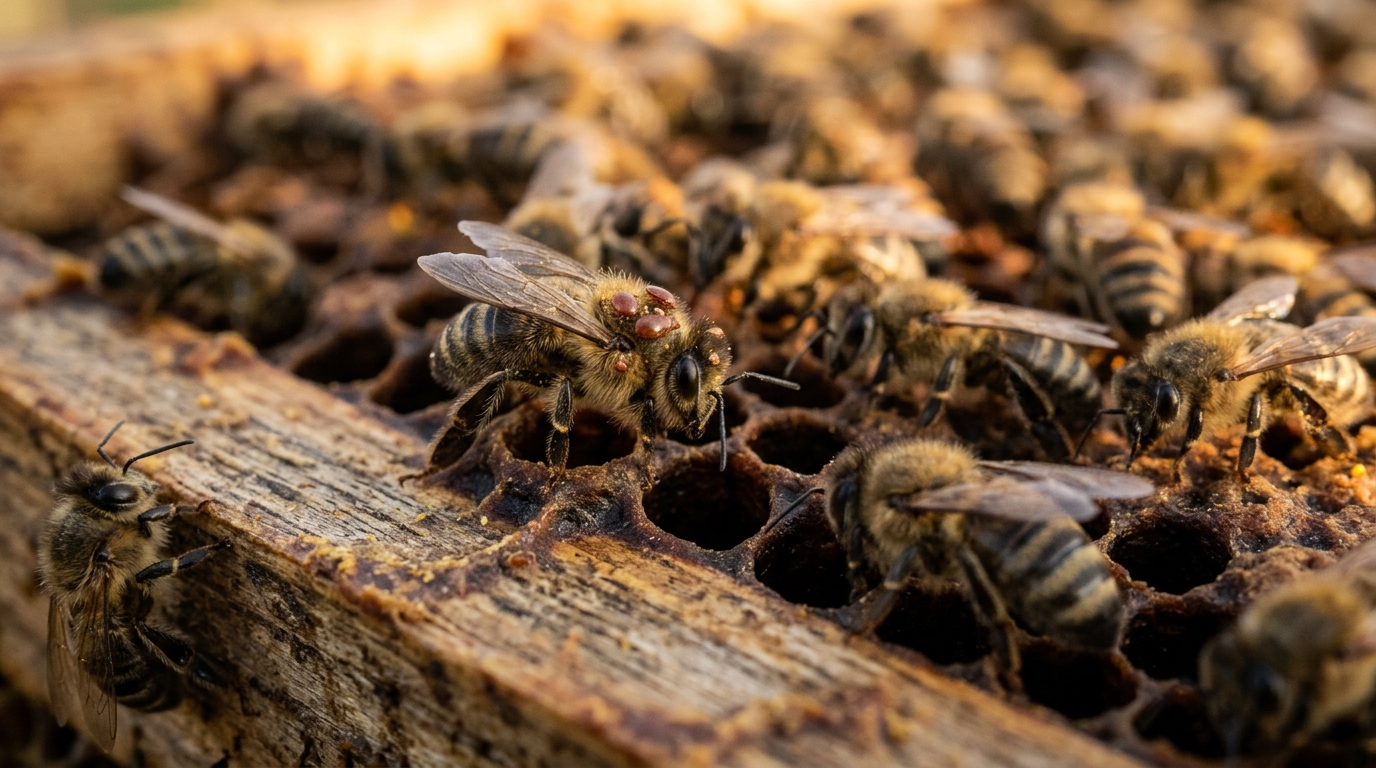
Amitraz-resistant varroa mites are now the single biggest threat to managed honey bee colonies in 2026. Apivar strips that knocked mites flat for fifteen years are leaving 40-70% of the population alive in apiaries across at least 19 U.S. states, according to bioassay data published by Project Apis m. and the Honey Bee Health Coalition (Project Apis m., 2025). The result was visible in last year's catastrophic survey numbers: U.S. beekeepers lost 55.6% of their managed colonies between April 2024 and April 2025 (Auburn University, 2025).
If you treated with Apivar last fall and still saw deformed wing virus symptoms, dwindling brood, and a March deadout, your apiary is probably already carrying a resistant mite population. The fix is not a stronger dose. The fix is a rotation strategy that assumes amitraz no longer works, paired with new tools that mites have not evolved around yet.
TL;DR: Amitraz resistance is confirmed nationwide. Treating with Apivar alone in 2026 is a coin flip on colony survival. Build a rotation that uses oxalic acid extended release (OAE), formic acid (Formic Pro), thymol (Apiguard), and the new RNAi product Vadescana across the season. Requeen with VSH or Pol-line stock to add genetic resistance underneath the chemical layer. Confirm efficacy with post-treatment alcohol washes — never assume a treatment worked.
What "Amitraz Resistant" Actually Means in 2026
Amitraz is the active ingredient in Apivar and Apitraz, and it has been the workhorse synthetic miticide in U.S. beekeeping since the early 2010s. It works by hyperactivating octopamine receptors in the mite's nervous system, causing tremors and death within 42 days of strip placement.
Resistance means the mite population has shifted genetically so that the same dose no longer kills the same percentage of mites. Field trials in 2024 and 2025 documented Apivar efficacy dropping from a historical baseline of 95-99% mite knockdown to as low as 30-65% in resistant apiaries (USDA-ARS Bee Research Lab, 2025).
The mechanism is a point mutation in the octopamine receptor gene first characterized in Varroa destructor populations in Argentina and France a decade ago. It has now been confirmed in U.S. samples from California, Florida, Texas, the Dakotas, and the Pacific Northwest commercial migration corridor (Honey Bee Health Coalition, 2025).
Three signs your apiary already has resistant mites:
- Post-treatment alcohol washes still show 3+ mites per 100 bees within 2 weeks of strip removal
- Colonies that received fall amitraz treatment crash in January or February with high mite loads
- You see deformed wing virus symptoms in worker bees throughout strip residency
If any of those describe your operation, treat for resistance from this point forward.
Why Apivar-Only Programs Are Failing
The single-product strategy that worked through the 2010s assumed three things: amitraz remained 95%+ effective, treatment timing was the main variable, and rotation was optional. All three assumptions broke between 2022 and 2025.
Beyond the genetic mutation, three operational factors accelerated the failure:
- Continuous selection pressure. Many commercial beekeepers used Apivar twice a year, every year, for over a decade. That kind of single-mode-of-action exposure is exactly what selects for resistant alleles.
- Sub-lethal residues in wax. Amitraz residues persist in brood comb, exposing successive mite generations to non-lethal doses — an ideal selection environment.
- Migration mixing. Commercial pollination routes shuttle resistant mite genetics across the country every almond bloom, homogenizing the resistance signal nationwide.
The Honey Bee Health Coalition's 2025 Tools for Varroa Management update no longer recommends Apivar as a standalone treatment. They recommend it as one rotation slot among at least three different chemistries per year (Honey Bee Health Coalition Tools for Varroa Management, 2025).
Pro Tip: Run a 48-hour alcohol wash on a sample of 300 bees both before and after every treatment. The pre-treatment wash sets your baseline; the post-treatment wash tells you whether the chemistry actually worked. If post-treatment counts are within 30% of baseline, the treatment failed and you need to switch chemistries within seven days.
The 2026 Treatment Toolkit
Six chemistries and one biological tool make up the modern resistance-management arsenal. Each has a different mode of action, which is the entire point — mites cannot evolve resistance to all of them simultaneously.
Comparison Table: 2026 Varroa Treatment Options
| Treatment | Active Ingredient | Mode of Action | Temperature Range | Honey Super On? | 2026 Efficacy |
|---|---|---|---|---|---|
| Apivar | Amitraz | Octopamine receptor agonist | 50-100 F | No | 30-65% (resistant) / 95% (susceptible) |
| Apiguard | Thymol | Membrane disruption | 60-105 F | No | 75-90% |
| Formic Pro | Formic acid | Mitochondrial inhibition | 50-85 F | Yes (with caveats) | 83-95% |
| OAE (extended release) | Oxalic acid + glycerin | Ionic disruption | 35-90 F | No | 85-97% |
| OA Vapor | Oxalic acid | Ionic disruption | Above 35 F | No | 90-99% (broodless) |
| HopGuard 3 | Hop beta acids | Membrane disruption | 50-92 F | Yes | 60-80% |
| Vadescana | dsRNA (RNAi) | Gene silencing | 50-95 F | Yes | 85-95% (early field data) |
Sources: Honey Bee Health Coalition Varroa Tools, 2025; EPA registration data, 2025; Project Apis m. field trials, 2025.
What's New in 2026: Vadescana (RNAi)
GreenLight Biosciences received EPA registration in late 2024 for Vadescana, the first RNA interference product approved for use in honey bee colonies. It works by feeding bees a dsRNA molecule that, when ingested by varroa mites during feeding, silences a gene essential for mite survival. The mite dies. The bee is unaffected because the target gene sequence is varroa-specific.
Early commercial trials reported 85-95% mite reduction without disrupting brood or queen (Project Apis m. Field Trial Summary, 2025). Vadescana is currently distributed through select commercial channels and beekeeping cooperatives. Hobbyists may not see retail availability until late 2026.
This matters for resistance management because RNAi has a completely different mode of action than every existing chemical. It belongs in the rotation as soon as it is available to you.
Oxalic Acid Extended Release (OAE)
Oxalic acid has been used as a winter broodless dribble or vapor for years. The 2026 evolution is the extended-release format — oxalic acid mixed with glycerin and applied on cellulose pads or shop towels that release product slowly over 28-42 days. EPA approved the formulation in 2025 under a Section 18 emergency exemption that has since transitioned to full registration in most states (EPA pesticide registration, 2025).
OAE is the closest thing the industry has to a "drop-in replacement" for Apivar in summer because it works during active brood, fits the same six-week treatment window, and shows no current resistance signals.
A 2026 Rotation Calendar That Works
Single chemistry, single season — that strategy is dead. The 2026 baseline is three different modes of action across the year, calibrated to your climate and your post-treatment monitoring data.
Here is a defensible rotation built around current Honey Bee Health Coalition recommendations and adapted for the amitraz-resistance reality.
Annual Rotation Schedule
| Window | Treatment | Why This Slot |
|---|---|---|
| Late February (broodless) | Oxalic acid vapor | Knock down winter mite population before spring buildup |
| Late May / early June | Formic Pro (single dose) | Treats under brood cappings; honey supers can stay on |
| Mid-July to late August | OAE pads OR Apiguard | Critical window — protects winter bee generation |
| Mid-October | Vadescana OR second OAE round | Final pre-winter knockdown; sets up broodless December |
| Late December (broodless) | Oxalic acid vapor or dribble | Catches phoretic mites with no brood to hide in |
Notice what is missing from that calendar: Apivar. In an apiary with confirmed resistance, Apivar slots out entirely. In an apiary without confirmed resistance, you can substitute Apivar for one of the OAE windows — but only if your post-treatment alcohol wash confirms 95%+ efficacy.
The single most important treatment is the late summer window. That is when your winter bees are being raised, and mite-damaged winter bees are why colonies "starve" in February with full honey stores.
Climate Adjustments
- Hot southern climates (above 90 F summer highs): Skip Formic Pro in July; substitute OAE. Formic acid evaporates too aggressively above 85 F and can kill the queen.
- Cool maritime climates (Pacific Northwest, coastal Northeast): Move the second OAE/Vadescana window earlier — first week of October. Brood shuts down sooner.
- Continental climates with hard winters: Rely heavily on the late-December broodless oxalic acid vapor. It is the most efficient single treatment of the year because there is no brood for mites to hide under.
For the full month-by-month framework that pairs treatment timing with feeding, ventilation, and brood checks, see our guide to Beekeeping First Winter Survival.
Genetic Resistance: The Layer Underneath the Chemicals
Chemistry buys you time. Genetics buys you a sustainable apiary. The two best-supported genetic lines for varroa resistance in 2026 are Varroa Sensitive Hygiene (VSH) stock developed by USDA-ARS and Pol-line bees, a USDA-ARS commercial-scale derivative.
VSH bees detect mite-infested pupae through their cell cappings and uncap and remove the infected larvae, interrupting the mite's reproductive cycle. Pol-line stock combines VSH traits with commercial productivity targets — stronger spring buildup, comparable honey yields, and acceptable temperament for migratory operations (USDA-ARS Honey Bee Breeding Lab, 2025).
Field data from USDA-ARS multi-year trials show VSH and Pol-line colonies maintain mite loads roughly 50-70% lower than commercial Italian or Carniolan stock under identical management, and require one fewer chemical treatment per year (USDA-ARS Bee Breeding Research, 2025).
Three actions to layer in genetic resistance:
- Requeen at least 30% of your colonies per year with VSH-graded queens
- Source from breeders who provide VSH scoring data, not just "varroa resistant" marketing language
- Track which colonies survive winter without treatment-failure signs and graft from those queens
Pro Tip: Do not assume a queen marketed as "hygienic" is the same as VSH-tested. Ask the breeder for their VSH scoring methodology — ideally USDA-protocol freeze-killed brood removal at 24 and 48 hours, with documented removal rates above 95%.
If you are not yet testing for hygienic behavior, our Hive Inspection Checklist walks through the freeze-killed brood test most VSH evaluators use.
Monitoring: The Step Most Beekeepers Still Skip
Treatment without monitoring is gambling. Project Apis m. data from 2024 showed that fewer than 40% of surveyed beekeepers performed alcohol washes at the recommended monthly cadence, and fewer than 20% performed a post-treatment efficacy check (Project Apis m., 2025).
In a resistance environment, the post-treatment check is non-negotiable. It is the only way to know whether your chosen chemistry actually worked on your specific mite population.
The Two Monitoring Methods That Matter
- Alcohol wash (most accurate). Collect 300 bees from a brood frame (avoid the queen). Shake in 70% isopropyl alcohol for 60 seconds. Strain through a 1/8 inch mesh into a second container. Count the mites that drop through. Divide by 3 to get mites per 100 bees. Action threshold: 2 mites per 100 in spring, 3 in summer, 1 in fall.
- Sugar roll (non-lethal but less accurate). Same bee sampling, but use powdered sugar instead of alcohol. Recovery rate is roughly 70-85% of true mite load, so multiply your count by 1.2-1.4 for a comparable threshold.
Sticky boards are useful as a relative trend indicator across the season but should not drive treatment decisions on their own — they undercount mite load in colonies with low brood.
When to Test
- Pre-treatment baseline: 24-48 hours before applying any product
- Mid-treatment check: Day 14 of a 28-42 day treatment
- Post-treatment efficacy: 14 days after strip removal or final OAE pad change
Compare pre and post numbers. A successful treatment cuts mite load by 85% or more. Anything less means resistance, mistimed application, or a re-infestation pressure issue. Diagnose the cause before the next treatment window closes.
For full seasonal monitoring schedules paired with brood and queen checks, see our companion guide on Varroa Mite Treatment Timing.
Mistakes That Kill Resistance-Aware Apiaries
Even beekeepers who have read the resistance research still lose colonies to a handful of operational errors.
- Treating without monitoring first. You waste a rotation slot on a colony that did not need treatment, accelerating resistance selection.
- Stopping treatment early because "the bees look fine." Mite damage shows up months after the population peaks. Visual signs are a lagging indicator.
- Mixing miticides outside label instructions. Stacking Apivar with Formic Pro does not multiply efficacy — it stresses queens and kills brood.
- Ignoring drift and reinfestation. A neighboring untreated apiary within two miles can re-seed your hives within weeks.
- Skipping the late-December broodless window. This is the most efficient single treatment of the year and the easiest to plan because the bees are clustered.
A more comprehensive list of preventable colony killers is in our roundup of 12 Beekeeping Mistakes That Kill Colonies.
For broader context on why resistance is now a survival-level problem rather than an academic one, see our deep dive on the Colony Collapse Crisis 2026.
What to Do This Week If Your Apiary May Have Resistant Mites
If you are reading this in late spring 2026, the operational priorities are clear:
- Run a baseline alcohol wash on every production colony today
- Order OAE pads, Formic Pro, and (if available) Vadescana for the season's rotation slots
- Order at least one VSH-graded queen per ten colonies for late-summer requeening
- Calendar your post-treatment efficacy washes — same week you place strips, schedule the 14-day-after wash
- Identify and document any colonies showing deformed wing virus symptoms; these are likely resistance survivors and should not be split into new colonies
Resistance management is not a single decision. It is a rotation discipline practiced across years. The apiaries that came out of the 2024-2025 collapse intact were the ones already doing this work. The apiaries that lost 70-90% of colonies almost universally relied on a single Apivar treatment per year.
For a deeper look at the bee diseases that ride alongside varroa pressure — including the viruses that turn a high mite load into a March deadout — see our guide to Honey Bee Diseases Identification.
Frequently Asked Questions
Is Apivar still worth using in 2026?
Apivar is still useful in apiaries without confirmed amitraz resistance, but only as one rotation slot — never as the sole annual treatment. If your post-treatment alcohol wash shows less than 85% mite reduction, switch chemistries immediately and assume resistance is present going forward.
How do I know if my mites are amitraz resistant?
The diagnostic signal is a post-treatment alcohol wash 14 days after strip removal that still shows 3+ mites per 100 bees, paired with deformed wing virus symptoms or a winter colony loss. University labs in several states offer formal bioassay testing if you need confirmation. Project Apis m. and your state apiary inspector can point you to the nearest lab.
Does oxalic acid extended release work on amitraz-resistant mites?
Yes. Oxalic acid has a completely different mode of action than amitraz — it disrupts mite ion balance and damages soft tissues on contact. There is no documented cross-resistance between the two chemistries, and OAE field trials in 2024-2025 reported 85-97% efficacy regardless of amitraz resistance status (Honey Bee Health Coalition, 2025).
Can I use Vadescana right now?
Vadescana is EPA-registered and shipping through commercial channels and select beekeeping cooperatives in 2026. Hobbyist retail availability is rolling out through the year. Check with your state beekeeping association or commercial supplier for current allocation. If you cannot source it yet, OAE is the strongest available substitute.
How often should I rotate treatments?
The minimum effective rotation is three different modes of action per year. Best practice is four — late winter oxalic vapor, late spring formic acid, late summer OAE or thymol, and late fall RNAi or oxalic vapor. Never use the same chemistry twice in a row.
Will VSH bees eliminate the need to treat?
Not yet. VSH and Pol-line stock typically reduce treatment frequency by one application per year and lower mite reproductive rates, but they do not eliminate the need for monitoring and intervention. Genetics and chemistry work together — neither alone is sufficient under current resistance pressure.
What is the single most important treatment window?
Late summer — mid-July through late August in most U.S. climates. This is when your winter bee generation is being raised. Mite-damaged winter bees cause February colony deaths even when honey stores look adequate. Miss this window, lose the colony.
Bottom Line
Amitraz resistance changed the math on varroa management. The apiaries that survive 2026 will be the ones that monitor before and after every treatment, rotate at least three modes of action across the year, and layer genetic resistance underneath the chemical program.
Build the rotation, monitor the results, and your apiary has its best shot at staying alive.
If you are setting up a treatment plan for the season ahead, start with the Varroa Mite Treatment Timing seasonal guide and pair it with a hive inspection cadence using our Hive Inspection Checklist.
Learn Beekeeping the Northern California Way
Eight written modules built around Northern California seasons — first inspection through first harvest, with printable checklists.
Keep reading
Beekeeping & Sustainability
Varroa Mite Treatment Timing: When to Treat, How to Monitor & What's Changing in 2026
Colony losses hit 55.6% in 2024-2025, and mistimed varroa treatments are a leading driver. This seasonal guide covers monitoring methods, treatment windows, the amitraz resistance crisis, and new tools like RNAi and disease-resistant bee stocks that are reshaping mite management in 2026.
Beekeeping & Sustainability
Honey Bee Diseases: How to Identify 8 Common Threats
U.S. beekeepers lost 55.6% of managed colonies in 2024-2025, and disease ranks among the top drivers alongside varroa mites. This field-ready guide covers the 8 most common honey bee diseases -- from American foulbrood to Nosema -- with visual symptom descriptions, prevention protocols, and treatment options so you can catch problems before they destroy a colony.
Beekeeping & Sustainability
Colony Collapse Crisis 2026: What Record Bee Losses Mean and How You Can Help
The 2024-2025 season recorded the highest honeybee colony losses since tracking began — 55.6% of managed colonies gone. This guide breaks down what's driving colony collapse disorder heading into 2026, the real-world consequences for food prices and agriculture, and concrete steps you can take to help reverse the decline.
Beekeeping & Sustainability
12 Beekeeping Mistakes That Kill Colonies (and How to Avoid Every One)
The U.S. lost 55.6% of managed colonies in 2024-2025, and first-year beekeepers fare even worse. These 12 mistakes account for the vast majority of preventable colony deaths. Each one includes the specific fix that keeps hives alive.