
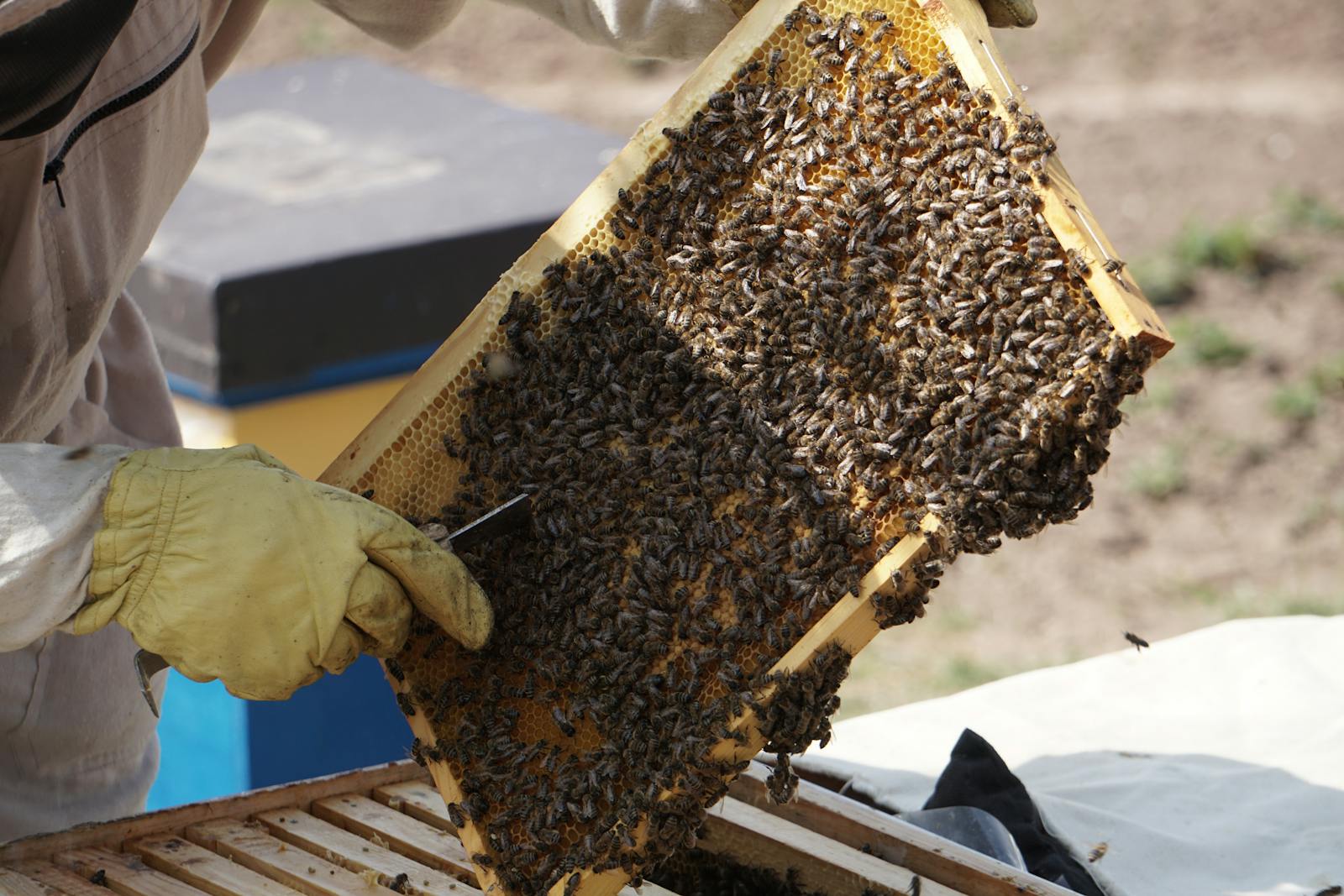
Quick answer: To read a brood frame, inspect it in this order — (1) check for eggs to confirm a laying queen within 3 days, (2) ID larvae stages to gauge brood spread, (3) evaluate capped brood color and pattern, (4) distinguish drone from worker cells, and (5) score the overall pattern as solid (healthy) or spotty (warning). A healthy brood pattern is concentric, with 90%+ of cells filled in the brood nest center. A spotty pattern with skipped cells, sunken caps, or perforations signals queen failure, varroa damage, or disease.
Learning how to read brood frames is the single skill that separates beekeepers who lose colonies from beekeepers who save them. The frame is the colony's medical chart — every egg, larva, and capped cell tells you something about the queen, the workers, and any pathogens or pests creeping in.
This guide is built around the same inspection sequence experienced beekeepers run on every frame they pull. By the end, you will be able to glance at a brood frame and diagnose what you are seeing in under 30 seconds.
What Is a Brood Frame and Why Reading It Matters
A brood frame is any frame in the hive where the queen is laying eggs and workers are raising the next generation of bees. In a Langstroth hive, brood frames usually sit in the bottom box (the brood chamber), surrounded by frames of pollen and honey.
Reading a brood frame means evaluating four things on every inspection:
- Presence of eggs (proves the queen has been laying within the last 3 days)
- Larvae at multiple stages (proves consistent egg-laying over the past 6–8 days)
- Capped brood quality (color, texture, pattern, and cell shape)
- Overall pattern (solid concentric brood vs. scattered/spotty)
According to the USDA Bee Research Lab, the leading indicator of colony failure is not adult bee population — it is brood pattern degradation in the 4–6 weeks before collapse. Catching pattern problems early gives you 30+ days to intervene.
Pro Tip: Always read brood frames in natural daylight with the sun over your shoulder. Eggs are nearly invisible in shade or LED light. Tilt the frame so light falls into the cell bottoms.
Tools You Need Before Pulling a Brood Frame
You don't need much, but the basics matter:
- A lit smoker with cool white smoke
- A hive tool to break propolis seals
- A bee brush (for moving bees off cells you need to see clearly)
- Reading glasses or a 5x magnifier loupe (eggs are 1.5mm long)
- A notebook or a hive-tracking app for recording findings
- A frame perch or stand so you can set frames down without crushing bees
If you are new to inspections, our hive inspection checklist for beginner beekeepers walks through smoker prep, frame removal order, and what to do when bees get defensive.
The 5-Step Brood Frame Reading Sequence
Run this exact order every time. It builds from "is the queen alive?" up through "is the colony healthy long-term?" so you stop early if you find a critical problem.
Step 1: Find Eggs (Confirm Queen Activity in the Last 3 Days)
Eggs are the first thing to look for. They prove the queen was alive and laying within roughly 72 hours, regardless of whether you actually spot her on the frame.
What you are looking for:
- Color: Pearly white, almost translucent
- Size: About 1.5mm — roughly the size of a pencil-tip dot
- Position: Standing upright at the bottom-center of an empty cell on day 1
- Angle change: Tilting at about 45° on day 2, lying flat against the cell bottom on day 3
The 3-day egg stage gives you a built-in clock. If eggs are upright, the queen laid yesterday. If they are flat, the queen laid 2–3 days ago.
Here is what one egg looks like through the standard 3-day pre-larval stage:
What it means when you can't find eggs:
- No eggs anywhere on any frame: Queen may be missing, failing, or recently swarmed. Check for queen cells next.
- Eggs only in scattered or unusual positions: Multiple eggs per cell, eggs on cell walls — strong sign of laying workers (a queenless emergency).
- Eggs with no larvae or capped brood: Queen may have just been installed or just resumed laying after a break.
If you find a single egg per cell at the cell bottom, you have a working queen. Move to step 2.
Step 2: Identify Larvae Stages (Gauge Brood Spread Over 6 Days)
Once eggs hatch, the larva spends about 6 days as a curled white "C" before being capped. Identifying larvae stages tells you whether the queen has been laying consistently or whether she had a break.
The larval stages, by day:
| Day | Larva Appearance | What It Tells You |
|---|---|---|
| 4 (Day 1 larva) | Tiny C-shape, smaller than the egg, swimming in royal jelly | Queen laid here ~3 days ago |
| 5–6 | Visible C-curled, pearly white, fed heavily | Healthy nurse activity |
| 7–8 | Fills cell bottom, glossy and plump | Strong worker brood |
| 9 | Stretches lengthwise in cell, cell about to be capped | Pre-capping stage |
A healthy frame shows larvae at multiple stages because the queen has been laying continuously. If you only see one stage, ask why — was there a recent gap in egg-laying? Did the colony just emerge from winter?
What healthy larvae look like:
- Bright pearly white (not yellow, gray, or brown)
- Glossy, wet appearance from royal jelly
- Tightly curled C-shape, not stretched or twisted
- Sitting cleanly at the cell bottom, not against the wall
What unhealthy larvae look like:
- Yellow or melted appearance: European Foulbrood (EFB)
- Brown ropy goo when probed with a toothpick: American Foulbrood (AFB) — call your state apiarist
- White chalk-like mummies: Chalkbrood fungal infection
- Twisted or off-center positioning: Chilled brood from cold exposure
For a deeper look at brood diseases, our honey bee diseases identification guide covers the eight most common threats and their treatment protocols.
Step 3: Evaluate Capped Brood (Color, Texture, and Pattern)
Capped brood is the dome-shaped wax covering over a developing pupa. This is the longest single stage — about 12 days for workers — so capped brood usually covers the most cells on a brood frame.
Healthy worker capped brood looks like:
- Color: Tan to light brown, like dry wheat
- Texture: Slightly raised, dry, and intact
- Spread: Concentric circle of cells with very few skipped cells (90%+ filled)
- Edges: Clean, well-defined cap edges
Warning signs in capped brood:
- Sunken or perforated caps: Workers detected disease and tore open the cap to remove the larva — common with AFB, sacbrood, or heavy varroa
- Greasy or wet-looking caps: Possible AFB
- Punched-out holes mid-cap: Hygienic workers cleaning out diseased pupae
- Bullet-shaped raised caps: Drone brood (different cell type — see step 4)
The proportion of capped brood to eggs and larvae also matters. A balanced frame should roughly mirror the lifecycle: a healthy queen produces about 1,500 eggs per day, and at any given time about 60% of brood will be capped, 25% larvae, and 15% eggs.
For the full developmental timeline, see our honeybee lifecycle complete guide.
Step 4: Distinguish Drone Brood from Worker Brood
Drone brood and worker brood look different on the frame, and confusing them is one of the most common mistakes new beekeepers make. A frame with too much drone brood, or drone brood in worker cells, is a serious diagnostic finding.
Visual differences:
Worker cells are smaller (about 5.2mm across), have flat or slightly raised caps, and dominate the center of brood frames. Drone cells are larger (about 6.9mm across), have distinctly domed bullet-shaped caps, and usually cluster along the bottom and edges of frames.
A normal healthy colony has 5–15% drone brood during spring and summer. The amount drops to near zero in fall and winter.
When drone brood becomes a diagnostic problem:
- Drone brood scattered through worker cells in a "shotgun" pattern: Drone-laying queen — she has run out of viable sperm and is laying unfertilized (drone) eggs in worker-sized cells. Requires requeening.
- Drone brood with multiple eggs per cell, deposited on cell walls: Laying workers — the colony has been queenless long enough that workers' ovaries developed. Very hard to fix; usually requires combining with a queenright colony.
- Drone brood in unusual quantity (30%+): Queen failing or colony has decided to swarm and is investing heavily in drones for future mating flights.
Our how to requeen a hive guide walks through the buying, introducing, and acceptance steps if you confirm a drone-laying queen.
Step 5: Score the Overall Brood Pattern (Solid vs. Spotty)
The overall pattern is the most diagnostic single signal on a brood frame. After you have checked eggs, larvae, capped brood, and drone vs. worker, step back and look at the whole frame.
A solid brood pattern looks like a concentric oval or football shape, with capped brood densely packed in the center, larvae in a ring around them, and eggs at the outer edge of the brood nest. Empty cells should be rare — under 10% of cells in the brood area.
A spotty brood pattern has scattered empty cells, skipped rows, missing cells, and an overall "shotgun blast" appearance. The brood area looks moth-eaten.
Here is how the two patterns compare visually:
Some skipped cells in an otherwise solid pattern are normal — workers may have removed brood from cells with structural defects, or hygienic bees may have cleared diseased larvae. The diagnostic threshold most beekeepers use: more than 10–15% empty cells in the brood area is concerning, more than 25% is a clear problem.
Pro Tip: A single inspection showing a slightly spotty pattern is not necessarily an emergency. Track the same hive over 2–3 inspections spaced 7–10 days apart. A pattern that gets worse week-over-week is far more diagnostic than a single snapshot.
Spotty Brood Pattern Causes: A Diagnostic Matrix
When you find a spotty pattern, the next question is why. Different causes create slightly different signatures, and matching the signature to the cause guides your treatment decision.
| Cause | Pattern Signature | Other Signs | Action |
|---|---|---|---|
| Failing queen (old or poorly mated) | Gradually worsening over 3–4 weeks; mostly worker cells but with skipped rows | Smaller queen, fewer eggs, possible scattered drone brood | Requeen within 2–3 weeks |
| Drone-laying queen | Drone cells in worker-sized cells across the frame | Bullet caps in center of frame, declining worker population | Requeen immediately |
| Laying workers | Multiple eggs per cell, eggs on walls, drone brood in worker cells | No queen, no queen cells, defensive colony | Combine with queenright colony |
| Varroa damage (PMS) | Spotty with sunken/punched-out caps, "snotty" larvae, deformed-wing adults | Mites visible on bees and in drone brood, low population | Treat with appropriate miticide based on temperature |
| European Foulbrood (EFB) | Twisted yellow/brown larvae lying off-center, sour smell | "Melted" larvae visible in uncapped cells | Requeen + Terramycin (with state vet approval) |
| American Foulbrood (AFB) | Sunken perforated caps, dark scale at cell bottom, ropy brown goo | Sulfur smell, scale that won't scrape out | Burn hive + report to state apiarist |
| Chalkbrood | White chalk-like mummies in cells or on bottom board | Stress-related: damp hive, cool weather, weak colony | Improve ventilation, requeen if persistent |
| Sacbrood (viral) | Dead larvae stretched in cells, pointed heads, "Chinese slipper" shape | Often follows other stressors | Usually self-resolves with requeening |
| Chilled brood | Brood killed at frame edges, often after cold snap | Recent cold weather, undersized colony | Tighten cluster, reduce hive volume |
| Pesticide kill | Sudden brood collapse, all stages affected at once | Dead adults at entrance, recent ag spray nearby | Move hive if possible, document for state |
If you suspect AFB, do not delay. American Foulbrood is a federally regulated disease in most states and requires state apiarist notification. The classic confirmation: insert a toothpick into a sunken cell, twist, and pull — AFB-infected larvae stretch into a brown rope 1+ inch long.
For more on the timing and chemistry of mite treatments specifically, our varroa mite treatment timing guide covers when to treat, how to monitor, and what is changing in 2026.
Brood Pattern Decision Tree: Quick Field Diagnosis
When you are standing at the hive with a frame in your hands, you don't have time to walk through a 2,000-word table. Use this decision tree as a 60-second triage:
Walk this tree top-down on every brood frame, and most diagnoses become obvious within a minute.
How Often Should You Read Brood Frames?
Inspection frequency is one of the most argued topics in beekeeping forums. The honest answer is "as often as you have a question, and not more often than that."
A reasonable cadence for most hobbyists:
- Spring (March–May): Every 7–10 days during build-up, looking for swarm cells and queen quality
- Summer (June–August): Every 14 days during honey flow, less invasive checks
- Fall (September–October): Every 10–14 days, focused on winter prep and varroa load
- Winter (November–February): No deep brood inspections — quick top checks only when above 50°F
Each full brood inspection should take 10–15 minutes per hive. Inspecting more than weekly is rarely productive and stresses the colony.
Pro Tip: Schedule brood inspections for 10am–2pm on warm sunny days when foragers are out. The colony is calmer, more bees are away from the hive, and brood frames are easier to read.
Common Mistakes When Reading Brood Frames
Even experienced beekeepers fall into these traps. Watch for them:
- Inspecting in shade or fading light — eggs become invisible, larvae color changes are missed
- Pulling frames too fast — you crush bees on adjacent frames before checking the brood frame itself
- Confusing pollen for brood — bright orange/yellow capped cells are pollen, not brood; brood caps are tan and slightly raised
- Reading only one frame — a single frame sample is misleading; check at least 2–3 brood frames
- Diagnosing from a single inspection — track patterns over 2–3 weeks before declaring a queen failed
- Smoking the brood nest heavily — this drives the queen and nurse bees off, making it harder to read the frame
- Holding frames horizontally — capped honey can drip and brood can fall out; always rotate frames vertically
For the long list of inspection-related mistakes that kill colonies, our guide on 12 beekeeping mistakes that kill colonies covers patterns we see across hundreds of hive records.
Reading Brood Frames Through the Seasons
Brood patterns shift naturally through the year. What looks "wrong" in October would be perfectly healthy in June.
Spring: Heavy egg-laying, expanding brood nest, lots of drone production. Expect 5–10 frames of brood at peak.
Summer: Mature brood pattern, queen at peak laying (1,500–2,000 eggs/day for healthy queens), modest drone production.
Fall: Brood production drops sharply. Drone brood disappears (workers evict adult drones). A small concentrated brood patch is normal — do not confuse with a failing queen.
Winter: In northern climates, brood-rearing pauses entirely for 4–8 weeks at the solstice, then restarts in late January. A frame with no brood in December is normal; a frame with no brood in May is not.
For Northern California beekeepers specifically, the northern California nectar flow calendar maps brood expansion against bloom timing month by month.
Frequently Asked Questions
What does a healthy brood pattern look like?
A healthy brood pattern is concentric and oval-shaped, with capped brood densely packed in the center, larvae in a ring around the capped cells, and eggs at the outer edge. Empty cells in the brood area should be under 10%. Caps are tan-colored, dry, and intact — neither sunken nor perforated. The pattern looks like a football laid on its side, with very few skipped cells. A queen producing this kind of pattern is laying steadily and the colony's nurse bees are caring for brood properly.
What causes a spotty brood pattern?
A spotty brood pattern has eight common causes: a failing or poorly-mated queen, a drone-laying queen, laying workers in a queenless colony, varroa-induced parasitic mite syndrome (PMS), European Foulbrood, American Foulbrood, chalkbrood, or chilled brood from cold exposure. Each cause produces a slightly different signature — sunken caps suggest disease, drone cells in worker cells suggest queen failure, and missing edge brood suggests chilling. Always check for sunken/perforated caps and a foul smell first, since AFB requires immediate state apiarist notification.
How do you tell if a queen is laying well?
A well-laying queen produces three signals on a brood frame: (1) eggs in single, centered placement at the bottom of empty cells, (2) larvae visible at multiple development stages indicating consistent egg-laying over the past week, and (3) a solid concentric brood pattern with 90%+ of cells in the brood nest filled. A peak-laying queen produces 1,500–2,000 eggs per day, which translates to roughly 5–8 frames of brood across the hive. If you find eggs but the pattern is increasingly spotty over 2–3 inspections, the queen is failing even if she is technically still alive.
How can I tell drone brood from worker brood?
Drone brood cells are larger (about 6.9mm wide vs. 5.2mm for worker cells) and have distinctly domed, bullet-shaped caps that protrude well above the comb surface. Worker cell caps are flat or only slightly raised. Drone brood is normally located along the bottom edges and corners of frames, while worker brood dominates the center. If you see drone-shaped cells scattered through the worker brood area in the center of the frame, that signals a drone-laying queen or laying workers — both serious problems requiring immediate intervention.
Is some spotty brood always bad?
No — a small amount of skipped cells is normal. Hygienic worker bees actively remove brood from cells with structural defects, viral infections, or varroa infestation as a colony defense. Some skipped cells in an otherwise solid pattern is actually a sign of a hygienic, healthy colony. The diagnostic threshold most beekeepers use is 10–15% empty cells in the brood area: anything under that is normal, 15–25% deserves a closer look across multiple frames and inspections, and 25%+ is a clear problem requiring action.
What does sunken or punched-out capped brood mean?
Sunken caps with small holes in the center are usually a sign that worker bees detected a problem inside the cell and tore the cap open to remove the diseased larva or pupa. The most common causes are American Foulbrood (AFB), heavy varroa infestation causing parasitic mite syndrome, or sacbrood virus. The toothpick "rope test" is the field diagnostic for AFB: insert a toothpick into a sunken cell, twist, and pull. If the contents stretch into a brown rope an inch or longer, it is almost certainly AFB and you must contact your state apiarist immediately.
How long does it take to learn to read brood frames well?
Most beekeepers reach competent brood-frame reading within their first season (about 8–12 inspections). Confidence reading subtle disease and queen-failure signatures typically takes 2–3 seasons. The fastest learning path is shadowing an experienced beekeeper for 3–5 inspections — the visual differences between healthy and unhealthy brood are very hard to learn from photos alone. Our find a beekeeping mentor guide covers how to connect with local clubs and mentorship programs.
Bringing It Together: Your Brood-Reading Routine
Reading a brood frame well comes down to running the same five-step sequence every inspection until it becomes automatic:
- Find eggs first — confirms queen activity within 3 days
- ID larvae across multiple stages — confirms consistent laying
- Evaluate capped brood color, texture, and integrity
- Distinguish worker from drone brood and flag misplaced drone cells
- Score the overall pattern as solid or spotty, then diagnose with the matrix
After your first dozen inspections, this whole sequence takes about 60 seconds per frame. After your first season, you will start spotting problems before you have consciously walked through the steps — your brain pattern-matches what "wrong" looks like.
The single highest-return habit you can build as a beekeeper is recording brood pattern notes at every inspection. A simple 1–5 pattern score per hive, tracked across the season, will catch failing queens 4–6 weeks earlier than memory alone. Combined with regular varroa monitoring and seasonal management, brood-reading is the foundation of every successful colony.
If you want a printable inspection sheet that walks through brood frame reading alongside the full inspection workflow, our hive inspection checklist for beginner beekeepers is the companion piece to this guide. And if you find yourself diagnosing a failing queen, the how to requeen a hive guide walks through buying, introducing, and acceptance step-by-step.
Read the frame. Trust the pattern. Your bees will tell you what they need.
Learn Beekeeping the Northern California Way
Eight written modules built around Northern California seasons — first inspection through first harvest, with printable checklists.
Keep reading
Beekeeping & Sustainability
Hive Inspection Checklist for Beginner Beekeepers
Regular hive inspections are the single most important habit separating thriving colonies from failed ones. This step-by-step checklist walks beginner beekeepers through every phase of an inspection — from lighting the smoker to reading brood patterns and recording findings — so you catch problems before they become colony losses.
Beekeeping & Sustainability
Honey Bee Diseases: Identify, Prevent & Treat 8 Common Threats
U.S. beekeepers lost 55.6% of managed colonies in 2024-2025, and disease ranks among the top drivers alongside varroa mites. This field-ready guide covers the 8 most common honey bee diseases -- from American foulbrood to Nosema -- with visual symptom descriptions, prevention protocols, and treatment options so you can catch problems before they destroy a colony.
Beekeeping & Sustainability
Varroa Mite Treatment Timing: When to Treat, How to Monitor & What's Changing in 2026
Colony losses hit 55.6% in 2024-2025, and mistimed varroa treatments are a leading driver. This seasonal guide covers monitoring methods, treatment windows, the amitraz resistance crisis, and new tools like RNAi and disease-resistant bee stocks that are reshaping mite management in 2026.
Beekeeping & Sustainability
Honeybee Lifecycle: From Egg to Forager in 4 Stages
Every honeybee passes through four distinct stages -- egg, larva, pupa, and adult -- but the timeline and outcome depend entirely on caste. Queens emerge in 16 days, workers in 21, drones in 24. Here is the complete biology behind each stage and what it means for your hive.