
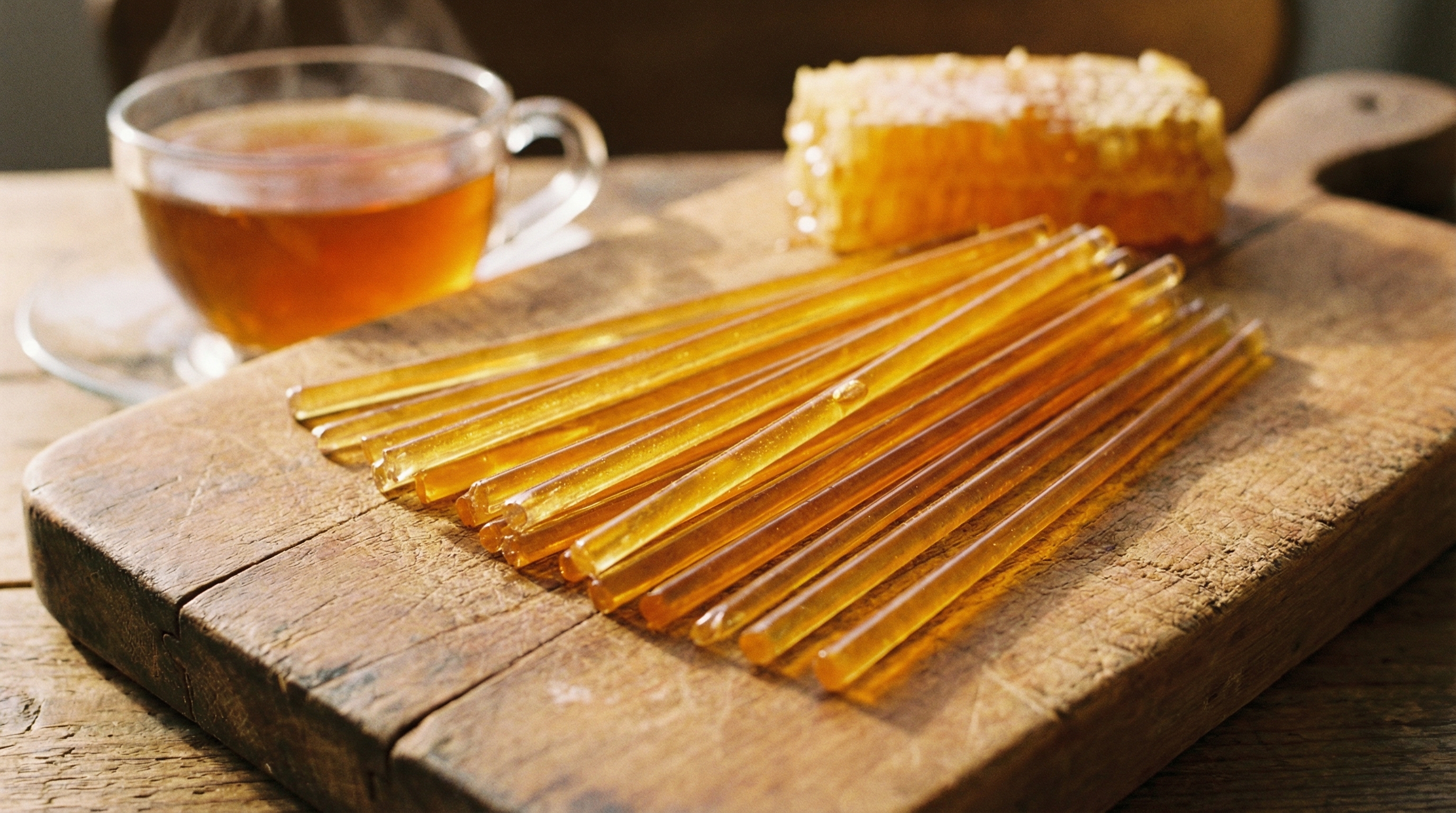
Honey sticks are one of the simplest ways to enjoy real honey — portable, pre-portioned, and zero mess. Each stick holds a single serving of honey sealed inside a food-grade straw. Snap the end, squeeze it out, and you have pure honey wherever you are. No sticky jars, no measuring, no guessing.
Whether you are sweetening tea at your desk, fueling a long hike, packing school lunches, or building a gift basket, honey sticks are the format that makes it easy. Below is everything worth knowing: how they are made, the different types available, creative ways to use them, basic nutrition facts, and where to buy sticks filled with actual raw honey instead of corn syrup blends.
What Are Honey Sticks?
A honey stick (also called a honey straw) is a narrow, food-grade plastic or resin tube filled with honey and heat-sealed at both ends. Each stick holds roughly one teaspoon (about 5 grams) of honey. The tubes are typically 6 to 7 inches long and about a quarter inch wide.
The process is straightforward: liquid honey is pumped into the straw, then each end is crimped and sealed with heat. No preservatives are needed because honey is naturally shelf-stable. A good honey stick contains nothing but honey — no additives, no artificial flavors, no high-fructose corn syrup.
Honey sticks were originally popularized at farmers' markets and county fairs as a way to offer single-serving samples. Today they are sold in packs ranging from 10 to 100+ sticks and used for everything from tea sweetening to marathon fueling.
How to Open Honey Sticks
Opening a honey stick takes about two seconds once you know the trick. There are three reliable methods:
Bite and tear. Hold the stick near one end and bite through the sealed tip, the same way you would crack a sunflower seed. Squeeze the honey out from the opposite end. This is the most common method and works anywhere.
Flip the seal. Some honey sticks have a small raised tab at one end. Press your thumbnail under the tab and flip it open like you are flipping a coin. This gives you a clean opening without teeth marks.
Scissors or a small tear. If you are serving honey sticks at an event or giving them to small children, snip the end with scissors for a clean, controlled opening.
Once open, squeeze gently from the bottom and the honey slides right out. A single stick delivers the perfect amount for one cup of tea, one piece of toast, or one quick energy hit on the trail.
Types of Honey Sticks
Not all honey sticks are the same. The honey inside determines the flavor, color, and nutritional profile. Here are the most common types you will find:
Raw honey sticks
Filled with unfiltered, unheated honey that retains its natural enzymes, pollen, and antioxidants. Raw honey sticks tend to have a richer, more complex flavor than processed alternatives. The color ranges from light gold to deep amber depending on the floral source. If you care about getting real honey with its full nutritional profile intact, raw is the way to go.
Pure Honey Sticks — Raw Wildflower
Clover honey sticks
Clover honey is the classic, mild-flavored honey most people recognize. It comes from bees that forage primarily on clover blossoms, producing a light, clean sweetness that works well in tea and coffee without overpowering the drink. Clover honey sticks are a great starting point if you are new to honey sticks or prefer a gentler flavor.
Flavored honey sticks
Some producers infuse honey with natural flavors — lemon, cinnamon, ginger, lavender, or even hot pepper. Flavored sticks add variety and work well in specialty drinks or as a standalone snack. When shopping for flavored sticks, check the ingredients list. Quality versions use real honey infused with natural extracts. Cheaper versions sometimes use honey-flavored syrup, which is not the same thing.
Wildflower honey sticks
Wildflower honey comes from bees foraging across multiple flower species in a region. The flavor shifts with the season and geography, producing honey with more depth and character than single-source varieties. Northern California wildflower honey, for example, carries floral notes from sage, buckwheat, and blackberry blossoms that you will not find in generic clover.
Manuka honey sticks
Manuka honey comes from New Zealand bees foraging on the manuka bush. It is prized for its antibacterial properties (measured by its MGO rating) and carries a distinctive earthy, slightly medicinal flavor. Manuka honey sticks command a premium price — expect to pay several times more per stick than standard honey varieties.
How to Use Honey Sticks
Honey sticks are more versatile than most people realize. Here are the most popular uses, ranked by how often people actually reach for them:
Sweetening tea, coffee, and drinks
Drop a honey stick into your mug and stir. One stick is roughly a teaspoon, which is about the same sweetening power as a sugar packet — the difference is flavour, not blood sugar. Honey is still sugar, and it counts toward your added-sugar intake the same way. Works in hot tea, iced coffee, lemonade, smoothies and cocktails.
Kids' lunchboxes and snacks
Honey sticks pack easily and do not leak the way a squeeze bottle or a jar does. A stick is a fixed portion — about a teaspoon — which makes it easier to control than a jar a child serves themselves from. It is a sweet treat, not a health food: roughly 20 calories of sugar, and the American Heart Association's guidance is that children aged 2-18 should stay under about 25 g of added sugar a day in total.
Safety: Do not give honey in any form — including honey sticks — to a child under 12 months. Honey can contain Clostridium botulinum spores, and an infant gut cannot yet handle them (CDC, Botulism Prevention). Above 12 months the botulism risk drops away, but honey is still sugar and still a choking-adjacent sticky food for very young children — supervise, and treat it as a sweet.
Honey Sticks for Lunchboxes: Portions, Age Safety and Mess-Free Pairings
Hiking, camping, and outdoor sports
Honey is mostly glucose and fructose — about 17 g of carbohydrate per tablespoon, so roughly 5-6 g in one stick (USDA FoodData Central). That is why some hikers and cyclists carry sticks instead of gels: it is a simple carbohydrate in a wrapper that weighs almost nothing, does not melt and does not leak into a pack.
We are not claiming a performance benefit, a smoother energy curve or a better recovery profile than any other carbohydrate. What a honey stick offers over a gel is a short ingredient list, a lower price per serving and a smaller package — not a physiological edge.
Honey Sticks vs. Energy Gels: Carbs, Ingredients, Cost & Portability
Labour bags
Honey sticks turn up on a lot of hospital-bag checklists. We are not going to tell you whether to pack them, because intake during labour is a clinical decision that varies by hospital, by birth plan and by individual risk factors — and the evidence on oral intake in labour is not something a honey retailer should be summarising for you.
Ask your midwife or obstetrician what their unit allows. If they say yes, a honey stick is a teaspoon of sugar in a sealed tube; if they say no, that answer is better informed than ours.
Gift baskets and party favors
Honey sticks make excellent additions to gift baskets, bridal shower favors, wedding favors, and holiday gift sets. They look elegant, they are individually wrapped, and they pair beautifully with tea samplers, cheese boards, or baked goods. A 10-pack of raw honey sticks costs under $7, making them an affordable way to elevate any gift.
At wedding scale the economics get more interesting. The largest pack sizes bring the cost down to about $0.30 per stick, well under the $1 to $5 per favour couples typically spend, and sticks need no assembly at all.
Compare every pack size and cost per stick
Honey Stick Wedding Favors: The Complete Cost Guide
Holiday honey gift ideas by budget, including stocking stuffers and office gifts
Cooking and baking
Use honey sticks to portion honey for recipes when precision matters. One stick equals roughly one teaspoon. They are especially handy for glazes, marinades, and salad dressings where you want a small, exact amount of honey without pulling out the jar and measuring spoon.
Honey Sticks Nutrition and Calories
A standard honey stick contains approximately:
- Calories: 20
- Total carbohydrates: 5–6 grams
- Sugars: 5–6 grams (naturally occurring glucose and fructose)
- Protein: 0 grams
- Fat: 0 grams
- Sodium: 0 mg
Raw honey sticks also contain trace amounts of enzymes, antioxidants, amino acids, and minerals including iron, zinc, and potassium. These are present in small quantities per stick but add up if you consume honey regularly.
Compared to a standard sugar packet (about 4 grams / 15 calories), a honey stick delivers slightly more calories but comes with a more complex flavor and compounds that refined sugar lacks entirely. For people replacing sugar in tea or coffee, one honey stick is a direct one-for-one swap.
How to Store Honey Sticks
Honey sticks are low-maintenance to store. Keep them at room temperature in a cool, dry place. There is no need to refrigerate — in fact, cold temperatures can cause the honey inside to crystallize faster, making it harder to squeeze out.
Properly stored, honey sticks stay good for years. Honey does not spoil. The sealed tube protects it from moisture and air, which are the only things that could degrade quality over time.
If a honey stick does crystallize (you will feel granules when you squeeze it), that is a sign of real honey. Processed honey loaded with corn syrup rarely crystallizes. Warm the stick gently in your hands or dip it in warm water for a minute, and the honey will return to liquid form.
How to Make Honey Sticks at Home
Making your own honey sticks is possible but requires some patience and the right supplies:
What you need:
- Food-grade plastic straws (BPA-free, heat-sealable)
- Raw honey (slightly warmed so it flows easily)
- Needle-nose pliers or a flat iron
- A small funnel or squeeze bottle
Steps:
- Seal one end of the straw using pliers heated over a flame, or clamp it with a flat iron on low heat. Press firmly for 3–5 seconds until the plastic fuses shut.
- Fill the straw with honey using a small funnel or squeeze bottle. Leave about half an inch of space at the open end.
- Seal the open end using the same heat-seal method. Make sure both seals are airtight.
- Wipe down the outside of each stick and let them cool completely.
The process works, but commercial honey sticks are sealed with industrial equipment that creates a much tighter, more consistent seal. Homemade sticks are best used within a few weeks and may leak if the seals are not perfect. For anything beyond a small batch — say, for a party or event — buying pre-made sticks is more practical and usually cheaper per stick than sourcing the supplies yourself.
How to Spot Low-Quality Honey Sticks
The honey stick market has the same problem as the honey jar market: not everything labeled "honey" is actually pure honey. Here is what to watch for:
Check the ingredients. The only ingredient should be honey. If you see corn syrup, high-fructose corn syrup, "honey blend," or artificial flavors, it is not a real honey stick.
Look for the source. Quality honey sticks will tell you where the honey comes from — the region, the floral type, or the beekeeper. Generic sticks that say "product of multiple countries" are often ultra-filtered blends designed to be cheap, not good.
Consider the price. Real honey costs real money. If a 100-pack is selling for $5, the maths does not work for actual honey — that is under a nickel a stick, before packaging, filling and shipping.
Check for crystallization. If you have had sticks sitting around for months and they still look perfectly clear and runny, that can be a sign of ultra-processing or adulteration. Real honey crystallizes naturally over time.
Is Grocery Store Honey Real? How to Tell What's Wrong with Cheap Honey?
Where to Buy Honey Sticks Online
When buying honey sticks online, you want sticks filled with real honey from a known source — not mystery blends. Here is what to look for:
Single-origin or regionally sourced. Sticks that name the honey's origin (California wildflower, clover from the Midwest, etc.) are more likely to contain real, quality honey.
Raw and unfiltered. Raw honey sticks retain the enzymes, pollen, and antioxidants that make honey worth eating in the first place. Pasteurized and ultra-filtered sticks lose most of these compounds.
Transparent producers. Buy from beekeepers or brands that can tell you where their honey comes from and how it is processed. If a seller cannot answer those questions, keep looking.
Pack size options. Most online retailers offer honey sticks in packs of 10, 25, 50, 100 and up. Smaller packs work for trying a variety. Bulk packs make sense for regular use, events or stocking a break room — and the price per stick drops as the pack size climbs, so it is worth checking the per-stick figure rather than the headline price.
Compare every pack size and cost per stick
Our raw wildflower honey sticks are filled with unfiltered Northern California honey — the same honey we sell by the jar, just portioned into single-serving straws. We also carry clover honey sticks for those who prefer a milder, classic honey flavor.
Honey Sticks vs. Honey Jars: When to Use Each
Honey sticks and jars serve different purposes. Neither replaces the other — they complement each other.
| Honey Sticks | Honey Jars | |
|---|---|---|
| Best for | On-the-go, portion control, travel, gifts | Cooking, baking, daily home use |
| Portion | ~1 tsp per stick | Unlimited, self-measured |
| Mess factor | None | Moderate (sticky lids, drips) |
| Cost per oz | Higher | Lower |
| Shelf stability | Excellent (sealed individual servings) | Excellent (if jar stays sealed) |
| Variety | Easy to try multiple flavors | Usually one flavor per jar |
For most households, a jar of raw honey in the kitchen and a pack of honey sticks in the pantry covers every scenario.
Frequently Asked Questions
Are honey sticks healthy?
A honey stick is about 20 calories of sugar. Raw honey also carries trace enzymes, antioxidants and minerals, but the quantities in one teaspoon are small — you would not eat honey for them.
The honest framing is that a honey stick is a sweetener, not a health food. If it replaces a sugar packet in your tea, you have swapped one teaspoon of sugar for another with more flavour and a little more character. The Dietary Guidelines for Americans count honey as an added sugar, and recommend keeping added sugars under 10% of daily calories. Anyone managing blood glucose should treat a honey stick exactly as they would treat sugar.
Can babies have honey sticks?
No. Honey in any form — including honey sticks — must not be given to an infant under 12 months, because honey can contain Clostridium botulinum spores that an infant gut cannot yet handle (CDC). This applies to raw and pasteurised honey equally; pasteurisation does not reliably destroy the spores.
After 12 months the botulism risk falls away. Honey is still added sugar, so treat it as one. Check with your paediatrician if you have any specific concern.
Honey for Babies and Kids: Safety Guide
Do honey sticks expire?
Technically, no. Honey does not expire. However, the quality of the seal matters — if air or moisture gets in, the honey can ferment. Commercially sealed honey sticks stored at room temperature will last for years without any issues.
Are honey sticks TSA approved?
Honey sticks are a gray area. The TSA classifies honey as a liquid, so each stick counts toward your 3.4 oz carry-on liquid limit. In practice, most travelers report no issues carrying a few sticks through security, since each one holds less than a teaspoon. For checked baggage, there are no restrictions.
How many honey sticks equal a tablespoon?
Three honey sticks equal approximately one tablespoon. Each stick holds about one teaspoon (5 grams) of honey.
Last updated: August 20, 2026
Shop Raw Honey Sticks
One teaspoon of raw Northern California wildflower honey per straw, sealed and mess-free. Seven pack sizes, from 10 up to 1000.
50 Pack · $24.99
Keep reading
Buyer Guides
Best Honey Gifts 2026: Ideas by Budget and Recipient
A practical honey gift guide: what to give under $15, $15-$40 and $40+, what suits a foodie, a tea drinker, a host, a coworker or a beekeeper, how to wrap it, and when to order so it arrives in time.
Buyer Guides
Honey Sticks for Tea and Coffee: Serving Size, Cost and Best Uses
A honey stick holds roughly one teaspoon of honey, which is one cup of tea or coffee. This guide works out the actual cost per cup at every pack size, covers hot versus iced, and compares wildflower against clover for drinks.
Buyer Guides
Honey Sticks for Lunchboxes: Portions, Age Safety and Mess-Free Pairings
Honey sticks pack flat and do not leak, which makes them easy lunchbox additions. This covers the one hard age rule, what a stick actually contains, how it fits against daily added-sugar limits, and pairings that survive a school bag.
Buyer Guides
Honey Sticks vs. Energy Gels: Carbs, Ingredients, Cost & Portability
Energy gels carry roughly four times the carbohydrate of a honey stick, and cost roughly four times as much. This compares what is actually on the two labels — carbs, ingredients, cost per serving, packaging and heat stability — without claiming either one makes you faster.
