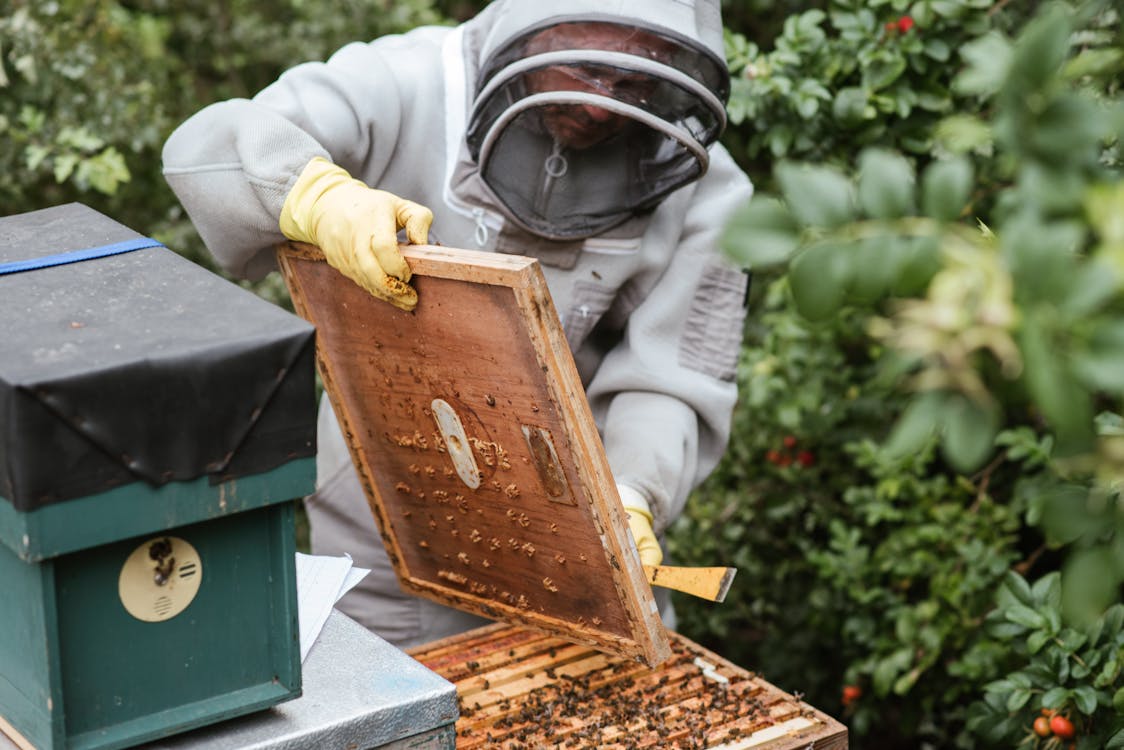
A Flow Hive is a Langstroth hive with a different honey super. The brood box, where the queen lays and where every inspection and mite check happens, is a standard Langstroth box in both. The only real difference is how you get the honey out: a Langstroth needs you to pull frames, uncap them, and spin them in an extractor, while a Flow Hive lets you turn a key and drain honey from plastic frames into a jar without opening the super.
That one difference changes three things: the price (a Flow Hive costs roughly three to four times as much as a comparable Langstroth kit), the harvest day (much less mess and disturbance with Flow), and how easy it is to take too much honey. It does not change how often you inspect, how you check for varroa, or how you feed through a dry summer.
Short answer: New beekeepers should start with a Langstroth. It costs less, every mentor and club knows it, and you can add Flow Frames to it later. A Flow Hive is a good choice for a beekeeper who already inspects on schedule and wants an easier harvest, especially someone with no space or budget for an extractor. In the Sacramento Valley, the Flow's harvest convenience matters less than managing the July-to-September dearth, which both hives handle the same way.
Flow Hive vs Langstroth at a Glance
| Langstroth | Flow Hive | |
|---|---|---|
| Typical 2026 price (hive only) | About $230-$350 for a complete assembled kit | $799-$959 (Flow Hive 2); $899-$1,059 (Flow Hive 2+) |
| What's in the box | Usually 1 deep brood box + 1 medium super, frames with foundation, bottom board, covers | Brood box with brood frames, Flow super with 6 or 7 Flow Frames, queen excluder, roof, base, harvest tubes, key |
| Honey harvest method | Remove frames, uncap, spin in an extractor (or crush and strain) | Turn a key in each frame; honey drains through a tube into a jar |
| Extra harvest gear | Extractor ($180-$280 for a manual 2-frame), uncapping tools, buckets, or borrow from a club | None beyond jars and covers |
| Disturbance at harvest | High: the super comes off, bees are cleared, frames go indoors | Low: the super stays closed |
| Routine inspections | Every 7-14 days in season | The same, because the brood box is identical |
| Varroa inspection access | Full access to brood frames; screened bottom board for sticky-board counts on many kits | Full access to brood frames; mesh base with a removable tray |
| Byproducts | Beeswax cappings every harvest; comb honey possible | Little wax (bees re-cap the same plastic cells); no comb honey from Flow Frames |
| Fast-crystallizing honey | Extract before it sets, or feed it back | Can set in the frames and won't drain without warming |
| Parts and resale | Universal, sold everywhere | Brood side is standard Langstroth; Flow Frames and super are proprietary |
Prices: Flow Hive pricing is from the manufacturer's US store in September 2026 (Flow Hive 2, Flow Hive 2+). The Langstroth figure uses Mann Lake's assembled 10 Frame Complete Hive Kit Combo at $226.99-$236.99 as the low end. Extractor pricing is from our honey extractor buyer's guide.
How Each Hive Works
The Langstroth hive
Lorenzo Langstroth patented his design in 1852. It is built around "bee space," a gap of about 3/8 inch that bees leave open instead of filling with comb or propolis. That gap is what lets you lift individual frames out of stacked boxes without tearing the colony apart.
A Langstroth is a stack of boxes: brood below, honey supers on top. At harvest you remove capped frames, slice off the cappings, and spin the honey out in an extractor, then return the drawn comb for the bees to refill. Without an extractor, you can crush and strain instead, at the cost of making the bees rebuild comb.
Our step-by-step honey extraction guide walks through a full Langstroth harvest.
The Flow Hive
The Flow Hive was invented in Australia by Stuart and Cedar Anderson and launched through a 2015 Indiegogo campaign that raised more than US$12 million (Wikipedia). The hive itself is a Langstroth-dimension brood box with a special super on top.
That super holds Flow Frames: plastic frames with partly formed hexagonal cells. The bees finish the cells with wax, fill them with nectar, and cap them like normal comb. When the frame is full, you insert the Flow Key and turn it. The cells split vertically and form channels, and honey runs down to a trough at the bottom of the frame and out through a tube. Turn the key back and the cells realign. The bees clean up, repair the cappings, and refill.
Each Flow Frame holds up to about 3.2 kg (roughly 7 lb) of honey, according to Flow's harvesting checklist. A full 6-frame super holds up to about 40 lb and a 7-frame super about 46 lb.
The 6-frame Flow super is sized for 8-frame Langstroth equipment, and the 7-frame super for 10-frame equipment. That compatibility is the most useful fact in this whole comparison, and we come back to it in the verdict.
Cost: What You Actually Pay
The Flow Hive's price gap is real, but it narrows once you count harvest equipment.
Langstroth. An assembled 10-frame kit with one deep and one medium super runs about $230-$350. To harvest, you buy a manual 2-frame extractor ($180-$280), borrow one from a local club, or crush and strain.
Flow Hive. The Flow Hive 2 is made of heat-treated Paulownia that Flow says must be sealed with at least two coats of exterior paint; the Flow Hive 2+ is western red cedar. If you already own a Langstroth, you can skip the full hive: a Flow Hive 2+ super alone is $519 (6-frame) or $579 (7-frame), and bare Flow Frames run $259 for 3, $349 for 6, or $449 for 7. Several items were sold out when we checked.
Bees, protective gear, a smoker, and mite treatments cost the same for both. Our first-year beekeeping budget covers those.
The math: a Langstroth kit plus a manual extractor still comes in well under a complete Flow Hive, and the gap grows if you borrow a club extractor. If you have nowhere to extract and no club nearby, the Flow's premium buys you something real.
Harvest Day: Where the Flow Hive Actually Wins
A Langstroth harvest means smoking the hive, pulling heavy supers (a full medium super can weigh 40-50 lb), clearing bees off the frames, moving everything indoors, uncapping, extracting, straining, and cleaning. It takes most of a day, and wet frames and cappings can draw robber bees if you are careless.
A Flow harvest skips almost all of that. You check the end-frame window to see that the cells are full and capped, set up the tubes, and let the honey drain into covered jars. Flow's own checklist says to keep jars covered with netting, cling wrap, or cloth so bees can't get into them. The super never comes off, and the colony barely notices.
Three honest caveats:
- You are judging ripeness through a window. The side window shows the end frame. Honey that bees have not capped is usually too wet and can ferment in the jar. Flow tells owners to harvest only frames that are mostly capped.
- Crystallized honey won't drain. Nectar from canola and other plants in the mustard family crystallizes quickly, sometimes in the comb. Flow's support site says crystallized frames need warming (a warming box at about 40°C, or removing the frames and soaking them in warm water) before they will flow (Flow Hive support). A Langstroth beekeeper can crush and strain or feed set frames back.
- The hive has to be tilted. Flow specifies a slight backward slope toward the honey outlets (about 3 degrees for the Flow Hive 2). A level hive can drain slowly or leak inside.
Inspections and Varroa Access: No Difference That Matters
Varroa mites, and the viruses they spread, are the main reason backyard colonies die. You control them by counting mites (an alcohol wash or sugar roll from a brood frame) and treating on schedule. Both of those happen in the brood box.
Because the Flow Hive's brood box is standard Langstroth, mite monitoring works exactly the same in both: smoke, lift off the super, pull a brood frame. The Flow Hive 2 base includes a mesh screen and a removable tray you can use for sticky-board counts. Many Langstroth kits come with a screened bottom board that does the same job.
The one difference is when you treat. Some mite treatment labels require honey supers to be off. The EPA-registered label for Apivar strips says not to use them while honey supers are present and to remove the strips 14 days before adding supers (EPA label). Formic Pro, by contrast, is labeled for use with honey supers on (NOD Apiary Products). A Flow owner who treats the super as a permanent fixture has to plan to take it off, or choose a treatment labeled for supers on. Always follow the label.
For timing, see our varroa mite treatment timing guide. For what to look at on every visit, use the hive inspection checklist.
Northern California: Heat and Summer Dearth
Most Flow Hive vs Langstroth comparisons are written for milder climates. The Sacramento Valley honey year is different.
The main flow ends early. Almond, ceanothus, orange blossom, and blackberry build colonies in spring, and yellow star thistle carries the flow into July. Most valley beekeepers treat the Fourth of July as the working end of the main flow. What follows is a two- to three-month dearth: August valley temperatures sit in the high 90s to low 100s and almost nothing produces nectar until fall bloom. Our Northern California nectar flow calendar maps the timing.
This is where the Flow Hive's ease becomes a risk. Taking honey from a Flow Hive is so easy that over-harvesting is the most common mistake critics point to. In the valley, the honey you leave in July is what the colony lives on through August and September. Drain every Flow Frame after star thistle and you may be mixing sugar syrup in late August, during the same weeks robbing is at its worst. The Flow mechanism doesn't cause over-harvesting; it removes the friction that used to prevent it.
Robbing during dearth favors the closed harvest. Robbing is most serious in the July-August dearth (MSU Extension). A Flow harvest keeps the hive closed and the honey in covered jars, which exposes less honey to foragers than pulling supers and leaving wet frames around the yard. If you must harvest a Langstroth late in summer, work fast, early in the day, and keep everything covered. Our summer dearth guide covers feeding and robbing control in detail.
Heat affects both hives the same way. Warm honey drains and extracts more easily. Both hives need afternoon shade, nearby water, and light-colored paint (Flow's Paulownia hive requires paint by Flow's own instructions). Wildfire smoke and drought hit both designs equally; see our drought and wildfire smoke guide.
Registration applies to both. California requires colony registration with the county agricultural commissioner regardless of hive type; our California beekeeping laws guide explains how.
Common Flow Hive Criticisms (and Which Ones Hold Up)
"It's too expensive." Holds up for beginners. Even after counting an extractor, a complete Flow Hive costs hundreds of dollars more than a Langstroth setup.
"Bees don't like the plastic frames." Partly true. Colonies can be slow to start working plastic, and a colony that is weak or in a dearth may leave a Flow super empty. The usual fixes are adding the super only to a strong colony during a strong flow, and brushing the frames with a little beeswax.
"It encourages hands-off beekeeping." This is the most serious criticism, and it is about how the hive is marketed, not how it is built. "Honey on tap" invites new beekeepers to skip inspections, and a colony that is never opened hides its mite load, queen problems, and swarm preparations.
"It makes over-harvesting easy." True, and it matters more in the Sacramento Valley than in most places, for the dearth reasons above.
"You lose the beeswax and comb honey." True. Every Langstroth harvest produces clean cappings wax you can render for candles or balms. Flow Frames reuse the same cells, so there is little wax to render, and you cannot cut comb honey from a plastic frame.
"Plastic touching honey." Flow says the frame centers are virgin food-grade polypropylene, free of BPA and other bisphenols, and that bees coat the cells in wax before storing honey (Flow Hive support). Many commercial Langstroth frames use plastic foundation too.
Who Each Hive Is For
Choose a Langstroth if:
- This is your first or second season
- You want a mentor or local club to be able to help you at the hive
- You want to stretch your budget into a second colony (two hives let you compare colonies and share frames when one struggles)
- You want beeswax, comb honey, or cut-comb frames
- You are willing to borrow or buy an extractor, or crush and strain
Choose a Flow Hive if:
- You already inspect on a schedule and have kept a colony through at least one winter
- Extraction is the part of beekeeping you can't manage: no room, no club extractor nearby, or a physical limitation that makes lifting full supers hard
- You want to harvest small amounts often rather than once or twice a year
- You understand that the Flow super is a harvesting tool, not a management system
The Verdict
For almost every new beekeeper, a Langstroth is the better first hive. It costs a fraction as much, every book, course, and club assumes it, and it teaches frame handling, the core skill of beekeeping.
The Flow Hive is not a gimmick. The harvest really is easier and gentler, and in a dearth-heavy climate a closed harvest has advantages. But everything that keeps a colony alive happens in the brood box, and that box is the same in both hives.
The smartest way to own Flow Frames is often not to buy a Flow Hive at all. Start with an 8-frame or 10-frame Langstroth. Learn to inspect and count mites. Then, if extraction is the part you dislike, add a Flow super or a set of Flow Frames sized to your boxes (6-frame for 8-frame, 7-frame for 10-frame) in year two or three. You get the easy harvest without paying for a second brood box you didn't need.
If you are still choosing between hive styles, including top-bar hives, our best beginner beehive kits comparison covers all three.
Learn the Brood-Box Skills First
Whichever hive you buy, the skills that keep bees alive are the same: reading brood frames, counting mites, and managing the valley's early flow and long dearth. The free Getting Started module of NorCal Nectar's Complete Beekeeper course includes a lesson on choosing your hive type, and the paid modules cover inspections, varroa, feeding, and harvest on a Northern California seasonal calendar.
Frequently Asked Questions
What is the main difference between a Flow Hive and a Langstroth hive?
The honey super. A Flow Hive uses a standard Langstroth-size brood box but replaces the wooden honey frames with plastic Flow Frames that you drain with a key, without opening the super. A Langstroth harvest requires removing the frames, uncapping them, and spinning them in an extractor. Inspections, mite checks, and feeding are the same in both.
Is a Flow Hive good for beginners?
It can work, but it is not the best first hive. It costs about three to four times as much as a Langstroth kit and doesn't reduce the inspections and varroa management that beginners most often get wrong. Most new beekeepers do better starting with a Langstroth and adding Flow Frames later if they want the easier harvest.
How much does a Flow Hive cost in 2026?
From the manufacturer's US store in September 2026: $799-$959 for the Flow Hive 2, $899-$1,059 for the cedar Flow Hive 2+, $519-$579 for a Flow Hive 2+ super alone, and $259-$449 for Flow Frames alone depending on how many. Bees, gear, and mite treatments are extra.
Can I put Flow Frames on my existing Langstroth hive?
Yes. The 6-frame Flow super fits 8-frame Langstroth equipment and the 7-frame super fits 10-frame equipment. You can also buy Flow Frames alone and fit them into a compatible super, following Flow's fitting instructions.
Does a Flow Hive work in hot climates like the Sacramento Valley?
Yes. Warm honey drains more easily, and a harvest that keeps the hive closed exposes less honey to robbers during the late-summer dearth. The main risk is over-harvesting in July, which leaves the colony short of stores for August and September. Leave enough honey for the dearth, give the hive afternoon shade and water, and paint the wood.
Learn Beekeeping the Northern California Way
Eight written modules built around Northern California seasons — first inspection through first harvest, with printable checklists.
Keep reading
Beekeeping & Sustainability
Best Beginner Beehive Kits Compared: Langstroth vs Flow Hive vs Top-Bar (2026)
Three hive styles dominate beginner beekeeping in 2026: Langstroth, Flow Hive, and top-bar. One is the right answer for almost every new beekeeper. This side-by-side comparison breaks down real costs, ease of use, inspection workflow, honey harvest, winter survival, and which kit actually fits your yard, budget, and skill level.
Beekeeping & Sustainability
Honey Extraction Process Step-by-Step: From Capped Frames to Bottled Jar
A no-fluff, step-by-step honey extraction process for hobbyist beekeepers. Pull capped frames, uncap with a knife or fork, spin in an extractor, double-strain, settle, and bottle -- with real timing, yield-per-frame numbers, and the moisture, temperature, and food-safety rules that protect raw honey from hive to jar.
Beekeeping & Sustainability
Varroa Mite Treatment Timing: When to Treat, How to Monitor & What's Changing in 2026
Colony losses hit 55.6% in 2024-2025, and mistimed varroa treatments are a leading driver. This seasonal guide covers monitoring methods, treatment windows, the amitraz resistance crisis, and new tools like RNAi and disease-resistant bee stocks that are reshaping mite management in 2026.
Beekeeping & Sustainability
Summer Dearth Beekeeping: How to Spot a Nectar Gap and Feed Without Triggering Robbing
A nectar dearth does not kill colonies on its own. Careless feeding during one does. This guide covers the seven signs a dearth has started, how to decide whether a colony actually needs syrup, the ratios to mix by date, and the entrance and timing rules that keep a feeder from turning into a robbing war.