
Summer dearth beekeeping comes down to three decisions made in the right order: confirm the nectar gap is real, check whether the colony actually needs food, and then feed in a way robbers cannot smell. Get that order wrong and the feeder becomes the thing that kills the hive.
A dearth by itself rarely destroys a healthy colony. What destroys colonies is a beekeeper who responds to one by opening hives more often, leaving syrup in the open, and handing the strongest hive in the yard a reason to dismantle the weakest.
It is mid-September as this publishes, which puts most of Northern California at the tail end of a dearth that started when the star thistle finished in July. Fall bloom is close but not here. This is the highest-risk four weeks of the beekeeping year for robbing, and the last clean window to fix a light colony before winter clustering begins.
TL;DR: A nectar dearth is a stretch when little or nothing in bloom is producing collectible nectar. Confirm it by watching forager traffic, comb building, and hive weight rather than the calendar. Feed only the colonies that are genuinely light, using 1:1 syrup while you still want comb and brood and 2:1 once you are building winter stores. Reduce entrances before the first feeder goes on, keep syrup inside the hive, feed at dusk, and never open-feed in a yard you care about. Late summer is also the critical varroa window, so treat while you feed.
What Is a Nectar Dearth?
A nectar dearth is any period when the plants in flight range are not producing collectible nectar, so incoming forage drops to near zero while the colony keeps consuming. University of Florida extension defines it simply as the inverse of a nectar flow, a scarcity period when bees start seeking alternative resources (Willingham, Klopchin, and Ellis, UF/IFAS Extension ENY-163).
The important word there is collectible. Plants can be visibly blooming and still yield nothing. Heat, drought stress, and low soil moisture all shut nectar secretion down while the flowers stay open and photogenic.
That gap between what a yard looks like and what it produces is why new beekeepers miss dearths entirely. The landscape looks fine. The scale says otherwise.
Dearths are also regional and seasonal rather than universal. Most of the United States gets a midsummer gap between the spring flow and fall bloom; our Northern California nectar flow calendar breaks down exactly which weeks go quiet here and which plants end the drought.
How Do I Know If My Bees Are in a Dearth? Seven Signs
Stop guessing from the calendar and read the colony. These are the signals, roughly in the order they appear.
- Hive weight stops climbing, then falls. A colony that gained through the flow plateaus and starts losing. This is the single most reliable indicator, and the only one that is hard to misread.
- Comb building stops. Bees draw wax on incoming nectar. When fresh nectar falls below what wax production requires, new comb stops and the white cappings you saw in June go dull.
- Forager traffic thins out and pollen drops off. Fewer bees leaving, fewer returning with loaded corbiculae, and long stretches of a quiet landing board in the middle of a warm afternoon.
- Temperament changes sharply. Colonies that were calm in July get defensive. Bees follow you across the yard. Smoke buys you less time than it did a month ago.
- Bees turn up on plants they normally ignore. During a flow, honey bees are picky. During a dearth they will work weeds, ornamentals, hummingbird feeders, and open trash cans.
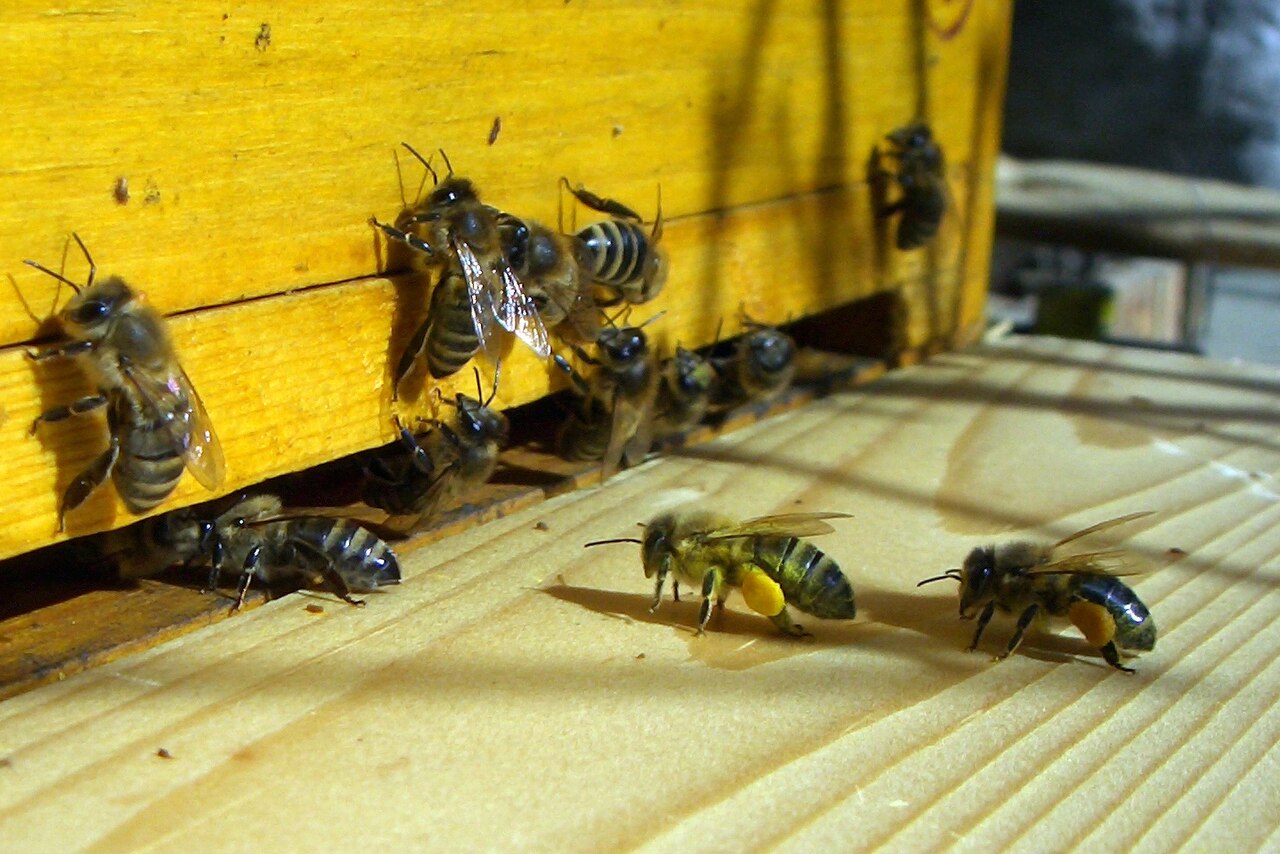
- Bees start investigating other hives. Individual bees hovering along the seams between boxes, around the lid, and at the bottom board are scouting, not visiting. This is the first move in a robbing event.
- Nectar is missing from the brood nest. Open cells around the brood that held shining fresh nectar in spring are dry, and the colony has begun eating into sealed stores.
Any two of those together is a dearth. Three or more and you should already have entrances reduced.
A scale under one hive turns all seven of those signals into one number. You do not need a telemetry setup. A luggage scale hooked under the back edge of the bottom board, lifted until the hive just tips, gives a repeatable half-weight you can log weekly.
The Northern California Dearth: Why Ours Runs Late
Most American beekeeping literature was written for a short, intense May and June flow followed by a long summer gap. Northern California does not work that way.
Here the main flow is front-loaded. It opens with almond pollen in February, builds through ceanothus, orange blossom, and blackberry in spring, and ends on yellow star thistle in July. Most valley beekeepers treat the Fourth of July as the working end of the main flow.
What follows is a genuine two- to three-month gap. August is the hardest month, with valley temperatures routinely in the high nineties to low hundreds and almost nothing secreting nectar. September carries that gap into early fall until coyote brush, rabbit brush, and in some areas eucalyptus and ivy come on.
Elevation moves all of this. Sierra foothill yards typically run a week or two behind the valley floor and get a slightly shorter dearth. Coastal and North Coast yards often see coyote brush earlier and harder, which can end the gap in September rather than October.
Drought years stretch the dearth in both directions. Wildfire smoke adds a second problem on top of it, suppressing flight on the days colonies can least afford to lose, which we cover in protecting hives through drought and wildfire smoke.
Pro Tip: Keep a one-line dearth log for each yard. Date the week comb building stops, the week you reduced entrances, and the week the first coyote brush pollen shows up on the landing board. Three seasons of that beats any published calendar for your specific sites.
Should I Feed Bees in Summer? The Decision Rule
Not automatically. Feeding is a response to a measurement, not to a month.
Supplemental feeding during a dearth is ordinary practice, not an admission of failure. A study that followed commercial colonies through an extended August-to-February forage dearth in Northern California puts it plainly: beekeepers feed artificial pollen substitute diets to offset periods of inadequate pollen forage (Ricigliano, Williams and Oliver, BMC Veterinary Research, 2022).
The E. L. Niño Bee Lab at UC Davis, which runs the California Master Beekeeper Program, researches how to make those supplements more nutritious rather than whether to use them at all. The open question has never been whether to feed. It is which colonies to feed, and when.
Here is the rule we work to.
- Four or more frames of sealed honey in the brood boxes: do not feed. The colony is carrying itself, and adding syrup only adds scent and robbing pressure to the yard.
- Two to three frames of sealed honey: monitor weekly. Feed if the trend is down two weeks running.
- Fewer than two frames, or any frame-shaking lightness: feed now. This colony will not self-correct.
- A nuc, a recent split, or a newly requeened colony: feed regardless of the calendar. Small colonies have no buffer, and a dearth is the worst possible time to be building comb from scratch.
- Any colony with a failing queen or a broken brood pattern: fix the queen first. Syrup does not fix a drone-laying hive, and reading the brood frame tells you which problem you actually have.
Pollen matters as much as nectar and gets ignored more often. A dearth usually knocks out both. When incoming pollen stops, nurse bees run down their protein reserves and the colony begins cutting brood, which is exactly the wrong move heading into the winter-bee cohort. Our honey bee nutrition and feeding guide covers protein supplements and when a pollen patty earns its place.
One thing not to do: harvest during a dearth. Pulling supers floods the yard with honey scent at the moment colonies are most primed to rob, and it takes stores from a colony that has no way to replace them. Harvesting responsibly means finishing before the flow ends, not after.
Work the whole Northern California season with printable checklists
Sugar Syrup Ratios for Late-Season Feeding
Two ratios cover almost everything, and the difference between them is what you want the bees to do with it.
| Ratio (sugar:water) | Approx. sugar content | What it signals to the colony | Use it when |
|---|---|---|---|
| 1:1 by weight | ~50% | Mimics a nectar flow — stimulates comb building and brood rearing | Spring buildup, new packages and nucs, drawing foundation, mid-dearth maintenance of small colonies |
| 2:1 by weight | ~67% | Storage food — little stimulation, much less water to evaporate | Late summer into fall, building winter stores, topping up a light colony before clustering |
| 1:2 by weight | ~33% | Very light maintenance feed | Keeping comb work going through a hot dearth without pushing brood |
That last row is not a typo. Randy Oliver, who keeps bees in the Sierra foothills and writes at Scientific Beekeeping, has reported that a 33% syrup, one part sugar to two parts water, is enough to keep his colonies whitening comb through the California summer dearth (Scientific Beekeeping). Light syrup does real work when the goal is maintenance rather than stores.
Mix by weight, not by volume. A pound of sugar to a pound of water is unambiguous; a "cup" of sugar depends on how hard you packed it.
A few mixing rules that save trouble later:
- Use white cane or beet sugar only. Brown sugar, raw sugar, molasses, and anything with added solids raise the ash content and cause dysentery in a wintering cluster.
- Never boil the syrup. Overheating sugar solutions can produce hydroxymethylfurfural, which is toxic to bees. Hot tap water dissolves 2:1 fine with stirring.
- Do not feed honey from another apiary. American foulbrood spores survive in honey and this is one of the most common ways the disease moves between yards. Our honey bee disease identification guide covers what you are risking.
- Mix only what you will use in a week. Thin syrup ferments fast in September heat, and sour syrup is worse than none.
By mid-September in Northern California, most colonies should be on 2:1. The window for stimulating brood has closed. What you want now is weight the colony can cap and hold.
Open Feeding vs Entrance Feeding vs Internal Feeders
This is where most robbing disasters start, and the ranking is not close.
| Method | How it works | Robbing risk | Verdict |
|---|---|---|---|
| Open feeding (bucket or trough in the yard) | Syrup in a shared container outside the hives | Very high | Avoid in any yard with more than one colony. Broadcasts scent, rewards the strongest hives, and starves the ones you meant to help |
| Entrance (Boardman) feeder | Inverted jar at the hive entrance | High | Puts a scented, unguarded food source at the front door — the single most exposed point on the hive |
| Inverted jar over the inner cover | Punched-lid jar above the cluster, under an empty super | Low | Cheap, effective, fully enclosed, easy to check |
| Frame feeder (division board) | Replaces a frame inside the brood box | Low | Large capacity, but requires opening the hive to refill |
| Hive-top feeder | Tray sitting directly on the brood box under the lid | Low | Best capacity-to-disturbance ratio for fall feeding |
The case people make for open feeding is convenience: one bucket, many colonies, no lids to open. The problem is that bees do not share fairly. The strongest colonies dominate the container, the weak ones get little, and every colony in flight range now has a food-scent map of your yard.
Entrance feeders fail for a narrower reason. A Boardman feeder sits at the exact point guard bees are trying to defend and leaks scent straight past them. It is a fine tool for water in the spring. It is a poor tool for syrup in September.
Robbing Prevention: Rules That Actually Work
Robbing happens when nectar is scarce and a colony finds an easier source than flowers. Mississippi State University Extension notes that robbing is most serious during the summer dearth of July and August and recommends keeping summer inspections infrequent and short (MSU Extension, Mississippi Beekeeping Calendar).
The UF/IFAS extension guidance is blunt about where the blame usually sits: beekeepers working colonies during nectar dearths, or leaving equipment exposed, often cause or worsen robbing themselves.
These are the rules, in priority order.
- Reduce entrances before the dearth, not after it starts. Once robbing is underway you are reacting. An entrance reducer set to its smallest opening, or a robbing screen, gives guard bees a door they can hold.
- Keep colony strength uniform. A weak colony next to a strong one in the same yard is an invitation. Combine hopeless colonies rather than nursing them through a dearth.
- Work fast and work one hive at a time. Open, do what you came for, close. Do not line up four open hives while you look for a queen.
- Cover everything. Supers off the hive go under a cloth or in a closed box. Burr comb goes in a bucket with a lid, not on the grass.
- Inspect late in the day. Fewer foragers are flying, and any robbing that starts has less daylight to escalate in.
- Never leave wet equipment out. Extracted supers, scrapings, and sticky tools are the most common robbing trigger in a hobby yard.
- Feed inside the hive, at dusk. See the section above. This one rule prevents most feeding-related robbing.
- Stop inspecting for the sake of it. A dearth is the wrong time for a curiosity inspection. Our hive inspection checklist covers what actually needs eyes on it and what can wait.
Knowing what robbing looks like matters as much as preventing it. UF/IFAS lists the specific signs: an unusually high number of bees flying and scouting around the apiary, fighting at entrances, bees probing the seams where supers meet and around the lid and bottom board, shredded wax cappings and hive debris on the landing board, and a rising count of dead bees at the entrance.
Normal orientation flights look like calm, face-on hovering in front of one hive in the early afternoon. Robbing looks like bees working the seams of a hive rather than its door, and fighting when they get there. Once you have seen the difference you will not confuse them again.
Robbing is not only an immediate loss. It is one of the main routes varroa mites and their viruses move between colonies, because robbers pick mites up from the collapsing hive they are stripping and carry them home.
How to Stop Robbing During a Dearth Once It Has Started
Move immediately. A robbing event can strip a small colony in a single afternoon.
- Close the hive you are working on. If you triggered it with an open inspection, stop the inspection and put the lid back on.
- Reduce the victim's entrance to a single bee-width. UF/IFAS recommends plugging openings with grass or tape and reducing entrances to a one- to five-bee capacity.
- Remove the attractant. Pick up the spilled syrup, the burr comb, the exposed super, whatever started it.
- Drape a wet sheet over the hive. Resident bees find their way in and out from underneath; robbers following scent get baffled by the barrier.
- Run a sprinkler on the hive. Beekeepers widely report this works, and UF/IFAS notes sprinkler irrigation as an effective measure. Simulated rain sends robbers home.
- Relocate the victim if it continues. Moving the colony a few miles for a week breaks the robbing pattern completely. Move it at night with the entrance closed.
- Fit a robbing screen before you reopen the entrance. Resident bees learn the indirect route within a day. Robbers following the scent to the front of the screen do not.
Do not simply block the entrance solid and walk away in September heat. A closed colony without ventilation on a ninety-degree afternoon can cook. If you must close one up, do it at night and screen it for airflow.
The Dearth Is Also the Varroa Window
Late summer is not only a feeding problem. It is the highest-stakes mite window of the year, and the two interact.
The colony's population is shrinking while the mite population is still climbing, which drives the infestation percentage up fast. Meanwhile, robbing bees moving into collapsing high-mite hives carry mites home. A single untreated hive dying nearby can reinfest a yard you just treated.
The Honey Bee Health Coalition's Varroa Management Guide is the standard reference for thresholds and treatment selection (Honey Bee Health Coalition). Common practice puts the action threshold in the range of two to three mites per hundred bees through the late-summer window, with the whole yard treated together rather than hive by hive.
The bees being raised right now are the ones that have to survive until spring. Mite damage to that cohort is what shows up as a dead hive in January, not in October. Our varroa mite treatment timing guide has the month-by-month protocol, and amitraz-resistant varroa covers what to do when the usual product stops working.
Context for why this matters: US beekeepers lost 39.9% of managed colonies over the April 2025 to April 2026 survey year, with 30.3% lost over winter, according to the survey led by Auburn University with Oregon State University and the Apiary Inspectors of America, covering more than 2,300 beekeepers and 219,000 colonies (Auburn University). That is an improvement on the 55.6% recorded the year before, and still roughly double what the industry considers sustainable. Parasites and poor forage were the pressures beekeepers named. Those are the two things the late-summer dearth concentrates into a single six-week window.
What Changes When Fall Bloom Arrives
The dearth ends when the bees tell you it ended, not when the calendar says so.
Watch for pollen coming in again, comb work restarting on the outer frames, and the hive weight curve turning back up. In much of Northern California that is coyote brush, sometimes with rabbit brush, eucalyptus, or ivy alongside it, from late September into November.
When it comes, three things change.
- Robbing pressure drops sharply. You can open entrances back up in proportion to colony strength and go back to normal inspection intervals.
- Feeding goals shift from survival to target weight. Keep feeding 2:1 until each colony hits the weight it needs to overwinter, then stop.
- The fall bloom is usually not a surplus. In most years coyote brush feeds the bees rather than the beekeeper. Leave it on the hive.
From here the work becomes winter prep: final weight checks, mouse guards, ventilation, and windbreaks. Our fall beekeeping checklist covers the sequence, and first winter survival is the month-by-month protocol for a colony going into its first cold season.
Longer term, the best dearth insurance is forage that blooms when nothing else does. Late-season natives planted around a home yard genuinely narrow the gap; our California pollinator garden guide and complete guide to bee-friendly plants cover what actually blooms in August and September here.
Frequently Asked Questions
What is a nectar dearth?
A nectar dearth is a period when the plants within flight range are not producing collectible nectar, so incoming forage drops to near zero while the colony continues to consume its stores. Plants can be in full bloom and still yield nothing when heat and drought stress shut nectar secretion down. Most regions have a predictable midsummer dearth between the spring flow and fall bloom.
How do I know if my bees are in a dearth?
Read the colony rather than the calendar. The reliable signs are hive weight plateauing and then falling, comb building stopping, thinner forager traffic with little incoming pollen, a sharp increase in defensiveness, bees working plants they normally ignore, and individual bees probing the seams of neighboring hives. Any two of those together means the dearth has started.
Should I feed bees in summer?
Feed only the colonies that are genuinely light, not every hive on the calendar. A colony with four or more frames of sealed honey can ride out a dearth untouched, and feeding it adds robbing pressure to the yard for no benefit. Nucs, recent splits, and newly requeened colonies should be fed regardless, because they have no stores buffer.
How do I stop robbing during a dearth?
Close any open hive immediately, reduce the victim's entrance to a one- to five-bee opening, and remove whatever attracted the robbers. A wet sheet draped over the hive or a sprinkler running on it both break the robbing pattern by confusing bees that are following scent. If robbing continues, move the colony a few miles at night for a week and fit a robbing screen before reopening the entrance.
What syrup ratio should I use during a late-summer dearth?
Use 1:1 sugar to water by weight while you still want comb drawn and brood reared, and switch to 2:1 once the goal is winter stores, because the bees have far less water to evaporate out of heavy syrup. By mid-September in Northern California most colonies should already be on 2:1. Mix by weight rather than volume, use only white cane or beet sugar, and never boil the syrup.
Is open feeding or entrance feeding better during a dearth?
Neither. Open feeding broadcasts syrup scent across the whole yard, rewards the strongest colonies, and starves the weak ones you meant to help. An entrance feeder puts an unguarded scented food source at the exact point guard bees are defending. Use an internal frame feeder, a hive-top feeder, or an inverted jar over the inner cover instead.
Can I harvest honey during a nectar dearth?
No. Pulling supers floods the yard with honey scent when colonies are most primed to rob, and it removes stores the bees have no way to replace before winter. Finish the harvest before the main flow ends, and leave what is on the hive after that.
Working the Gap
The colonies that come through a dearth well are not the ones that got fed the most. They are the ones whose keeper measured before acting, kept the yard clean, and closed the doors down before the first robber went looking.
We have been family beekeepers since 1892, and the late-summer gap still gets the same three answers every year: confirm it, weigh it, feed it quietly.
If you want the full seasonal sequence rather than one window of it, the Northern California nectar flow calendar maps the whole year, and the mistakes that kill colonies covers the ones that cluster in exactly these six weeks.
Learn Beekeeping the Northern California Way
Eight written modules built around Northern California seasons — first inspection through first harvest, with printable checklists.
Keep reading
Beekeeping & Sustainability
Northern California Nectar Flow Calendar: Month-by-Month Bloom Guide for Beekeepers
Northern California runs one of the longest and most complex nectar flows in North America — from January manzanita to November coyote brush. This month-by-month calendar maps the bloom species Sacramento Valley beekeepers can expect, the timing shifts to plan around, and the exact hive actions that separate a surplus honey year from a dead-out in February.
Beekeeping & Sustainability
Honey Bee Nutrition & Feeding Guide: Sugar Syrup, Pollen Patties, and Winter Stores
Most colony losses trace back to nutritional stress, not a single pest. This guide walks through honey bee nutrition from spring syrup to fall patties, with ratios, timing, and the peer-reviewed research on pollen substitutes, protein requirements, and when supplemental feeding helps -- or hurts.
Beekeeping & Sustainability
Varroa Mite Treatment Timing: When to Treat, How to Monitor & What's Changing in 2026
Colony losses hit 55.6% in 2024-2025, and mistimed varroa treatments are a leading driver. This seasonal guide covers monitoring methods, treatment windows, the amitraz resistance crisis, and new tools like RNAi and disease-resistant bee stocks that are reshaping mite management in 2026.
Beekeeping & Sustainability
Fall Beekeeping Checklist: September-November Tasks to Winterize Your Hive
The three months between Labor Day and Thanksgiving decide whether your colony survives until almond bloom. This fall beekeeping checklist walks through the exact September, October, and November tasks -- mite treatment, store assessment, ventilation, and entrance management -- calibrated for Northern California timing.