
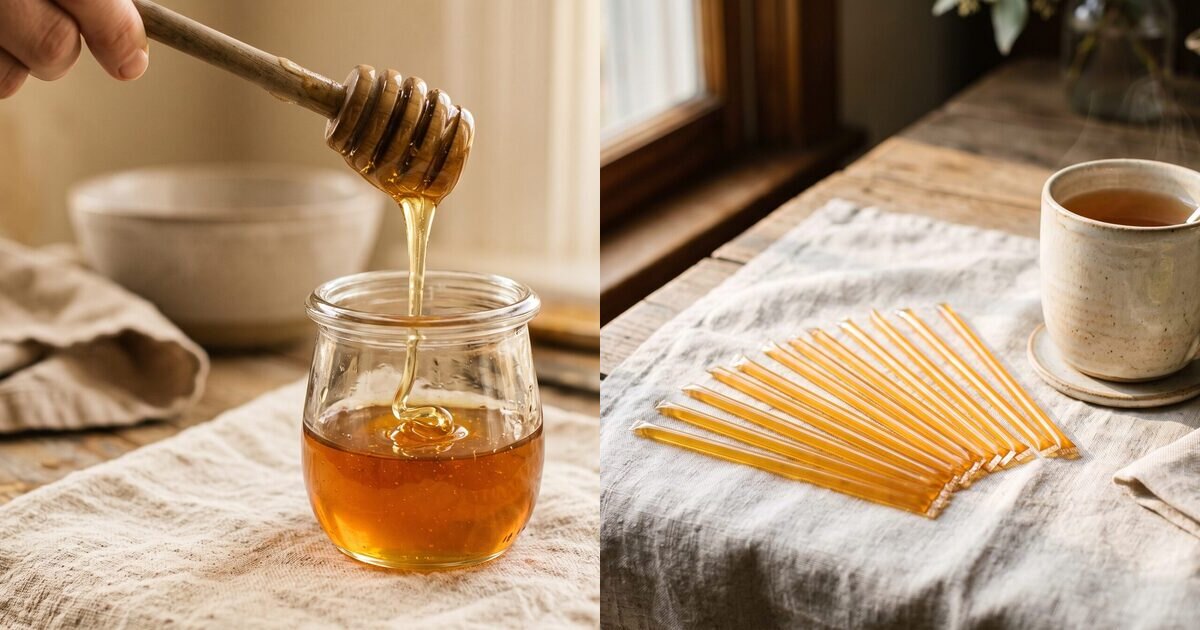
More than 159 million Americans drink tea on a typical day, and the country consumed about 85 billion servings in 2021 (Tea Association of the U.S.A., 2022). Yet the best honey for tea isn't one rare varietal. It is the honey whose flavor and package fit the cup you actually make.
For most home tea drinkers, a jar of raw wildflower honey offers the best balance of flavor, control, and price. Honey sticks win at a desk, in a hotel room, or anywhere a spoon and a sticky jar feel like too much trouble. This guide compares both formats using the same one-teaspoon serving, then matches them to black, green, herbal, and iced tea.
TL;DR: Choose jarred raw honey for your everyday kitchen cup because it costs less per serving and lets you adjust sweetness. Choose honey sticks for work, travel, and exact portions. At current catalog prices, a teaspoon from the 64 oz jar is about $0.21, while a 50-pack stick costs $0.50.
Best Honey for Tea: Quick Comparison
At prices checked on August 20, 2026, the 64 oz raw honey jar costs $0.86 per ounce, while the 50-pack of raw honey sticks costs $0.50 per stick. Both carry California wildflower honey. The meaningful difference is packaging, not a better or worse sweetener.
| Decision point | Raw honey jar | Raw honey sticks | Winner |
|---|---|---|---|
| Best setting | Home kitchen, tea station | Office, car, hotel, trail | Depends on setting |
| Portion control | Adjustable by the spoon | About one teaspoon each | Honey sticks |
| Estimated cost per cup | About $0.21 from 64 oz; $0.39 from 16 oz | $0.50 from a 50-pack | Jar |
| Mess risk | Needs a spoon and clean rim | Sealed single serving | Honey sticks |
| Flavor control | Easy to add half a teaspoon | Best in one-stick steps | Jar |
| Storage | One container | Individually sealed pieces | Jar at home; sticks away |
| Waste | One recyclable container | One small wrapper per serving | Jar |
| Best buyer | Daily tea drinker | Mobile or occasional tea drinker | Depends on habit |
A honey stick isn't a different class of honey. It solves a packaging problem. If both formats contain the same raw wildflower honey, the choice comes down to where you drink tea, how precisely you sweeten it, and whether convenience is worth roughly 10 to 29 cents more per cup.
What Is the Best Honey for Tea?
The National Honey Board counts more than 300 honey types in the United States (National Honey Board, 2020). For an all-purpose tea sweetener, choose a medium-flavored wildflower honey. It can support black tea and chai without burying lighter herbal blends when used sparingly.
Honey flavor follows the flowers available to the bees, so wildflower batches can shift by place and season. That variation is useful in tea. A brighter batch can lift mint or chamomile, while a darker harvest can stand beside Assam, Earl Grey, or masala chai. The three-honey comparison chart explains how wildflower, clover, and orange blossom differ.
Raw honey also gives buyers a clearer processing question to ask. USDA's recommended apiculture standards define raw honey as honey obtained by extraction, settling, or straining without added heat (USDA Agricultural Marketing Service, 2006). That doesn't make honey medicine, but it does make processing disclosure relevant.
Which Tastes Better: Jar Honey or Honey Sticks?
Black tea accounted for 84% of U.S. tea consumption in 2021, compared with 15% for green tea (Tea Association of the U.S.A., 2022). Jarred honey wins on fine flavor control because you can start with half a teaspoon. Sticks win when repeatable sweetness matters more than tiny adjustments.
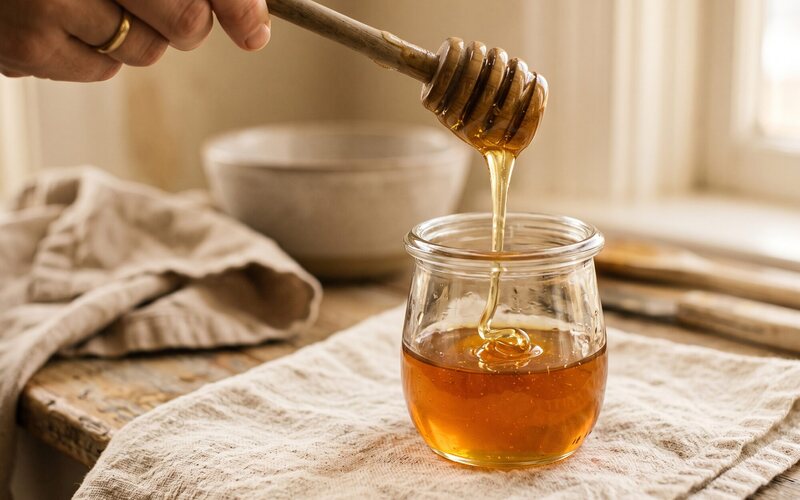
For a light green or white tea, start small. Half a teaspoon can soften bitterness without turning the cup into honey water. A full stick is better suited to a standard mug of black tea, chai, or a strongly brewed herbal blend.
Picture a quiet Sunday tasting: four small mugs, one pot of tea, and a jar in the center. The first cup gets no honey, the second gets half a teaspoon, and the last two get slightly more. That simple progression teaches your palate faster than any universal pairing list.
Verdict: the jar wins for flavor control. Sticks tie when the same one-teaspoon result every time is the goal.
Which Costs Less Per Cup?
U.S. honey prices rose 27% in 2025, reaching an average $3.05 per pound at the producer level (USDA National Agricultural Statistics Service, 2026). Against that market, the jar is still the value format: the largest current size works out to roughly $0.21 for a one-teaspoon cup.
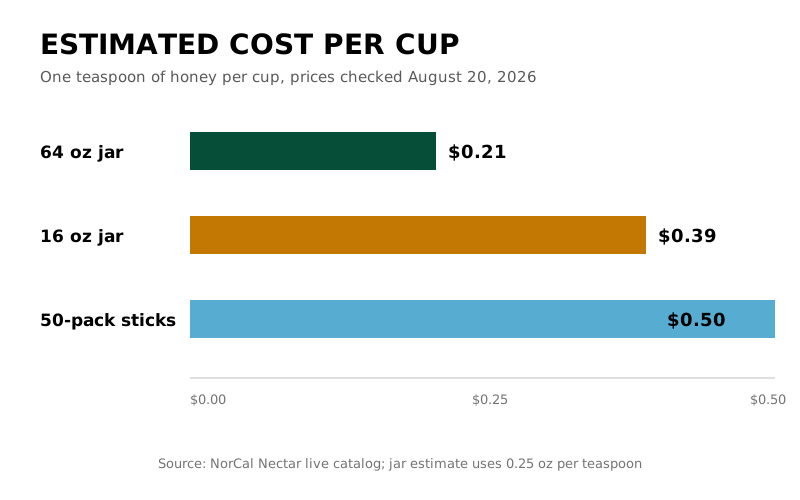
We used one approximate teaspoon per cup and current listed prices. The 16 oz jar at $24.99 lands near $0.39 per cup. The 64 oz jar at $54.99 lands near $0.21. A 50-pack at $24.99 is $0.50 per cup, while larger stick packs reduce that gap.
The jar's advantage grows with a daily habit. At one cup per day, saving 29 cents adds up to about $106 over a year. Still, a cheaper serving isn't cheaper if the jar sits unused at home while you buy sweetened drinks elsewhere.
Verdict: the jar wins on unit cost. Honey sticks sell convenience, not the lowest price.
Which Is Easier at Work or on the Road?
Each current raw honey stick contains approximately one teaspoon, and the listed packs range from 10 to 1,000 sticks (Pure Honey Sticks, accessed 2026). That sealed serving wins anywhere you don't control the kitchen. There is no spoon to wash, jar to carry, or rim to wipe.
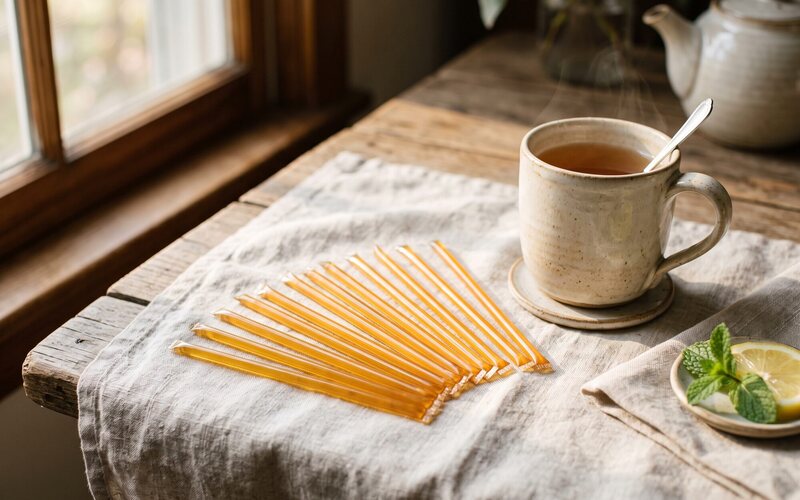
Imagine the 2:40 p.m. office cup. The shared kitchenette has tea bags and hot water, but the communal sugar bowl is crusted and the teaspoons are gone. One stick opens, empties into the mug, and disappears into a bag pocket until you find a bin. That is the job the format does best.
The jar remains simpler for a permanent tea station. One bottle uses less packaging per serving and lets several people choose their own amount. For the mechanics of opening, storing, and using sticks, see the complete honey-stick guide.
Verdict: sticks win for mobility. The jar wins when the tea setup stays put.
What Honey Goes With Each Tea?
With more than 300 U.S. honey types available, pairing intensity matters more than chasing a single "best" varietal (National Honey Board, 2020). Use less honey in subtle tea and a fuller serving in bold tea. Wildflower covers the widest range because its floral depth sits in the middle.
| Tea | Honey starting point | Why it works | Best format |
|---|---|---|---|
| Green or white | 1/2 teaspoon wildflower | Softens bitterness without hiding aroma | Jar |
| Earl Grey | 1/2 to 1 teaspoon | Floral notes support bergamot | Jar |
| English Breakfast or Assam | 1 teaspoon | Stands up to malt and milk | Either |
| Masala chai | 1 stick or 1 teaspoon | Matches spice intensity | Either |
| Chamomile or mint | 1/2 to 1 teaspoon | Adds roundness without needing sugar syrup | Jar |
| Travel tea bag | 1 stick | Exact serving with no spoon | Sticks |
| Iced tea | Honey syrup to taste | Diluted honey mixes into cold liquid faster | Jar |
Temperature and dilution often matter more than varietal. Honey doesn't mix quickly into a fully chilled drink, no matter how good it tastes. For iced tea, stir honey into a small amount of warm water first, then add it to the cold pitcher.
Does Hot Tea Ruin Raw Honey?
Heat effects depend on both temperature and time. In one study, honey held at 80°C (176°F) for 15 minutes showed a 62% rise in HMF and lower diastase activity, while the authors did not find major overall quality loss across every measure (Journal of Food Science and Technology, 2016). A quick stir is not prolonged processing.
For flavor, let boiling water brew the leaves first. Remove the bag or strain the tea, wait until the cup is comfortable to sip, then add honey. This protects delicate aroma and keeps you from scalding your mouth. It also avoids the unsupported claim that one exact temperature instantly "destroys" everything valuable in honey.
If your real goal is cough comfort, the evidence and portions differ from an everyday beverage. Use the dedicated honey lemon tea recipe instead of treating every cup as a remedy.
Verdict: add honey after brewing and a short cool-down. Don't panic over a normal hot cup.
How Much Honey Should You Put in Tea?
The American Heart Association recommends limiting added sugar to 25 grams per day for most women and 36 grams for men, and it explicitly includes honey as added sugar (American Heart Association, 2026). Start with half a teaspoon, taste, then add more only if needed.
A practical serving ladder works better than a rule:
- Brew the tea at the temperature suited to the leaves.
- Let it cool briefly after steeping.
- Add half a teaspoon from a jar for delicate tea.
- Use one full teaspoon or one stick for black tea, chai, or a larger mug.
- Count honey with the rest of the day's added sugar.
Honey brings flavor, but it doesn't get a free nutritional pass. Our honey versus sugar breakdown covers the tradeoff without pretending either sweetener is unlimited.
Choosing a Jar, Sticks, or Both
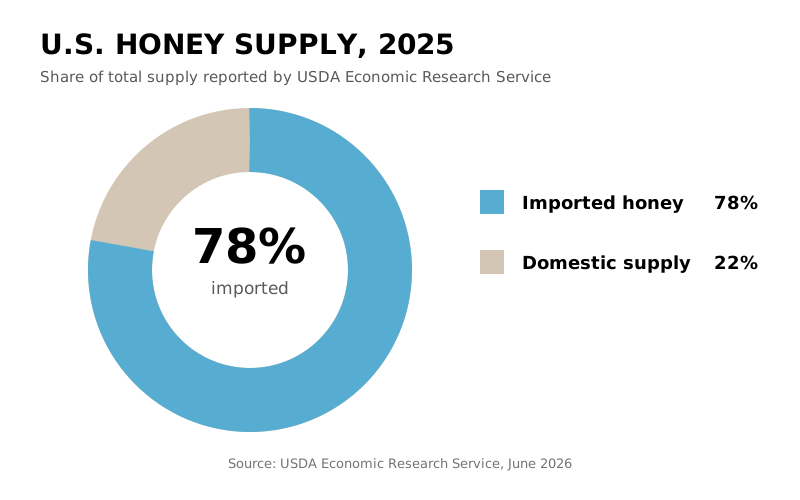
Americans used about 1.9 pounds of honey per person in 2025, and imported honey supplied 78% of the U.S. market (USDA Economic Research Service, 2026). Format and source are separate decisions. Choose the package for your routine, then check origin and processing before buying.
Daily home tea drinker: Choose a jar. You get the lowest cost per cup, less serving waste, and control over sweetness.
Commuter, traveler, or office tea drinker: Choose sticks. The higher unit cost pays for a clean, measured serving wherever hot water appears.
Household with both routines: Keep a jar beside the kettle and a small pack of sticks in the desk or travel bag. This is the practical overall winner because each format handles the setting where the other creates friction.
Buyer focused on source: Read the label and seller details. The raw honey buying checklist covers origin, processing, photos, and other trust signals before checkout.
Frequently Asked Questions
Honey is safe for most people over age one, but the FDA says never to feed it to a child under 12 months because of infant botulism risk (U.S. Food and Drug Administration, 2022). That rule applies to jarred honey, honey sticks, and honey stirred into tea.
Are honey sticks good for tea?
Yes. A standard honey stick provides about one teaspoon, which suits an ordinary mug of black tea, chai, or herbal tea. Its advantage is the sealed portion. For delicate green or white tea, a jar offers better control because half a teaspoon may be enough.
Is raw honey better than regular honey in tea?
Raw honey gives you clearer processing criteria and often more batch-specific flavor. USDA guidance defines it by extraction, settling, or straining without added heat. The best cup still depends on taste, source transparency, and how much you add, not the word "raw" alone.
Can I put a whole honey stick in one cup?
Yes. One stick is approximately one teaspoon, a sensible starting point for an 8 to 12 oz mug. Start with less when drinking subtle green or white tea. If you monitor added sugar, include the serving in your daily total.
What is the best honey for black tea?
Wildflower honey is a flexible match for black tea because its medium-to-bold floral flavor can stand beside Assam, English Breakfast, and Earl Grey. Start with one teaspoon. For a very delicate Darjeeling, begin with half that amount and taste before adding more.
Should I buy honey sticks or a jar first?
Buy a jar first if most cups happen at home. Buy sticks first if most cups happen at work or while traveling. If you drink tea in both places, a small stick pack plus the best-value jar covers both routines without forcing one package to do every job.
The Bottom Line
U.S. honey production fell 14% to 116 million pounds in 2025, even as producer prices rose 27% (USDA National Agricultural Statistics Service, 2026). That makes a clear buying rule useful: choose a value jar for daily cups and sticks where portability prevents you from using the jar.
For the best honey for tea at home, start with raw wildflower honey and adjust by the half teaspoon. For tea away from home, carry a stick. The honey can be the same; the right package is the one that removes friction from the cup you already drink.
Taste Northern California Raw Honey
Raw, unfiltered wildflower honey in 16, 32 and 64 oz. Never heated above 95°F, so the pollen and enzymes stay in.
16 oz · $24.99
Keep reading
Buyer Guides & Shopping
3 Honey Types Compared: Flavor, Uses & Buying Chart
Choose wildflower honey for bold, batch-variable flavor; clover for mild everyday sweetness; and orange blossom for a fragrant citrus note.
Buyer Guides
Honey Sticks: What They Are, How to Use Them, and Where to Buy
Honey sticks are single-serving tubes of pure honey sealed in a food-grade straw. This guide covers how to open them, the best types to try, creative uses, nutrition info, and where to find quality honey sticks online.
Recipes
Honey in Coffee: How to Do It Right
Honey can replace sugar in your daily coffee, but temperature, timing, and honey choice all matter. Here's how to do it right—plus creative honey coffee recipes.
Recipes
DIY Honey Lemon Tea for Colds
Raw honey is a natural cold remedy backed by real clinical data. Get our beekeeper-tested honey lemon tea recipe with variations for ginger, turmeric, ACV, and thyme -- plus the science behind why it works.
