
Couples with more than 100 guests spend an average of $560 on favors and wedding party gifts (The Knot, 2026). Honey sticks cover the same guest list for under $70. That's not a discount or a sale price, it's just what happens when the favor doesn't need a jar, a lid, a dipper, a ribbon, and an afternoon of assembly.
You already believe edible favors work better than trinkets. You're right, and the data backs you up. What most guides won't give you is the actual arithmetic: how many you need, which pack sizes cost least, what the display looks like, and when to order. This guide covers all of it, with our own pricing shown openly so you can check the math.
TL;DR: Honey sticks run $0.30 to $0.70 each depending on pack size, landing below the $1 to $5 per favor that couples typically spend (The Knot, 2026). A 100-guest wedding costs about $52 in sticks versus a $560 category average. No assembly, no breakage, no expiration date.
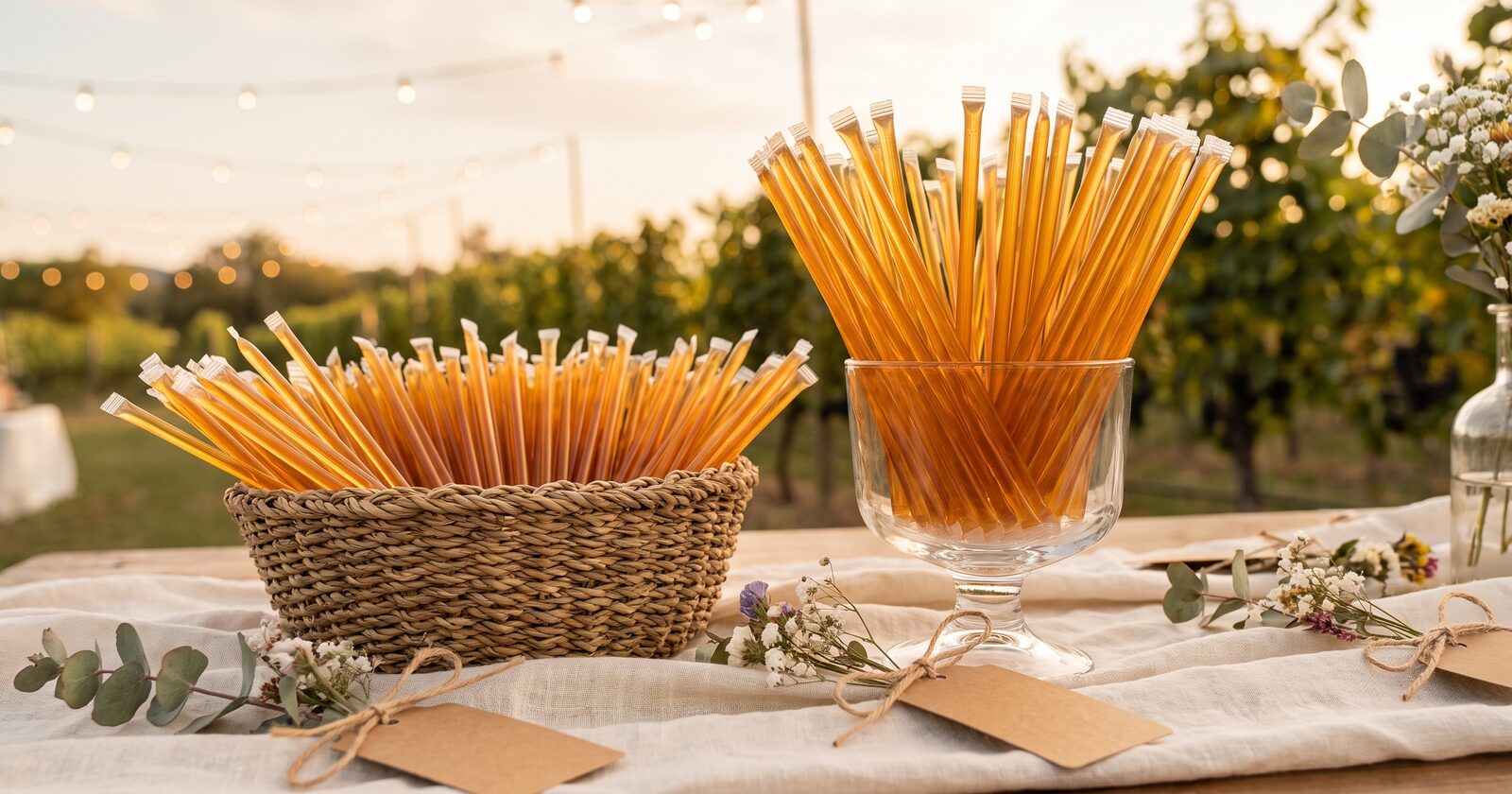
How Much Do Honey Stick Wedding Favors Cost?
Honey sticks cost between $0.30 and $0.70 each, with the price per stick falling as pack size climbs. Couples typically spend $1 to $5 per favor (The Knot, 2026), so even our smallest 10-pack comes in under the bottom of that range. Here's the full tier structure.
| Pack size | Price | Per stick |
|---|---|---|
| 10 Pack | $6.99 | $0.70 |
| 25 Pack | $14.99 | $0.60 |
| 50 Pack | $24.99 | $0.50 |
| 100 Pack | $44.99 | $0.45 |
| 250 Pack | $99.99 | $0.40 |
| 500 Pack | $179.99 | $0.36 |
| 1000 Pack | $299.99 | $0.30 |
Live per-stick figures for every tier are on the bulk honey sticks page, which reads them straight from the store rather than repeating them here where they can go stale.
The jump worth noticing is between the 50-pack and the 250-pack. Going from $0.50 to $0.40 per stick sounds small until you multiply it across 200 guests, where it's the difference between a favor line item and a rounding error.
How many do you need?
You need 100 sticks. The cheapest way to cover that from current stock:
- 1 × 100 Pack ($44.99 each)$44.99
- Total
- $44.99
- Per guest
- $0.45
- Per stick
- $0.45
Exact coverage, no spares. Orders under $50 pay flat-rate shipping.
Choose these pack sizesHow Many Sticks Do You Need for Your Guest Count?
Plan on one stick per guest plus a 10% buffer. The average US wedding hosts 117 guests (The Knot, 2026), which means budgeting for 129 sticks rather than 117. The buffer absorbs plus-ones you didn't count, the guests who take two, and the handful that end up in a flower girl's pocket.
Honey sticks avoid the awkward math that trips up other favors. There's no "one per couple" ambiguity, because a stick is small enough that nobody feels greedy taking their own. Here's what four common wedding sizes actually cost:
| Guests | Sticks needed | Pack combination | Total | Per guest |
|---|---|---|---|---|
| 50 | 55 | 50 + 10 | $31.98 | $0.64 |
| 100 | 110 | 100 + 10 | $51.98 | $0.52 |
| 150 | 165 | 100 + 50 + 10 + 10 | $83.96 | $0.56 |
| 200 | 220 | 250 | $99.99 | $0.50 |
We built that table by pricing every pack combination that clears each guest count and keeping the cheapest one. It's worth doing yourself rather than defaulting to a single large pack. At 150 guests, for instance, a 250-pack costs $99.99 while stacking a 100, a 50, and two 10-packs covers you for $83.96, saving $16 and leaving fewer leftovers.
Honey Sticks vs. Mini Jars vs. Other Edible Favors
Mini honey jars, the closest competitor to sticks, run $1.50 to $4.00 per guest (Huckle Bee Farms, 2026; Paperlust, 2026). That's three to eight times the cost of a stick for the same product inside. What you're paying for is the glass, the lid, the label, and the labor.
Cost isn't the only axis, though. Here's how the practical differences stack up:
| Honey sticks | Mini honey jars | Cookies or baked goods | |
|---|---|---|---|
| Cost per guest | $0.30-$0.70 | $1.50-$4.00 | Varies widely |
| Assembly required | None | Fill, seal, label, tie | Bake, cool, wrap |
| Breakage risk | None | Glass, ships heavy | Crumbles |
| Shelf life | Indefinite | Indefinite | Days |
| Order lead time | Ships as stock | Often made to order | Days before |
| Dietary friction | Vegetarian, gluten-free, nut-free | Same | Allergens common |
The one place mini jars win is presence. A 4oz jar looks like a bigger gift sitting at a place setting. If your reception leans formal and the favor is doing visual work on the table, that heft matters. For everything else, sticks do the same job for a fraction of the cost.
What Do Wedding Guests Actually Take Home?
Only 51% of couples provide favors at all (The Knot, 2026), and a big reason is the widespread suspicion that favors get abandoned. That suspicion is well founded for trinkets. Edible favors are the most popular category precisely because they get consumed rather than left behind (Zola).
Consider what a personalized coaster asks of a guest. It has to survive the night, fit in a clutch or a jacket pocket, then earn permanent space in a home that already has coasters. A honey stick asks for none of that. It goes in a pocket, and it either gets eaten in the car or dropped in a tea mug on Monday morning.
We saw this play out with a customer who ordered 250 sticks for an October wedding in Nevada County, then emailed a week later slightly annoyed: the display basket was empty before dinner service started, and she'd watched several guests take three. She asked whether we thought she should have ordered more. The honest answer is that running out because people wanted seconds is a considerably better outcome than the alternative, which is boxing up 60 unclaimed favors at midnight.
The wider context is worth keeping in view. The average wedding now costs $34,200 across 10,474 couples surveyed, working out to $292 per guest (The Knot Worldwide, 2026). Against that, the favor is a rounding error either way. The question isn't whether you can afford $560 of favors. It's whether $560 of favors does anything $52 of favors doesn't.
What Should You Look For in a Favor Honey Stick?
Not every honey stick contains only honey. The category ranges from raw single-source honey to corn syrup tinted amber and dosed with artificial flavoring, and the packaging rarely makes the difference obvious. Since you're handing these to a hundred people who will associate them with your wedding, the ingredient panel is worth thirty seconds of attention.
Five things separate a good favor stick from a cheap one:
- A one-ingredient label. It should say honey, and nothing else. Flavored sticks commonly list added sugar or "natural and artificial flavors" alongside a minority share of actual honey.
- Raw rather than heavily processed. Raw honey keeps its pollen, enzymes, and floral character. Ultra-filtered commodity honey is sweeter and flatter, and it's the grade most bulk favor sellers buy.
- Both ends properly heat-sealed. A weak seal leaks into a gift bag or a jacket pocket. This is the single most common complaint about bargain sticks.
- A full teaspoon of fill. Roughly 5 to 7 grams is standard. Some discount sticks run noticeably thinner for the same headline price per unit.
- Clear country of origin. Honey adulteration is a persistent problem in the import market, which is why our guides on reading honey labels and whether grocery store honey is real exist in the first place.
Our sticks are filled with raw honey from our Northern California apiaries, unheated and unfiltered, which is why they occasionally crystallize and why they taste like the forage rather than like generic sweetness. That's the tradeoff worth understanding: a commodity stick will always look identical in the basket and cost a little less, and it will taste like sugar.
One caution on flavored sticks specifically. They're popular for kids' parties and they photograph well in a rainbow of colors, but at a wedding they read as candy rather than as something from a farm. If the story you want the favor to tell is local and agricultural, plain honey tells it better.
How Do You Display and Label Honey Stick Favors?
Skip individual assembly. This is the part that saves more than the money does. A mini-jar favor needs filling, sealing, labeling, and tying, repeated once per guest. Honey sticks arrive sealed and ready, so the entire setup is standing them upright in a vessel and putting a card beside it.
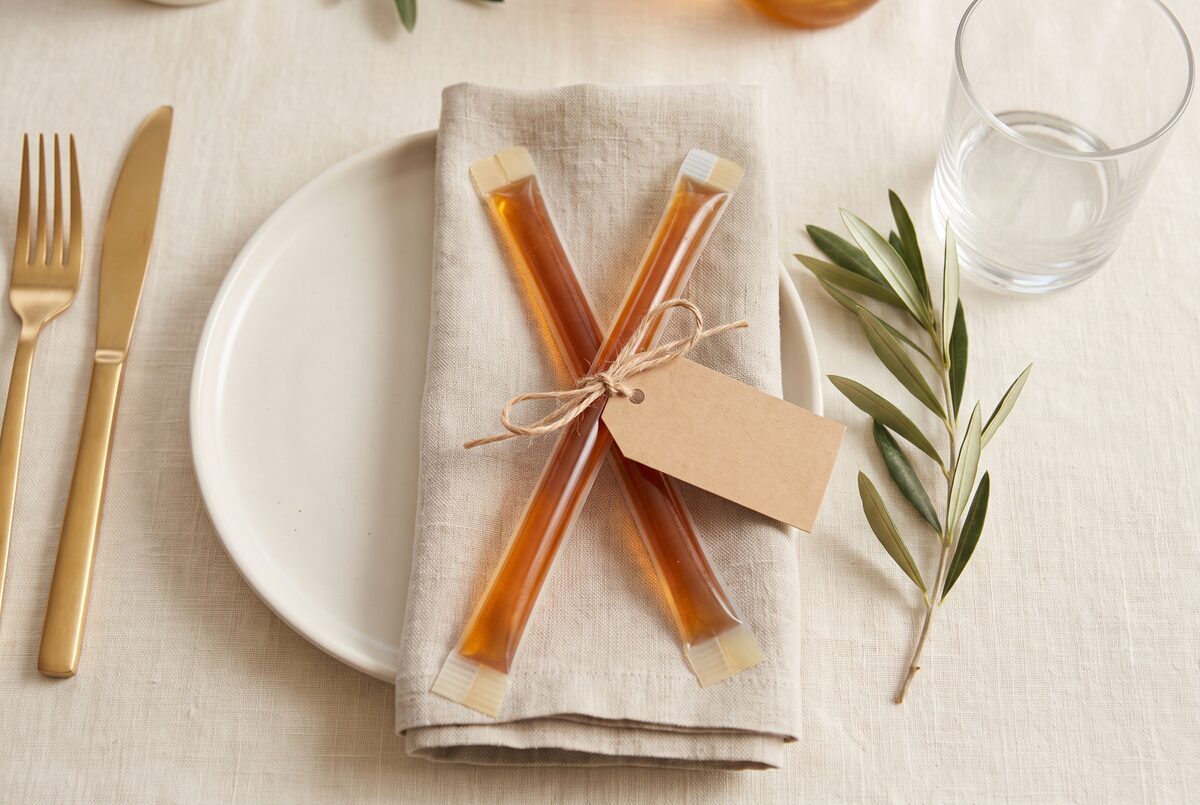
Three display approaches work well:
- The bulk vessel. Stand sticks upright in a shallow basket, a footed glass compote, or a wide mason jar near the escort cards. Guests self-serve. Setup takes five minutes.
- The place setting. Lay one stick across each folded napkin, optionally tied to a tag. This looks intentional and doubles as a place marker, but it adds handling time across every seat.
- The favor bar. Offer two or three varietals side by side with a small card describing each. This turns the favor into a small tasting moment, and it works especially well if you're already serving tea or coffee.
For labeling, one printed card at the vessel does the work of 130 individual tags. Something as simple as "A little sweetness from our hive to your home, thank you for celebrating with us" is enough. If you want tags on each stick, use blank kraft tags and thin twine, and budget roughly an hour per 100 sticks. That hour is real, and it's the hidden cost most favor guides leave out of their totals.
One practical note: honey crystallizes over time, and a crystallized stick is still perfectly good honey. If your sticks arrive looking cloudy or grainy after a cold shipment, that's a sign the honey is raw rather than a defect. Warm water brings it back. Our guide on why raw honey crystallizes covers the full explanation if a guest asks.
When Should You Order Wedding Favors?
Order two to three months out, and order early rather than late. Honey stored sealed between 50 and 70 degrees F has an indefinite shelf life, per USDA storage guidance, so there's no freshness argument for waiting. Archaeologists have recovered 3,000-year-old honey from Egyptian tombs that was still edible, which is a slightly absurd but genuinely useful fact when you're deciding how early to buy.
Our own handling time is one business day, and standard transit runs about two to seven business days within the US, so the physical minimum is roughly two weeks including a safety margin. Two to three months is not about the honey — it is about you, and about congestion.
The real reason to order early is congestion. About 76% of US weddings happen between May and October, with October and June each accounting for 16% of the annual total (Love & Lustre, 2026). Every vendor in the chain is busiest exactly when you need them. Ordering a shelf-stable favor in March for a September wedding removes one moving part from the month when you'll have the least patience for moving parts.
This is where honey has a structural advantage that cookies, macarons, and anything refrigerated simply can't match. You can buy it whenever it's convenient, store it in a closet, and forget about it. Our post on whether raw honey expires goes deeper on the storage science.
Shipping Weight, Breakage, and the Hidden Costs of Jar Favors
Here's a comparison nobody publishes, so we ran it ourselves. A 100-guest wedding needs about 110 favors. In honey sticks, that's roughly 1.7 pounds of product, because each stick holds about a teaspoon of honey, which is close to 7 grams. In 4oz jars, the same 110 favors carry 27.5 pounds of honey plus roughly 24 pounds of glass, for a shipping weight near 50 pounds.
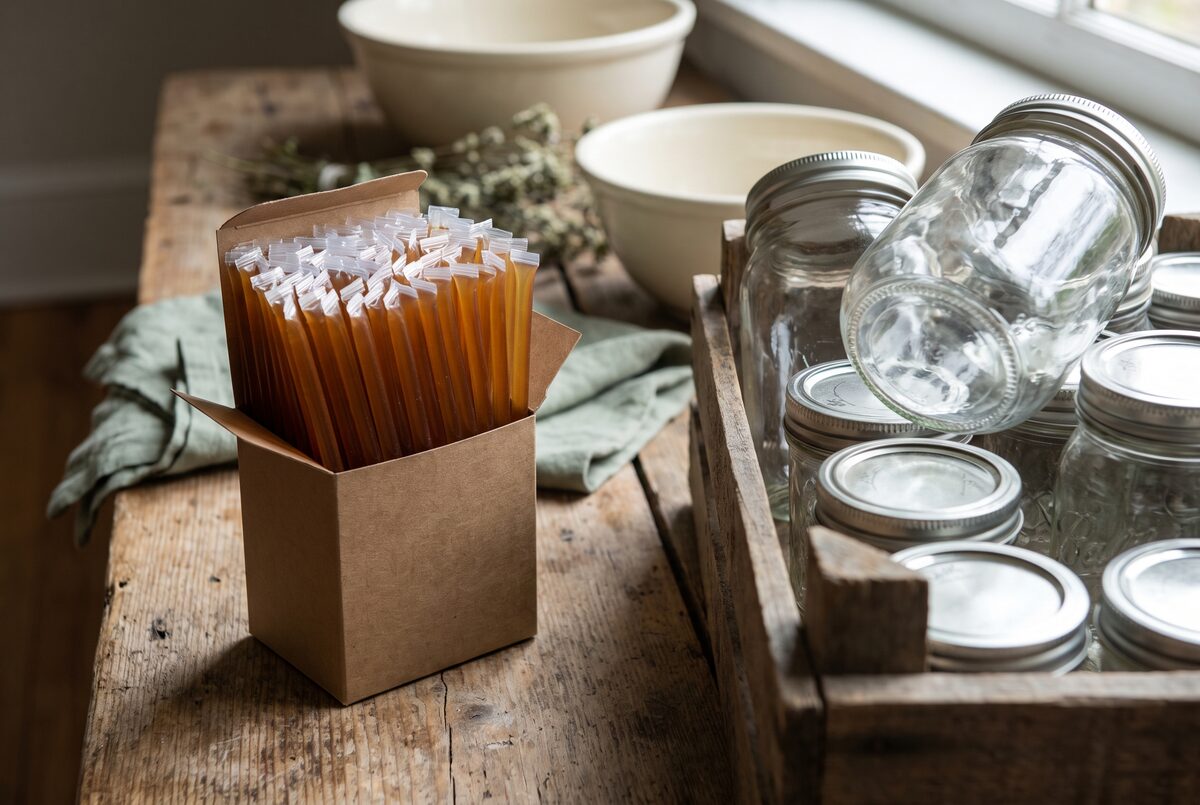
That's about a 30-fold difference in what has to be boxed, shipped, carried into a venue, and set up. It shows up in three places on your budget and your wedding day:
- Shipping cost. Freight scales with weight. Fifty pounds of glass costs meaningfully more to move than under two pounds of straws.
- Breakage. Glass jars arrive broken sometimes, which is why jar favor guides tell you to order extras. Sticks don't have that failure mode, so your 10% buffer is purely for guest behavior.
- Venue logistics. Somebody carries the favors in. Usually that somebody is a family member on the morning of, and one box beats four crates.
Beyond Weddings: Showers, Corporate Events, and Party Favors
Roughly 2.04 million weddings take place in the US each year (Giggster, 2026), but weddings are only part of where favor-sized honey ends up. The same math applies anywhere you need a hundred-plus small, shelf-stable, allergen-friendly gifts.
Bridal and baby showers usually land in the 20 to 50 guest range, which the 50-pack covers cleanly. Corporate gifting and client appreciation tend to run larger, and that is where the 500 and 1000-packs earn their pricing: a sales team tucking a stick into each order confirmation, a hotel putting one on the turndown tray, a clinic keeping a bowl at reception. Same product, same maths, different address.
At the 1000-pack's per-stick price, putting two sticks in every client mailing costs about 60 cents a client. That is arithmetic on the tier above, not a case study — we are not going to invent a customer to illustrate it.
For quantities beyond the 1000-pack, or for a repeating schedule, use the wholesale enquiry form. Tell us the quantity and how often, and you will get a straight answer about what we can actually supply — we are a small operation, and an honest no is more use to you than an optimistic yes.
Compare every pack size and cost per stick
For smaller multi-product gifting, our honey gift guide and the honeycomb cheese board both work as starting points.
Frequently Asked Questions
How many honey sticks do I need for 100 wedding guests?
Plan on 110 sticks for 100 guests, which is one per guest plus a 10% buffer. A 100-pack combined with a 10-pack covers it for $51.98. The buffer accounts for uncounted plus-ones and guests who take a second stick, which happens more often than couples expect.
Are honey sticks a good wedding favor?
Yes, for most weddings. Edible favors get consumed rather than abandoned (Zola), and honey sticks are vegetarian, gluten-free, and nut-free, so they clear nearly every dietary restriction. They also need no assembly, which saves hours over jar favors.
How much do wedding favors cost per guest?
Couples typically spend $1 to $5 per favor, with total favor and wedding party gift spending averaging $480 (The Knot, 2026). Weddings under 50 guests average $330, while those over 100 guests average $560. Honey sticks run $0.30 to $0.70 per guest depending on pack size, so a 100-guest wedding lands near $52 rather than $560, and the gap widens as the guest list grows.
Do honey sticks expire before the wedding?
No. Honey stored sealed between 50 and 70 degrees F keeps indefinitely, so sticks bought months ahead are fine on the day. Order two to three months out to avoid peak-season shipping congestion between May and October, when 76% of US weddings take place.
Can I put my names or wedding date on honey sticks?
Not on the stick itself, but you can tie a blank kraft tag to each with twine, or place one printed card at the display vessel. The single-card approach takes five minutes instead of the hour per 100 sticks that individual tagging requires, and guests read it just as well.
The Bottom Line
Honey sticks work as wedding favors because they remove cost and labor at the same time. A 100-guest wedding spends about $52 instead of a $560 category average, skips the assembly entirely, carries no breakage risk, and can be ordered in March for a September date without a second thought.
The tradeoff is presence. If your favor needs to look substantial sitting at a formal place setting, a 4oz jar does that better, and you should pay for it knowingly. For everything else, the stick delivers the same honey with none of the overhead.
If you're weighing varietals, our guide to honey types by flower covers how flavor shifts by nectar source, and raw versus clover honey explains the difference between the two styles most often used in sticks. New to the format entirely? Start with what honey sticks are and how to open them. Buying at volume for something other than a wedding? Our bulk honey guide covers larger formats.
Price Out a Bulk Order
Compare the 100, 250, 500 and 1000 packs side by side, work out cost per stick, and size the order to your guest or headcount.
500 Pack · $179.99
Keep reading
Buyer Guides
Best Honey Gifts 2026: Ideas by Budget and Recipient
A practical honey gift guide: what to give under $15, $15-$40 and $40+, what suits a foodie, a tea drinker, a host, a coworker or a beekeeper, how to wrap it, and when to order so it arrives in time.
Buyer Guides
Honey Sticks: What They Are, How to Use Them, and Where to Buy
Honey sticks are single-serving tubes of pure honey sealed in a food-grade straw. This guide covers how to open them, the best types to try, creative uses, nutrition info, and where to find quality honey sticks online.
Buyer Guides
Honey Sticks for Tea and Coffee: Serving Size, Cost and Best Uses
A honey stick holds roughly one teaspoon of honey, which is one cup of tea or coffee. This guide works out the actual cost per cup at every pack size, covers hot versus iced, and compares wildflower against clover for drinks.
Raw Honey Benefits & Education
Why Does Raw Honey Crystallize? (And Does Honey Ever Expire?)
Crystallized honey is normal, safe and reversible, and sealed honey doesn't really expire. Here's the science, the safe way to re-liquefy a jar, the one thing that actually spoils honey, and how to store it.
