
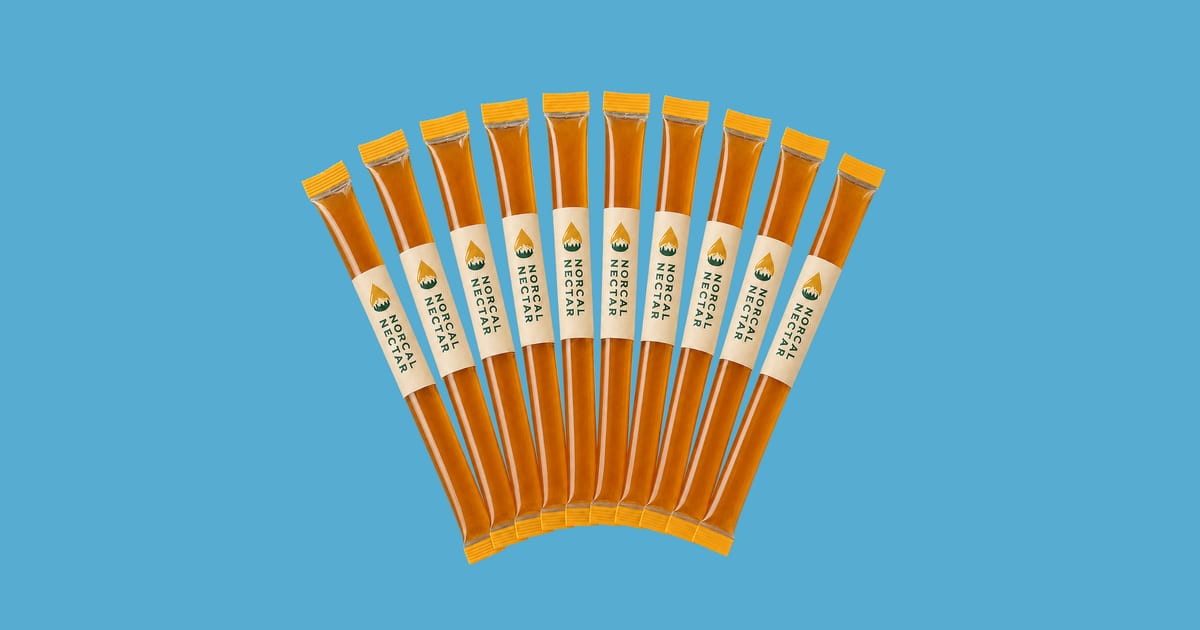
One honey stick holds about a teaspoon of honey. That is one cup of tea or one cup of coffee, which is the whole reason the format exists — you get a fixed portion without a jar, a spoon or a sticky lid.
This guide covers what a stick actually delivers, what it costs per cup at each pack size, how sticks behave in hot versus iced drinks, and where wildflower and clover honey differ once they hit hot water.
TL;DR: A honey stick is roughly 5-7 g of honey — about one teaspoon, the same sweetening job as a standard sugar packet. Cost per cup runs from about 30 cents in the largest pack to about 70 cents in the smallest. Sticks are worth it for desks, travel, hotel trays and break rooms, where a jar is impractical. At home, a jar is cheaper per ounce and you should use one.
How much honey is in one stick?
About one teaspoon — roughly 5 to 7 grams depending on the fill. For comparison:
| Portion | Weight | Carbohydrate |
|---|---|---|
| 1 honey stick | ~5-7 g | ~4-6 g |
| 1 teaspoon of honey | ~7 g | ~6 g |
| 1 tablespoon of honey | ~21 g | ~17 g |
| 1 standard sugar packet | ~4 g | ~4 g |
Honey is about 82% sugar by weight, and roughly 17 g of carbohydrate per tablespoon (USDA FoodData Central). So one stick and one sugar packet are doing a comparable job in the mug. Three sticks make up about a tablespoon, which is the figure to use when a recipe calls for honey by volume.
Honey is sweeter than table sugar by weight, mostly because of its fructose content, so many people find one stick sweetens a mug that would otherwise take a heaped teaspoon of sugar. That is a taste observation, not a nutrition claim: honey is still added sugar, and the Dietary Guidelines for Americans count it as one.
How many do you need?
You need 100 sticks. The cheapest way to cover that from current stock:
- 1 × 100 Pack ($44.99 each)$44.99
- Total
- $44.99
- Per people
- $0.45
- Per stick
- $0.45
Exact coverage, no spares. Orders under $50 pay flat-rate shipping.
Choose these pack sizesWhat does a honey stick cost per cup?
This is the number that decides whether sticks make sense for you, and it depends entirely on pack size. Because one stick equals one cup, cost per stick is cost per cup.
| Pack | Price | Cost per cup |
|---|---|---|
| 10 Pack | $6.99 | $0.70 |
| 25 Pack | $14.99 | $0.60 |
| 50 Pack | $24.99 | $0.50 |
| 100 Pack | $44.99 | $0.45 |
| 250 Pack | $99.99 | $0.40 |
| 500 Pack | $179.99 | $0.36 |
| 1000 Pack | $299.99 | $0.30 |
For context, a 16 oz jar of the same raw honey works out at roughly 6 cents per teaspoon. Sticks cost around seven times more per unit of honey. That premium buys portability and portion control, and it is only worth paying where those actually matter.
So the honest rule is:
- At home, use a jar. Nothing about a stick improves a mug of tea at your own kitchen table.
- Away from home, use sticks. Desk drawer, travel kit, hotel room, campsite, car — anywhere a jar would be absurd.
- For other people, use sticks. Break rooms, waiting rooms and beverage stations, where a shared jar becomes a hygiene and mess problem within a week.
Hot drinks
Drop the stick in, snap or bite one end, squeeze, and stir. In a hot drink the honey dissolves immediately.
A few practical points:
- Heat changes raw honey. Stirring raw honey into near-boiling water will degrade some of its enzymes. If that matters to you, let the tea cool to drinking temperature first. If it does not matter to you, it genuinely does not — the sweetness and the flavour survive either way.
- Coffee is a harder match than tea. Honey has its own floral character, and in a dark roast it can read as muddy. It works better in lighter roasts, in cold brew, and in anything with milk. Our guide on honey in coffee goes into which roasts take it best.
- Do not add honey to a drink you are about to reheat repeatedly. Nothing dangerous happens; the flavour just flattens.
Iced drinks
Honey does not dissolve well in cold liquid — it sinks and sits at the bottom of the glass in a rope. Two ways around it:
- Squeeze the stick into a small splash of hot water first, stir until it is a thin syrup, then pour that over ice.
- Squeeze it in before the ice, while the base liquid is still at room temperature, and stir hard.
For iced tea and lemonade in quantity, making a honey syrup ahead is easier than doing this per glass — but for a single glass, a stick and a teaspoon of hot water is quicker than getting a jar out.
Where honey sticks earn their premium
Desk drawers. A jar at a desk becomes a lid you have to touch with sticky fingers. A box of sticks does not. This is the single most common repeat use we see.
Travel kits. Sticks weigh almost nothing and do not leak. On carry-on: the TSA treats honey as a liquid, so it counts toward the 3.4 oz container rule in principle. In practice a few sticks are well under that and travellers rarely report problems, but the officer at the checkpoint has the final say. In checked baggage there is no issue at all.
Hotel beverage stations and in-room trays. A single-serve sweetener that is not a sugar packet, and that does not leave a shared, half-crystallised jar on the tray.
Café counters. Consistent portioning without a barista measuring, and no open jar sitting in the service area.
If you are buying for a business rather than a household, the bulk honey stick page has the per-stick maths for every size, and the wholesale enquiry form is the right route for recurring orders.
Wildflower or clover for drinks?
The two styles behave differently in a mug.
Wildflower honey comes from whatever is blooming, so its flavour shifts by season and region. Northern California wildflower honey tends to be darker and more assertive — noticeably floral, sometimes with a slightly savoury or herbal edge. In tea it is a flavour ingredient, not just a sweetener. It stands up well in strong black tea, chai and herbal infusions. In a delicate green or white tea it can dominate.
Clover honey is milder, lighter and closer to what most people picture when they picture honey. It sweetens without adding much character of its own. That makes it the safer default for green tea, white tea, and for a break room where you do not know what everybody is drinking.
Neither is better. If you want the honey to taste of somewhere, take wildflower. If you want the tea to taste of tea, take clover. Our wildflower versus clover comparison covers the difference in more depth.
One thing to be aware of: our clover honey sticks are filled with US Grade A clover honey from a supplier. They are not raw, and they are not from our own hives. The wildflower sticks are. We keep those two things clearly separated rather than letting one product borrow the other's provenance.
Storage
Keep sticks at room temperature, out of direct sun. They do not need refrigerating, and cold storage makes them harder to squeeze.
If a stick feels grainy, the honey has crystallised. That is normal for real honey and is not a fault — warm it in your hand for a minute or drop it straight into a hot drink and it clears. Processed honey cut with syrup crystallises far less readily, so graininess is mildly reassuring.
Honey does not spoil while it stays sealed and dry. The sealed straw is doing the same job a closed jar lid does.
Frequently asked questions
How many honey sticks equal a teaspoon?
One. A stick holds roughly 5-7 g of honey, which is about a level teaspoon. Three sticks make up about a tablespoon.
Is a honey stick healthier than a sugar packet?
Not meaningfully. A stick is a slightly larger portion of a different sugar with more flavour and trace amounts of enzymes, antioxidants and minerals. Those trace compounds are real but the quantities in one teaspoon are small. Treat a honey stick as what it is: added sugar.
Can I use honey sticks in iced coffee?
Yes, but dissolve the honey in a splash of hot water first. Squeezed straight into a cold drink it will sink and sit at the bottom.
Are honey sticks safe for children?
Not under 12 months — honey can contain Clostridium botulinum spores that an infant gut cannot yet handle (CDC). This applies to raw and pasteurised honey equally. Above 12 months, a honey stick is a teaspoon of sugar and should be treated as one. Our lunchbox guide covers portions and age safety in more detail.
How many should I buy for an office?
Work backwards from cups, not people. A ten-person office where half of them take honey in one drink a day gets through roughly 25 sticks a week — a 100-pack lasts about a month. The calculator on this page will size it for you.
Do honey sticks work for hot chocolate?
They do, but honey and cocoa fight a little. A mild clover stick disappears into it more cleanly than an assertive wildflower one.
The bottom line
A honey stick is one cup of tea, priced between 40 and 70 cents depending on how many you buy. That is more per ounce than a jar and always will be — you are paying for the packaging, not better honey.
Buy sticks for the places a jar cannot go: a desk, a bag, a hotel tray, a break room, a counter. Buy a jar for your own kitchen. Most people who use both end up with exactly that split.
Shop Raw Honey Sticks
One teaspoon of raw Northern California wildflower honey per straw, sealed and mess-free. Seven pack sizes, from 10 up to 1000.
50 Pack · $24.99
Keep reading
Buyer Guides
Honey Sticks: What They Are, How to Use Them, and Where to Buy
Honey sticks are single-serving tubes of pure honey sealed in a food-grade straw. This guide covers how to open them, the best types to try, creative uses, nutrition info, and where to find quality honey sticks online.
Buyer Guides
Honey Sticks for Lunchboxes: Portions, Age Safety and Mess-Free Pairings
Honey sticks pack flat and do not leak, which makes them easy lunchbox additions. This covers the one hard age rule, what a stick actually contains, how it fits against daily added-sugar limits, and pairings that survive a school bag.
Recipes
Honey in Coffee: How to Do It Right
Honey can replace sugar in your daily coffee, but temperature, timing, and honey choice all matter. Here's how to do it right—plus creative honey coffee recipes.
Buyer Guides & Shopping
Best Honey for Tea: Jar vs Honey Sticks (2026)
Jarred raw honey gives daily tea drinkers the best value and control. Honey sticks trade a little cost for a clean, measured serving wherever you brew.
