
Do not give honey in any form — including honey sticks — to a child under 12 months. Honey can contain Clostridium botulinum spores, and an infant's gut cannot yet handle them. This applies to raw and pasteurised honey equally; pasteurisation does not reliably destroy the spores. Source: CDC, Botulism Prevention.
With that stated first, because it is the only part of this article that is not a matter of preference: honey sticks work well in a lunchbox for the same reason they work in a bag or a desk drawer. They lie flat, they do not leak, and the portion is fixed at about a teaspoon whether the child is five or fifteen.
They are also a sweet. This guide treats them as one.
TL;DR: One stick is roughly 5-7 g of honey — about 20 calories, all of it sugar. Never under 12 months. Above 12 months it counts toward daily added sugar, which the American Heart Association puts at under about 25 g a day for ages 2-18. Sticks pair well with plain yoghurt, apple, nut butter and crackers; keep them out of anything that needs refrigerating hard, since cold makes them stiff.
The one hard rule: 12 months
Infant botulism is rare but serious, and honey is its best-documented food source. The rule is absolute and simple:
- Under 12 months: no honey. Not raw, not pasteurised, not baked into something, not "just a taste".
- 12 months and over: the botulism risk has passed. Honey becomes an ordinary sugary food.
The CDC and the NHS both state this without qualification, and the FDA advises the same. It is not a raw-honey issue and it is not a brand issue — it applies to every honey product sold anywhere.
If honey sticks are going into a shared setting — a classroom snack box, a party bag, a favour table at an event where babies may be present — put the warning on the container. One printed line does the job.
What is actually in one stick
| Per honey stick | |
|---|---|
| Honey | ~5-7 g |
| Calories | ~20 |
| Carbohydrate | ~4-6 g, all sugars |
| Protein | 0 g |
| Fat | 0 g |
| Sodium | 0 mg |
| Ingredients | Honey |
Honey is roughly 82% sugar by weight and carries about 17 g of carbohydrate per tablespoon (USDA FoodData Central). A stick is about a third of a tablespoon.
Raw honey also contains trace enzymes, antioxidants and minerals. Those are real, but the quantity in one teaspoon is small enough that they are not a reason to give a child honey. Nobody should be eating honey for its micronutrients.
How a stick fits against daily sugar limits
The American Heart Association recommends that children aged 2 to 18 keep added sugars under about 25 g (6 teaspoons) a day, and that children under 2 have no added sugar at all.
One honey stick is about 5 g of sugar. So:
- Under 2: not appropriate as an added sugar, even though it is safe from a botulism standpoint after 12 months.
- Ages 2-18: one stick is roughly a fifth of the daily allowance. That is a normal-sized treat, comparable to a small biscuit, and it leaves room for the rest of the day.
- Two or three sticks in a single lunchbox is most of a day's added sugar in one sitting. One is the sensible number.
This is the honest framing, and it is why this article does not call honey sticks a "healthy snack". They are a controlled portion of a sweet food. The portion control is genuinely the advantage — a child serving themselves from a squeeze bottle does not stop at a teaspoon.
Storage and opening
Storage. Room temperature, out of direct sun. Sticks do not need refrigerating. A cold stick is stiff and much harder for small hands to squeeze, so avoid packing them right against an ice pack.
Crystallisation. If a stick feels grainy, the honey has crystallised. It is fine to eat, and it is mildly reassuring — honey that has been cut with syrup crystallises far less readily. Rolling it between warm hands for a minute usually clears it.
Opening. The straw is heat-sealed at both ends. Adults tend to bite one end like a sunflower seed or flip the seal open with a thumbnail. For younger children, snip the end with scissors before it goes in the lunchbox — a clean cut is easier to squeeze and less likely to end in a burst straw. Snip one end only, and pack it snipped-end-up.
Waste. The empty straw is small enough to lose in a bag. Worth a word with a child about putting it back in the box rather than in the playground.
Pairings that survive a school bag
Honey sticks are a component, not a snack on their own. What works:
- Plain yoghurt. The obvious one. A pot of unsweetened yoghurt plus one stick gives you control over the sugar in a way that a pre-sweetened pot does not.
- Apple or pear slices. Squeeze the stick into a small pot as a dip. Toss the slices in a little lemon juice first so they do not brown.
- Nut butter on wholemeal. Honey and peanut butter is a classic for a reason. Check your school's nut policy first.
- Plain crackers and a mild cheese. Honey with cheese works as well in a lunchbox as it does on a board.
- Porridge or overnight oats. Squeeze it in at the table rather than the night before, so it does not all sink.
- Warm milk in a flask. Stir the stick in when the flask is opened.
What to avoid:
- Anything already sweetened. A flavoured yoghurt plus a honey stick is two portions of added sugar pretending to be one.
- Dipping directly into a shared pot. Squeeze into an individual pot instead.
- Packing them loose with a leaky drink. The straws are sealed, but a wet lunchbox makes them unpleasant to handle.
Buying for a class or a group
If you are stocking a classroom, a scout hut or a party bag rather than one lunchbox, buy by the pack rather than by the box:
- A class of 30 with one stick each is a 50-pack with spares, or a 100-pack if you are doing it more than once.
- A whole-year or multi-session run is where the 250-pack starts making sense on price, and a whole school is 500 or 1000.
The bulk honey sticks page shows cost per stick at every size and has a calculator that sizes an order from a headcount. For anything recurring — a school, a nursery, a club — the wholesale enquiry form is the right route.
Whatever the setting: if under-1s could be present, the age warning goes on the container.
Frequently asked questions
At what age can a child have a honey stick?
12 months. Below that, honey in any form carries a risk of infant botulism (CDC). Above 12 months it is safe, and it is a sugary food like any other.
Is a honey stick a healthy snack?
It is a controlled portion of sugar with a clean ingredient list. Whether that counts as healthy depends on what it replaces. Swapped for a sweetened yoghurt or a sugary cereal bar, it is a smaller and simpler portion. Added on top of those, it is just more sugar.
How many calories are in a honey stick?
About 20, from roughly 4-6 g of sugar.
How many should a child have a day?
One is a sensible treat portion for a school-age child. The AHA's added-sugar guidance is under about 25 g a day for ages 2-18, and one stick is about a fifth of that. Children under 2 should have no added sugar at all.
Will a honey stick leak in a lunchbox?
Not while it is sealed — the straw is heat-sealed at both ends. Once it has been opened, the remainder will run, so it is a use-it-now item rather than something to re-pack.
Are they allergy-friendly?
Honey is not a common allergen and our sticks contain nothing but honey — no nuts, no gluten, no dairy. That said, pollen traces are inherent to raw honey, so anyone with a known bee-product allergy should avoid them, and any school-specific policy overrides all of this.
Can I write a child's name on the stick?
Not usefully — the straws are printed and small. Label the pot or the box instead.
The bottom line
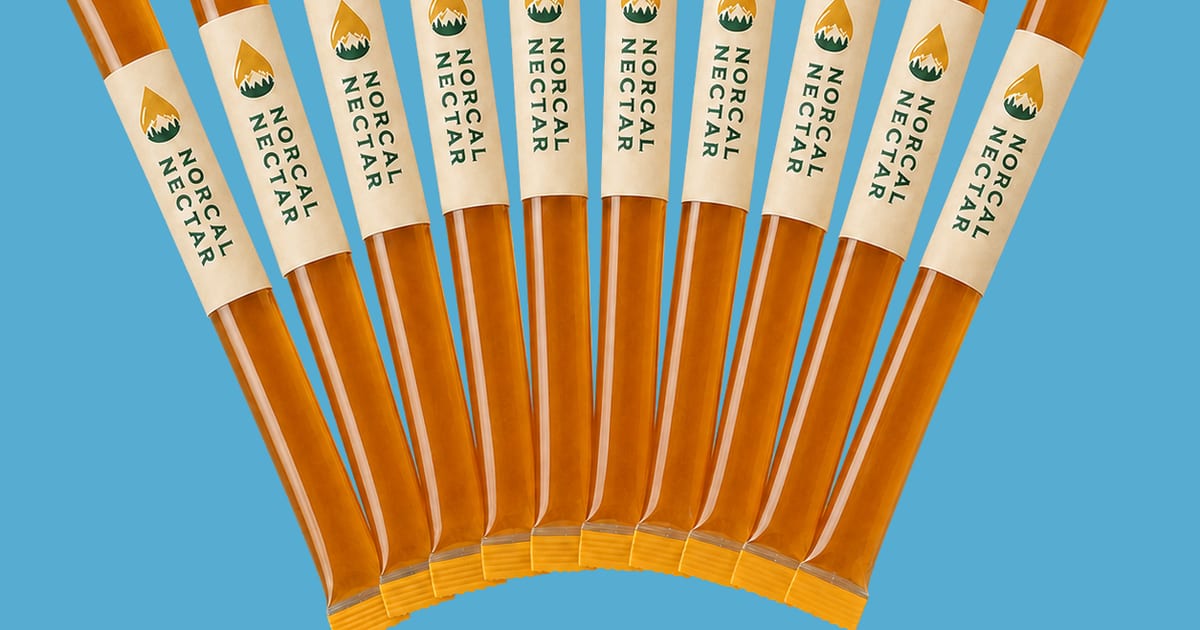
A honey stick is a teaspoon of honey in a sealed straw. In a lunchbox that means a fixed, tidy portion of a sweet food that pairs with plain yoghurt, fruit and crackers without leaking over everything else.
The rules are short: never under 12 months, none at all under 2 as added sugar, one at a time after that, and store it somewhere that is not cold. Everything else is a matter of what your child will actually eat.
Shop Raw Honey Sticks
One teaspoon of raw Northern California wildflower honey per straw, sealed and mess-free. Seven pack sizes, from 10 up to 1000.
50 Pack · $24.99
Keep reading
Buyer Guides
Honey Sticks: What They Are, How to Use Them, and Where to Buy
Honey sticks are single-serving tubes of pure honey sealed in a food-grade straw. This guide covers how to open them, the best types to try, creative uses, nutrition info, and where to find quality honey sticks online.
Buyer Guides
Honey Sticks for Tea and Coffee: Serving Size, Cost and Best Uses
A honey stick holds roughly one teaspoon of honey, which is one cup of tea or coffee. This guide works out the actual cost per cup at every pack size, covers hot versus iced, and compares wildflower against clover for drinks.
Buyer Guides
Honey Sticks vs. Energy Gels: Carbs, Ingredients, Cost & Portability
Energy gels carry roughly four times the carbohydrate of a honey stick, and cost roughly four times as much. This compares what is actually on the two labels — carbs, ingredients, cost per serving, packaging and heat stability — without claiming either one makes you faster.
Buyer Guides
Honey Stick Wedding Favors: The Complete Cost Guide
Honey sticks land below every price band the wedding industry quotes for favors. This guide runs the real per-guest math against The Knot's 2026 survey data, compares sticks to mini jars, and covers quantity, display, timing, and shipping weight.
