
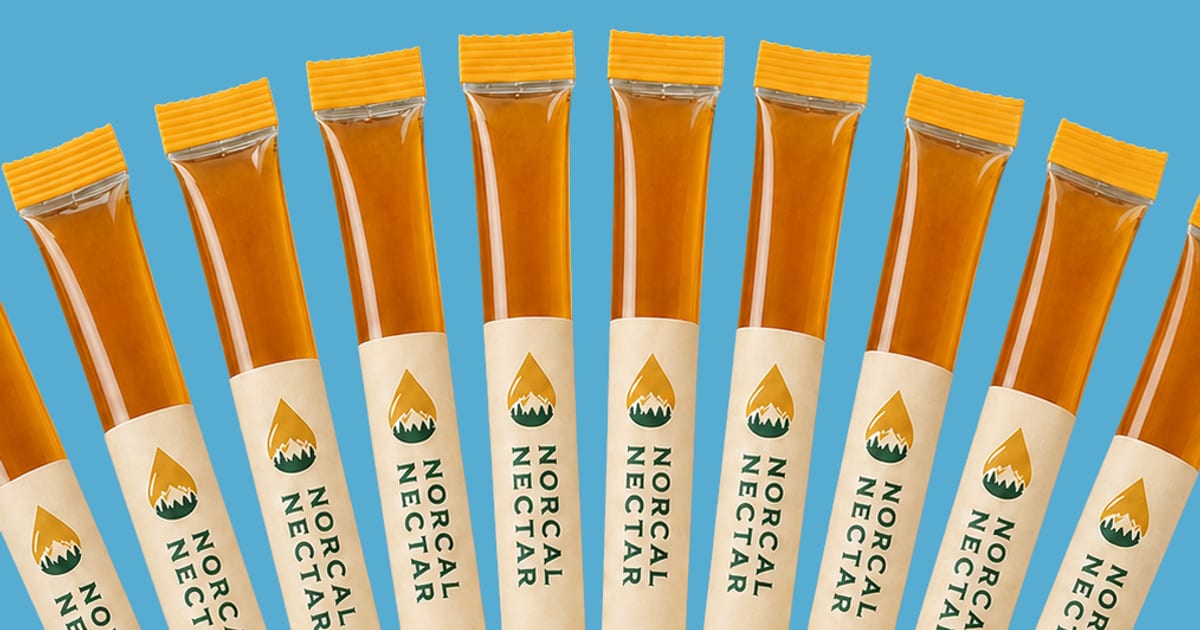
People reach for honey sticks as a gel substitute for two reasons: a shorter ingredient list, and a much lower price. Both are real and both are checkable on the label.
What is not checkable is the claim that usually gets attached to them — that honey gives you cleaner energy, avoids a crash, or aids recovery. We are not going to make that claim. This is a comparison of what the two labels say and what the two formats physically do, and nothing more.
TL;DR: A honey stick carries roughly 4-6 g of carbohydrate; a standard energy gel carries roughly 21-27 g. So a gel is about four sticks' worth. Sticks have one ingredient; gels typically have six to fifteen and often add sodium, caffeine or amino acids. Per gram of carbohydrate, sticks and gels land closer together than the sticker prices suggest. Gels are engineered for a specific job — high carbohydrate per gram carried during sustained endurance efforts — and sticks are not.
Carbohydrate per serving
This is the number that matters most and the one most comparisons skip.
| Honey stick | Typical energy gel | |
|---|---|---|
| Serving size | ~5-7 g | ~32-41 g |
| Carbohydrate | ~4-6 g | ~21-27 g |
| Calories | ~20 | ~90-110 |
| Sodium | 0 mg | ~50-200 mg (varies widely) |
| Caffeine | 0 mg | 0, or ~20-100 mg in caffeinated versions |
Honey is roughly 82% sugar by weight, about 17 g of carbohydrate per tablespoon (USDA FoodData Central). A stick is about a third of a tablespoon, so 4-6 g is the honest range.
The practical consequence: one gel is about four honey sticks. Any comparison that puts one gel against one stick is comparing a portion to a quarter-portion. Every figure below is normalised per gram of carbohydrate for that reason.
Endurance guidance from bodies such as the Academy of Nutrition and Dietetics and ACSM puts carbohydrate intake for efforts beyond about an hour in the region of 30-60 g per hour. Meeting that with honey sticks means six to twelve sticks an hour. Meeting it with gels means one to two. That is the single biggest functional difference between the formats, and it is arithmetic rather than opinion.
Ingredients
Honey sticks (ours): honey.
That is the entire list. No added glucose syrup, no flavouring, no preservative, no electrolyte blend.
Energy gels: typically maltodextrin and/or glucose syrup, water, a fruit-juice concentrate or flavouring, sodium citrate or sodium chloride, a preservative such as potassium sorbate, and often citric acid. Many add caffeine, and some add branched-chain amino acids or taurine. Six to fifteen ingredients is normal.
Neither list is inherently better. Maltodextrin is in gels for a reason — it is a rapidly absorbed carbohydrate with low osmolality, which is a genuine engineering advantage in a product designed to be swallowed mid-effort. The added sodium is there because you lose sodium in sweat.
What the short list gets you is knowing exactly what you are eating, and no added stimulants unless you want them.
Cost per serving
Sticker price is misleading here, so this compares by carbohydrate.
| Honey stick (1000 Pack) | Honey stick (10 Pack) | Typical energy gel | |
|---|---|---|---|
| Price per unit | $0.30 | $0.70 | $1.50-$3.50 |
| Carbohydrate per unit | ~5 g | ~5 g | ~24 g |
| Cost per 24 g carbohydrate | ~$1.44 | ~$3.36 | $1.50-$3.50 |
Bought in the largest pack, honey sticks come out just under the cheapest gels per gram of carbohydrate. Bought in a 10-pack, they do not — a 10-pack costs about as much per gram as a mid-priced gel, without the sodium or the convenience of a single-swallow serving.
So the cost argument for sticks is real, but only at volume. If it is a cost decision, buy a large pack; the bulk page shows the per-stick figure for every size.
Packaging and portability
Weight and bulk. A honey stick weighs about 7 g including the straw. A gel weighs 32-41 g. For the same carbohydrate you are carrying roughly the same mass either way — four sticks is around 28 g against one gel at 35 g. Sticks pack flatter, which suits a jersey pocket or a hip belt better than a gel does.
Opening one-handed. This is where gels win clearly. A gel has a tear notch designed to be opened with your teeth while moving. A honey stick needs you to bite or snap one end cleanly and then squeeze it out, and doing that on a bike is fiddlier. Snipping the ends in advance is not an option — that is what keeps them sealed.
Residue. A gel leaves a wrapper you must keep hold of, and a sticky one. A honey stick leaves a short empty straw. Both are litter if you drop them.
Temperature. Honey is stable across a wide temperature range and does not separate in heat. In cold weather it thickens, and a cold honey stick is genuinely hard to squeeze — the practical fix is keeping it in an inside pocket. Gels stay pliable in the cold, which is a real advantage in winter, and some thicken or separate in high heat.
Shelf life. A sealed honey stick keeps effectively indefinitely if it stays dry. Gels carry a best-before date, typically one to two years.
When each format is practical
A honey stick makes sense when:
- You want one ingredient and no added stimulants.
- You are moving at a pace where fiddling with a straw is fine — hiking, walking, casual riding, a round of golf, a long day outdoors.
- You want something small in a lunch, a pocket or a glovebox that will not melt or leak.
- You are buying in volume for a group, a club table or an event bag, where per-unit cost decides it.
An energy gel makes sense when:
- You need 30-60 g of carbohydrate an hour and cannot stop to eat.
- You want sodium alongside the carbohydrate.
- You want a format engineered to be opened and swallowed at speed.
- You want caffeine dosed and labelled.
There is no rule against carrying both. A lot of people use gels during an effort and sticks in the bag for before and after, which is a reasonable split.
What we are not claiming
To be explicit, because this category is full of it:
- We are not claiming honey gives smoother, longer or cleaner energy than a gel.
- We are not claiming honey avoids a blood-sugar crash. Honey is a sugar and behaves like one.
- We are not claiming a recovery, endurance, hydration or performance benefit.
- We are not claiming honey is better tolerated by the gut than maltodextrin. If anything, honey's fructose content is a reason some people tolerate it less well at volume during hard efforts.
If you want a product that has been formulated and tested for sports performance, buy a sports nutrition product. Ours is honey in a straw.
Frequently asked questions
How many honey sticks equal one energy gel?
About four, by carbohydrate. A gel typically carries 21-27 g and a stick around 4-6 g.
Are honey sticks better than gels for the gut?
There is no good evidence either way for a general population, and honey's fructose content is a plausible reason it could be worse at high hourly intakes for some people. Test anything new in training, not on the day.
Do honey sticks melt?
No. Honey does not melt or separate in heat the way some gels can. Cold is the bigger problem — a chilled stick gets stiff and hard to squeeze.
Which pack size makes sense for a club or team?
Anything from the 100-pack up. The bulk page has a calculator that sizes an order from a headcount, and the wholesale form covers recurring supply.
Can I use honey sticks instead of gels in a marathon?
You can carry them, but the arithmetic is against you: 30-60 g of carbohydrate an hour is six to twelve sticks an hour, which is a lot of straws to open while running. This is exactly the job gels were designed for.
The bottom line
Honey sticks and energy gels are not really competitors. A gel is a dense, engineered carbohydrate dose with sodium, built to be taken at speed. A stick is a teaspoon of honey in a wrapper.
Where a stick wins is ingredient transparency, price at volume, heat stability and pocket size. Where a gel wins is carbohydrate density, one-handed use and formulation for a specific physiological job.
Pick on those grounds, not on a marketing claim about energy curves — including ours.
Shop Raw Honey Sticks
One teaspoon of raw Northern California wildflower honey per straw, sealed and mess-free. Seven pack sizes, from 10 up to 1000.
50 Pack · $24.99
Keep reading
Buyer Guides
Honey Sticks: What They Are, How to Use Them, and Where to Buy
Honey sticks are single-serving tubes of pure honey sealed in a food-grade straw. This guide covers how to open them, the best types to try, creative uses, nutrition info, and where to find quality honey sticks online.
Buyer Guides
Honey Sticks for Tea and Coffee: Serving Size, Cost and Best Uses
A honey stick holds roughly one teaspoon of honey, which is one cup of tea or coffee. This guide works out the actual cost per cup at every pack size, covers hot versus iced, and compares wildflower against clover for drinks.
Buyer Guides
Honey Stick Wedding Favors: The Complete Cost Guide
Honey sticks land below every price band the wedding industry quotes for favors. This guide runs the real per-guest math against The Knot's 2026 survey data, compares sticks to mini jars, and covers quantity, display, timing, and shipping weight.
Raw Honey Benefits & Education
Raw Honey vs Sugar: Which Should You Choose?
Thinking about swapping table sugar for raw honey? This guide compares calories, glycemic index, antioxidants, and clinical outcomes to help you decide which sweetener belongs in your kitchen.
